Our research at McGill University recently won the 2026 Ig Nobel Technology Prize for demonstrating how mosquitoes can be used for high-resolution 3D printing.
The work repurposes deceased mosquitoes by carefully extracting their mouthpieces — or, as we say in scientific terms, their “proboscides” — and mounting them to a 3D printing system.
There they serve as fluid deposition nozzles, in a manufacturing process we have named “3D necroprinting.” We can use them to print very small and precise structures that are otherwise very difficult and expensive to produce.
A prize for funny science
The Ig Nobel Prize is awarded to research around the globe that first makes people laugh — and then makes people think.
Founded by Marc Abrahams in 1991, it’s mission is simple: to reveal that scientific research stemming from the most improbable corners of the human mind can lead to worthwhile discoveries.
Each year, around 9,000 projects are nominated and one prize is awarded in each of 10 categories. This year, the categories were: biomechanics, economics, chemistry, medicine, biology, physics, technology, olfaction, peace and soil science.
The prizes are usually handed out by Nobel laureates in a gala event at either Harvard University, Massachusetts Institute of Technology (MIT) or Boston University. This year, in a break from tradition, we received our award in Zürich, Switzerland, while showered by the audience with paper airplanes.
Mosquitoes are organic, cheap, consistent
Why have we turned to dismantling mosquito corpses for manufacturing use? The answer is simple: Why break your head redesigning and manufacturing something when Mother Nature is offering you a pre-made solution, perfected over millions of generations?
The mosquito proboscis is a tiny, naturally evolved microneedle about half the width of a human hair. From a manufacturing perspective, fabricating such small needles to use as 3D printing nozzles has its challenges. Commercial micro-nozzles below 100 microns in size are expensive, at around $80 each. (One micron is 0.001 millimetres, so these are small.)
Glass-based needles, while they can reach these smaller diameters, are difficult to manufacture consistently and are extremely brittle.
Another concern with traditionally engineered alternatives is that these nozzles are made of non-organic, non-biodegradable materials. The mosquito proboscis, however, is 100 per cent organic material. It’s also cheaper, and consistent in size.
Could other insect or plant tubes work? Maybe. We only explored a tiny fraction of what Mother Nature offered us for what we do.
A 3D-printed honeycomb and maple leaf
To develop this 3D necroprinting technology, we carefully studied different elements of the mosquito proboscis.
(Justin Puma)
We discovered what pressure the mosquito proboscis can handle before bursting and how to properly tune the printing parameters and pressures to fabricate features as small as one-third the diameter of a human hair.
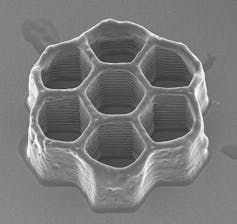
We also printed some interesting sample structures: a honeycomb, a cell-embedded scaffold (where live cells are contained in the ink for tissue engineering) and, of course, a Canadian maple leaf.
Each of these structures was roughly the size of a single grain of sand.
This high-definition 3D printing technology could also be used to produce small and highly detailed functional components, such as microfluidic chips for diagnostic testing and miniature soft robotic or biomedical device prototypes.
Read more:
We designed a new way to build miniature fluidic devices to enable personalized cancer treatment
The origin of our idea
In hindsight, the mosquito proboscis makes a lot of sense for micro 3D printing. However, the idea did not emerge from a logical derivation of previous studies.

(Justin Puma)
It stemmed from another project in our group — called “Skinbarrix” — in which we are developing a skin barrier to prevent insect bites.
There was a moment where I was wondering how to make the skin barrier effective against mosquito bites while I was surrounded by mosquitoes and a student was talking about 3D printing.
The idea of using organic tubes in nature, and a mosquito mouthpiece in particular, for micro-scale nozzles then occurred to me. After months of trial and error, the hero of our team, Justin, finally made it work.
Science can begin with play
Other Ig Nobel Prize winners this year included projects to devise a more precise definition of kissing and a study of the aerodynamics of nose blowing.
Our favourite research projects usually begin with questions that may seem “silly” or “useless,” yet lead to elegant studies that make you stop and say: “Wow.”
For example, in one study of the mechanics of twisting Oreo cookies, researchers found that the cream usually remains almost entirely on one wafer because the wafer-cream interface fails before the cream itself splits.
Whenever we read work like this, our internal reaction is: “What kind of detail-oriented person notices such an interesting problem and also has the capability to solve the problem with rigorous science? Amazing!”
The more you read this kind of research, the more creativity seems to develop naturally. Thinking outside of the box then becomes less of a deliberate effort and more of a habit.
Perhaps that is another important role of the Ig Nobel Prize: it reminds us that science can begin with play, curiosity and questions unconstrained by conventional boundaries.