
The Briefing
☀️ Happy Thursday! The Briefing is your guide to the world of news and information. Sign up here!
In today’s email:
- Featured story: The student journalists covering the Cornell rape case
- New from Pew Research Center: How urban, suburban and rural Americans engage in society
- In other news: Favorable Trump television ad was paid for with public funds
- Looking ahead: NPR’s moves to grow its video content
- Chart of the week: Is social media good or bad for democracy?
🔥 Featured story
Prosecutors this week reopened an investigation into a former Cornell University student’s claim that multiple men raped her at a campus fraternity house in 2024. The woman also filed a lawsuit against the university, the fraternity and others. The student-run Cornell Daily Sun has made headlines for its coverage – including its decision to publish the names of the men accused – and for running an editorial calling on Cornell to better protect its students.
This issue speaks to the broader question of advocacy among journalists. According to a 2025 Pew Research Center survey on how Americans understand the role of journalists, most U.S. adults say the people they get news from should definitely (32%) or probably (31%) advocate for the communities they cover in their daily work. A large majority also think the people they get news from should definitely (41%) or probably (31%) keep an eye on powerful people.
🚨 New from Pew Research Center
Urban, suburban and rural Americans engage with their communities at broadly similar rates. But they differ in some of the specific ways they get involved, from how they participate in politics to whether they are more likely to meet with people online or offline.
This data comes from a recent study from the Pew-Knight Initiative about how Americans engage with politics, civic life, religion and news.
📌 In other news
📅 Looking ahead
Radio news giant NPR recently acquired the video-first AI and technology podcast Machine Gods amid a broader shift toward watchable news content. The podcast will be available as a radio show on NPR stations, but it will also be posted as video on the NPR app and other platforms.
Many Americans report a preference for visual formats when getting news: 44% of U.S. adults say they prefer watching the news (rather than reading it or listening to it), according to a 2025 Center survey. This is more than double the share who prefer listening to the news (19%).
📊 Chart of the week
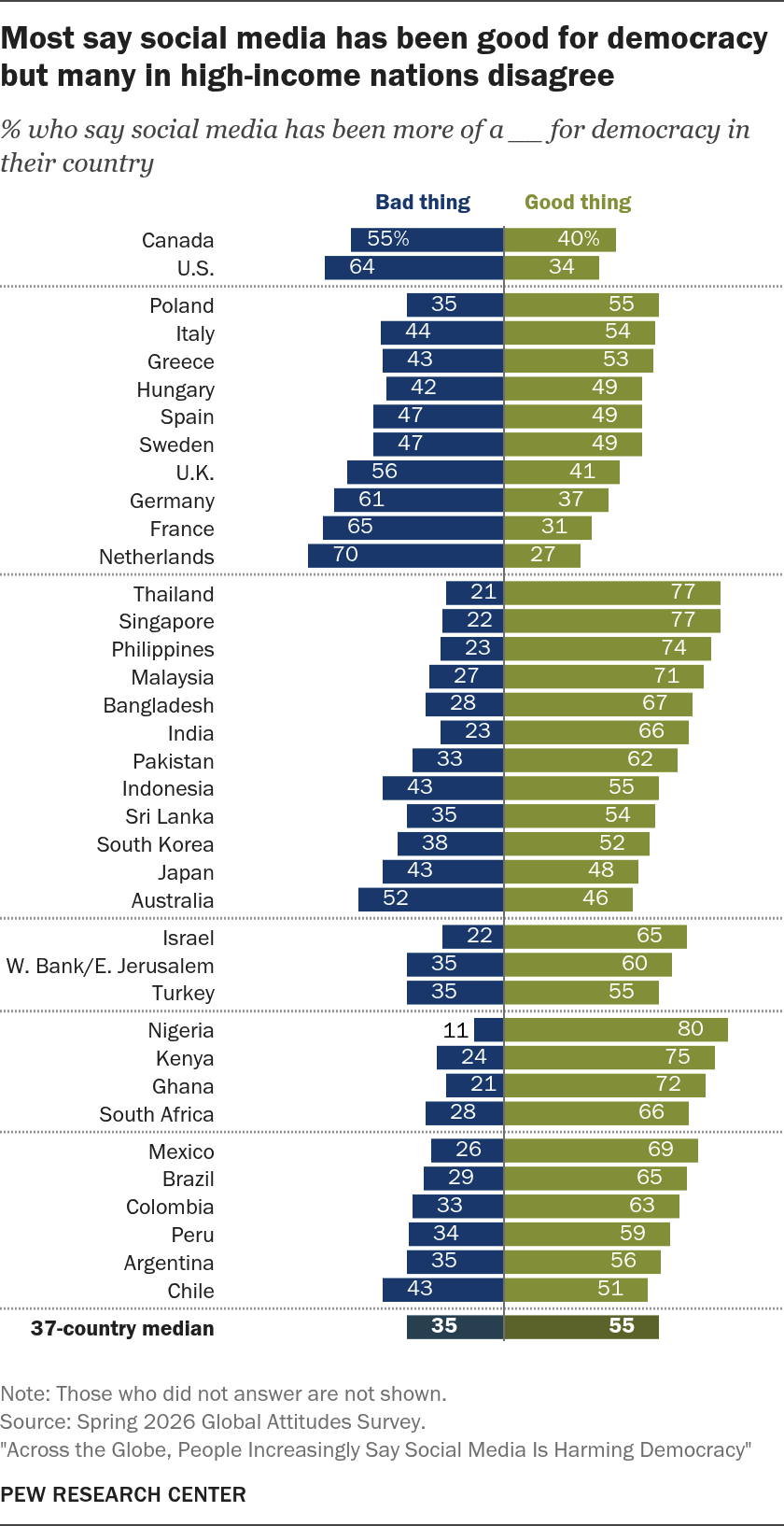
This week’s chart comes from a new Pew Research Center survey of 37 countries and looks at global views about the impact of social media on democracy.
Majorities in many countries say social media has been more of a good thing than a bad thing for democracy where they live. But more than half of Americans (64%) and Canadians (55%) see its effects as bad. People in some Western European countries, including the Netherlands, France, Germany and the United Kingdom, are also more likely to say social media has been a bad thing rather than a good thing for their democracy.
Most say social media has been good for democracy but many in high-income nations disagree
% who say social media has been more of a __ for democracy in their country
Note: Those who did not answer are not shown.
Source: Spring 2026 Global Attitudes Survey.
“Across the Globe, People Increasingly Say Social Media Is Harming Democracy”
PEW RESEARCH CENTER
Most say social media has been good for democracy but many in high-income nations disagree
% who say social media has been more of a __ for democracy in their country
| Country | Bad thing | Good thing | Grouping |
|---|---|---|---|
| Canada | 55 | 40 | North America |
| U.S. | 64 | 34 | North America |
| Poland | 35 | 55 | Europe |
| Italy | 44 | 54 | Europe |
| Greece | 43 | 53 | Europe |
| Hungary | 42 | 49 | Europe |
| Spain | 47 | 49 | Europe |
| Sweden | 47 | 49 | Europe |
| U.K. | 56 | 41 | Europe |
| Germany | 61 | 37 | Europe |
| France | 65 | 31 | Europe |
| Netherlands | 70 | 27 | Europe |
| Thailand | 21 | 77 | Asia-Pacific |
| Singapore | 22 | 77 | Asia-Pacific |
| Philippines | 23 | 74 | Asia-Pacific |
| Malaysia | 27 | 71 | Asia-Pacific |
| Bangladesh | 28 | 67 | Asia-Pacific |
| India | 23 | 66 | Asia-Pacific |
| Pakistan | 33 | 62 | Asia-Pacific |
| Indonesia | 43 | 55 | Asia-Pacific |
| Sri Lanka | 35 | 54 | Asia-Pacific |
| South Korea | 38 | 52 | Asia-Pacific |
| Japan | 43 | 48 | Asia-Pacific |
| Australia | 52 | 46 | Asia-Pacific |
| Israel | 22 | 65 | Middle East |
| W. Bank/E. Jerusalem | 35 | 60 | Middle East |
| Turkey | 35 | 55 | Middle East |
| Nigeria | 11 | 80 | Africa |
| Kenya | 24 | 75 | Africa |
| Ghana | 21 | 72 | Africa |
| South Africa | 28 | 66 | Africa |
| Mexico | 26 | 69 | Latin America |
| Brazil | 29 | 65 | Latin America |
| Colombia | 33 | 63 | Latin America |
| Peru | 34 | 59 | Latin America |
| Argentina | 35 | 56 | Latin America |
| Chile | 43 | 51 | Latin America |
| 37-country median | 35 | 55 | Median |
Note: Those who did not answer are not shown.
Source: Spring 2026 Global Attitudes Survey.
“Across the Globe, People Increasingly Say Social Media Is Harming Democracy”
PEW RESEARCH CENTER
👋 That’s all for this week.
The Briefing is compiled by Pew Research Center staff, including Naomi Forman-Katz, Christopher St. Aubin, Emily Tomasik, Joanne Haner, and Sawyer Reed. It is edited by Michael Lipka and copy edited by Anna Jackson.
Do you like this newsletter? Email us at [email protected] or fill out this two-question survey to tell us what you think.