


Pew Knight Initiative
The Pew-Knight Initiative supports new research on how Americans absorb civic information, form beliefs and identities, and engage in their communities.
Pew Research Center is a nonpartisan, nonadvocacy fact tank that informs the public about the issues, attitudes and trends shaping the world. Knight Foundation is a social investor committed to supporting informed and engaged communities. Learn more >
For roughly a quarter of Americans, the internet is where they found friends who are part of their life today. And for many of them, these friendships don’t just stay online – they’ve met in person, too.
About 1 in 4 U.S. adults – and higher shares who are under 30 or LGBTQ – have friends they met online
% of U.S. adults who say they first met at least one of their friends online
Note: Those who gave other responses or did not answer are not shown.
Source: Pew Research Center survey of U.S. adults conducted May 26-June 1, 2026.
PEW-KNIGHT INITIATIVE
About 1 in 4 U.S. adults – and higher shares who are under 30 or LGBTQ – have friends they met online
% of U.S. adults who say they first met at least one of their friends online
| Percentage | |
|---|---|
| U.S. adults | 24 |
| Ages 18-29 | 43 |
| 30-49 | 30 |
| 50-64 | 16 |
| 65+ | 8 |
| Among those who… | |
| Are LGBTQ | 45 |
| Are not LGBTQ | 22 |
Note: Those who gave other responses or did not answer are not shown.
Source: Pew Research Center survey of U.S. adults conducted May 26-June 1, 2026.
PEW-KNIGHT INITIATIVE
Young adults are more likely than older Americans to find friendship online, according to a new Pew Research Center analysis from the Pew-Knight Initiative. Today, 43% of adults under age 30 say they first met at least one of their friends online.
Three-in-ten Americans in their 30s and 40s also say they have one or more friends they met online. The share drops further for older age groups. Still, about one-in-ten adults ages 65 and older say this is the case.
LGBTQ adults stand out for having friends they met online, too: 45% of adults who are lesbian, gay, bisexual, transgender or queer say they met at least one of their friends this way. By comparison, 22% of those who are not LGBTQ say this. (This difference holds up even when accounting for factors like age.)
But not everyone is going online to make friends. Most Americans met all their friends without the internet’s help.
Online friendships often move offline
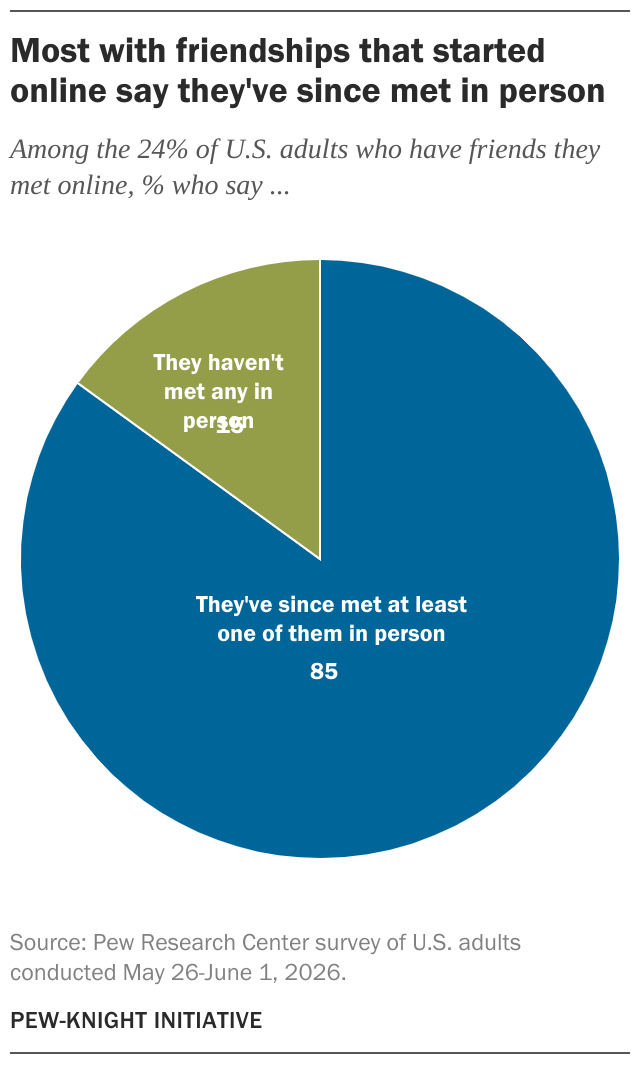
Meeting friends on the internet doesn’t always end there. Friendships that start online often lead to in-person meetups.
Most with friendships that started online say they’ve since met in person
Among the 24% of U.S. adults who have friends they met online, % who say …
Source: Pew Research Center survey of U.S. adults conducted May 26-June 1, 2026.
PEW-KNIGHT INITIATIVE
Most with friendships that started online say they’ve since met in person
Among the 24% of U.S. adults who have friends they met online, % who say …
| Response | % |
|---|---|
| They’ve since met at least one of them in person | 85 |
| They haven’t met any in person | 15 |
Source: Pew Research Center survey of U.S. adults conducted May 26-June 1, 2026.
PEW-KNIGHT INITIATIVE
Among those who have friends they first met online, the vast majority (85%) say they’ve met at least one of them in person.
This is widely true across demographic groups. For example, eight-in-ten or more in each age group say they’ve gotten together with at least one of the friends they met online.
Though our broader survey found that about half of Americans doubt the value of relationships people form online, those who have found friendship on the internet feel differently.
Among those with at least one friend they first met online, 62% think these kinds of relationships can be just as meaningful as in-person connections. Even for those who haven’t met those friends in person, a majority say this.
For those who met all their friends off the internet, that share falls to 25%.
Note: Here are the survey questions used for this analysis, the detailed responses and the methodology.