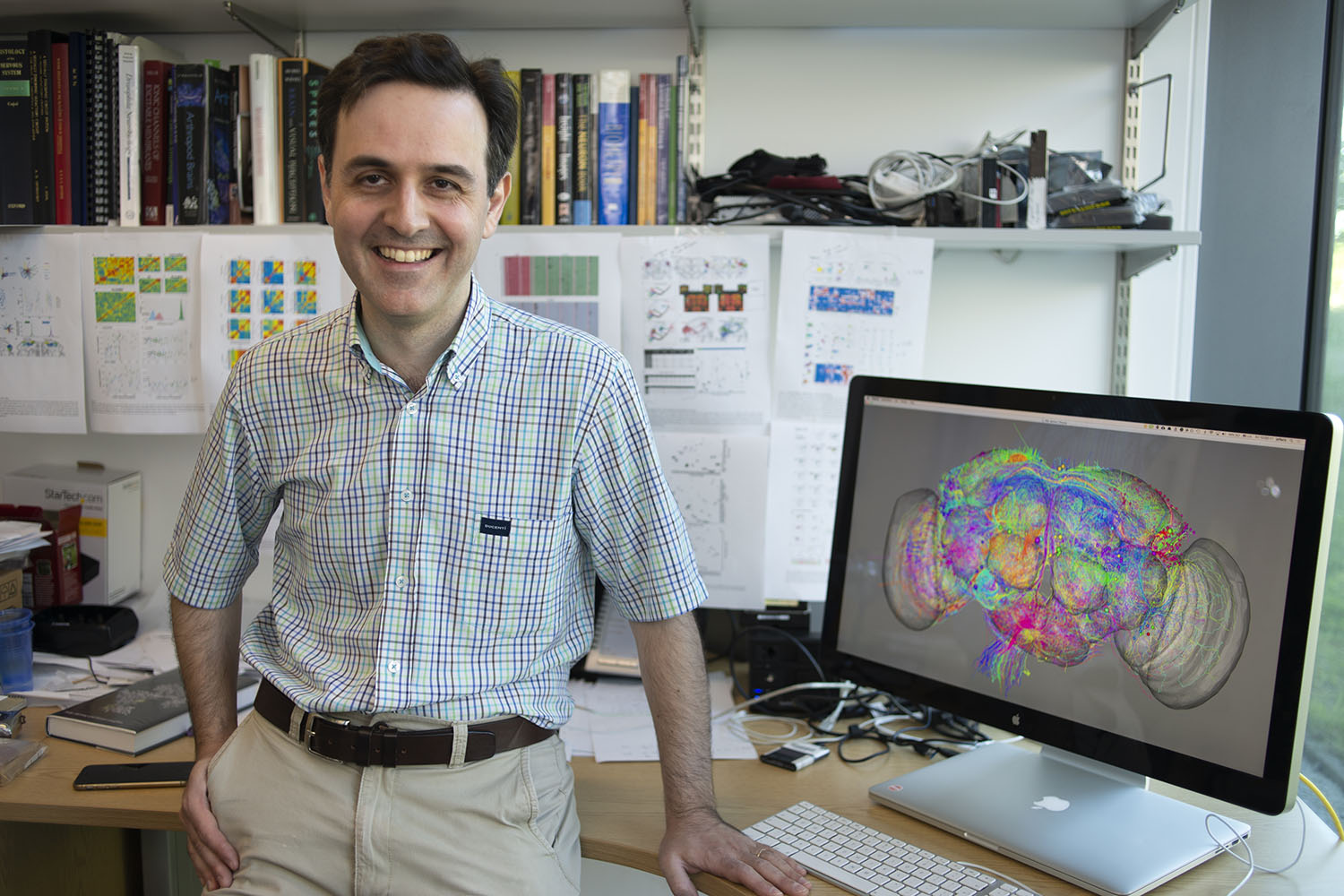
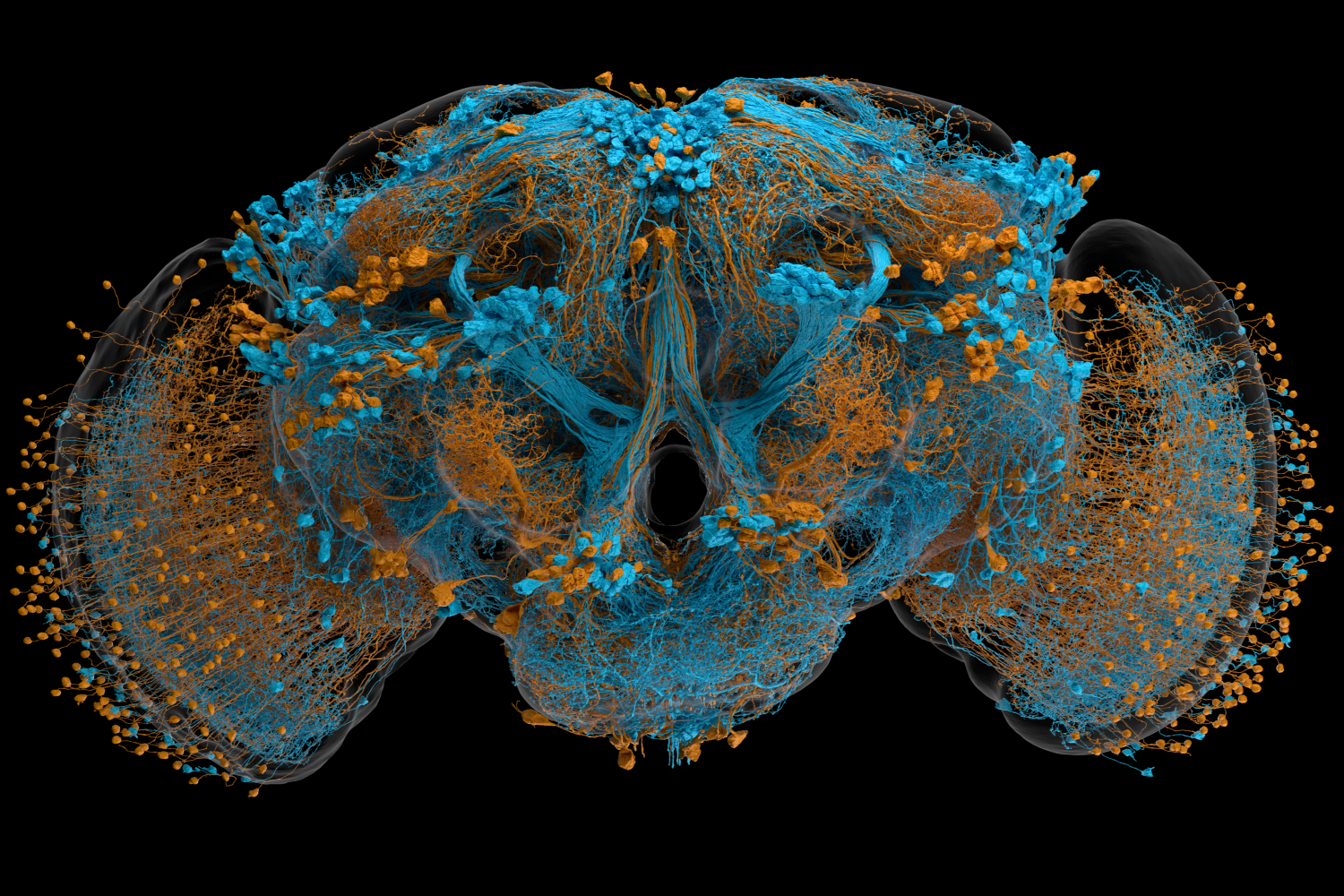
The findings, co-led by scientists at Medical Research Council (MRC) Laboratory of Molecular Biology (LMB), are expected to unlock unprecedented insights into the neural mechanisms that shape behaviour.
Known in scientific terms as a ‘connectome’, the team have produced a wiring map of the 166,700 neurons and the millions of connections between them.
International collaboration
It is the latest finding by a group of scientists co-led by:
- Greg Jefferis’s group at MRC LMB
- HHMI Janelia Research Campus
- Drosophila Connectomics Group at the University of Cambridge (Department of Zoology)
- Google Research
- Champalimaud Foundation
Understanding brain diversity
Dr Greg Jefferis at Laboratory of Molecular Biology and senior author on the study said:
Understanding how genetic differences translate into differences in brain wiring and behaviour should eventually help us to understand how brains differ, which in such cases, including autism and schizophrenia, have a strong genetic basis.
Connectomes
Comprehending the interactions between genetics, brain wiring and behaviour is key to explaining how healthy brains generate complex behaviours and what might go wrong during disease.
The newly generated wiring diagram reveals all the nanometre scale connections between neurons and is a scaffold for scientists to start disentangling these relationships.
Insights and methods developed as part of this project will enable work on larger, more complex brains, showcasing the importance of the growing field of connectomics.
This is the first connectome of a full central nervous system, with an intact brain and ventral nerve cord (the insect equivalent of the human spinal cord).
The complete map is necessary for tracing entire circuits from sensory input all the way to motor output, from eyes to legs.
Massive potential
Joint first author Dr Philipp Schlegel, based at the MRC Laboratory of Molecular and at the at the University of Cambridge said:
This full wiring diagram has massive potential – we’ve produced data that will enable all sorts of new studies into how the whole nervous system works to control behaviours.
Poppy seed
While only the size of a poppy seed, this dataset contains 124 million synaptic connections.
The study found that around 95% of the cells in the brain are shared between sexes.
But the remaining 5% differ enough to potentially drive distinct behaviours such as courtship in males and egg laying in females.
Launching pad
Dr Isabella Beckett, joint first author, said:
We now know from the connectome the extent to which sex-specific cells and different wiring distinguish the male from the female fly brain.
These findings are a launch pad for future experiments to trace how genes ultimately shape the wiring differences that switch behaviour.
The study
To compile the map, a male Drosophila central nervous system was cut into 66 pieces.
Each was imaged by repeated rounds of scanning the surface followed by shaving off a thin (around one ten-thousandth the width of a human hair) layer.
Seven electron-microscopes ran for a year to produce the images.
Using artificial intelligence, these images were stitched into a three-dimensional map of every neuron and the synapses where they communicate.
Experts then developed and used advanced software tools to annotate the brain map with known and newly identified cell types.
Funding
The study, published today in Cell, received investment by:
- UKRI Medical Research Council
- Wellcome Trust
- Howard Hughes Medical Institute
- Boehringer Ingelheim Fonds
- Cambridge Commonwealth
- European and International Trust