
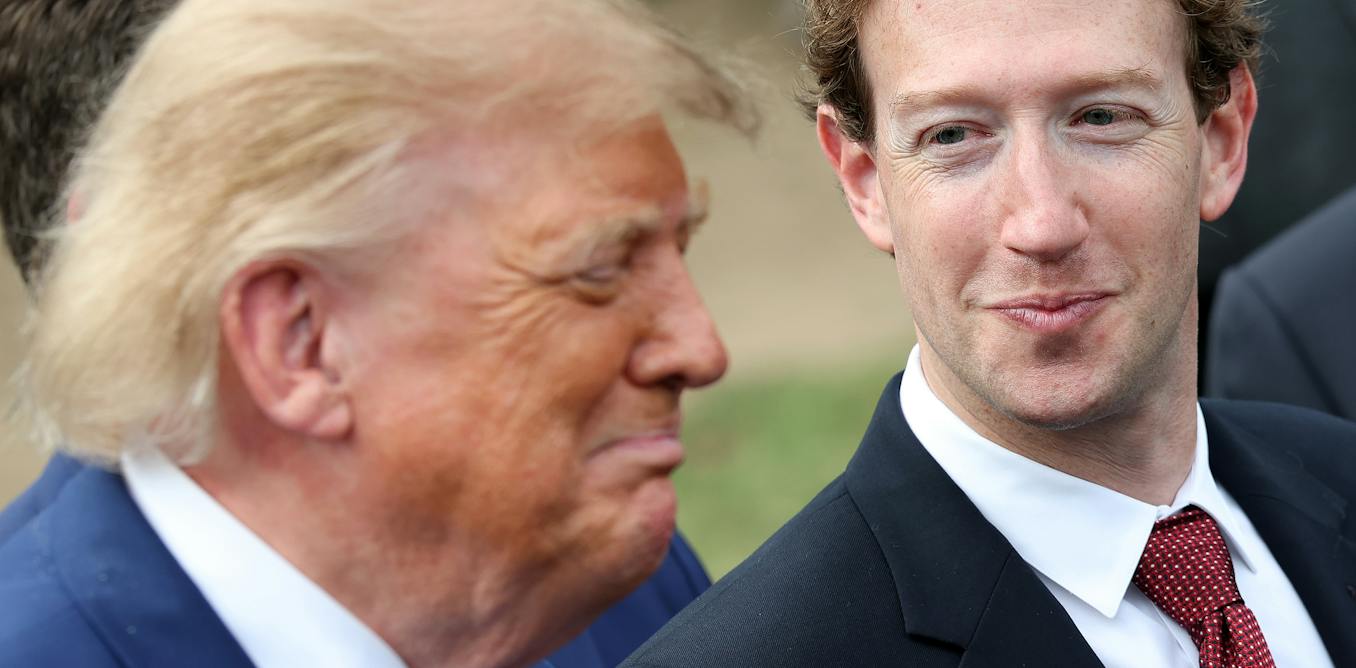
Earlier this week, United States president Donald Trump and representatives of six of the world’s most powerful tech companies signed the White House Accord on Super Intelligence.
The statement begins: “We believe that every company is responsible for developing its own technology safely,” then lays out a four-point plan for self-regulation by frontier AI companies.
The accord is a response to growing concerns, voiced by many tech bosses, academics and company insiders, that AI agents could soon be beyond human control, with some even claiming a 10% chance of AI wiping out humanity by the end of the decade. This follows high-profile hack attempts by AI agents on Canadian and Australian government websites.
The international political community has also responded. At the United Nations General Assembly last week, 22 world leaders signed a new AI safety declaration calling for an international AI safety regulator.
These public statements have grabbed headlines, but they are hardly novel. The recent history of AI is littered with similar declarations from governments and private industry making commitments to AI safety.
Ten years of agreements – and little change
Ten years ago, the Partnership on AI was formed to “address important questions about our future with AI”. Four of the six White House accord signatories are members, including Anthropic and OpenAI.
The partnership has published guidance for the safe deployment of foundation models, which includes a recommendation of “timely and responsible reporting of safety incidents”. When an OpenAI agent breached Medicare’s Statistics Reporting Service in June, it took three months for the company to notify the Australian government. A cynic might see this as evidence that tech companies regulating themselves is not working.
Governments too have signed plenty of AI safety agreements. In 2023, 28 countries and the European Union signed the Bletchley Declaration at the inaugural AI Safety Summit at Bletchley Park, in the UK. One prescient comment from the declaration: “We are especially concerned by risks in domains such as cybersecurity.”
The content of the Bletchley statement in 2023 and last week’s UN agreement are strikingly similar. Both call for shared international standards, strong human control, and shared responsibility between governments, industry and civil society.
Again, a cynic might ask why, if governments called for a change in approach in 2023, was there a need to reiterate this call three years later?
Summits and safety institutes
The Bletchley summit was the first in a series of AI summits, held in subsequent years in Seoul, Paris and New Delhi. These summits led to the creation of a network of ten AI safety institutes across the globe – though some have since renamed themselves (in the UK to the AI Security Institute, and in the US to the Center for AI Standards and Innovation).
Arguably the most successful of these institutes is the UK’s, which has been backed by 66 million pounds per year in funding, priority access to billions of dollars’ worth of computing power, and advance access to the latest frontier AI models for safety testing. By contrast, Australia’s AI Safety Institute was announced more than two years after the Bletchley Declaration and has around one-sixteenth the funding of its UK counterpart.
As former director of the digital research branch of CSIRO, Australia’s national science agency, I worked directly with many of the global AI safety institutes. Good work is going on, but many of the global institutes suffer from a lack of funding compared to the deep pockets of tech companies – they are like a bee on a bear.
What can make AI safety agreements work?
AI safety declarations – whether led by government or industry, nationally or globally – are critically important. Even if their direct outputs can sometimes seem underwhelming, they play an important role in raising awareness and in galvanising leaders to take action.
That said, they need four things to maximise their chances of success: real funding, standing institutional machinery, enforceable consequences and specific commitments.
Real funding is necessary for any kind of work with the famously deep-pocketed AI companies. The UK safety institute, for example, has serious money and priority access to computing power, and has been able to do excellent work.
Standing institutional machinery is what lets the work happen. Agreements with AI companies allowed the UK and US institutes to jointly evaluate Anthropic’s Claude Sonnet 3.5 before it was released in 2024, for example.
Enforceable consequences are needed to make safety declarations more than just lists of wishes. A 2025 study found evidence that a collection of voluntary commitments on AI safety which the White House secured from 15 AI companies in 2023 were followed only 53% of the time.
Specific commitments are what lead to real change. Broad declarations draw engagement but offer little in the way of action and enforcement. A sweeping statement from the February Delhi summit drew 92 signatories including the US and China. By contrast, September’s UN statement made specific calls for independent testing and incident reporting and only has around 30 signatories, with the US and China staying away.
What world leaders want
Even with all the right content, AI safety declarations are only as good as the motivations of the political leaders behind them.
In February 2025, one month after Trump’s second inauguration, I attended the Paris AI Summit. The mood among international leaders had clearly shifted.
The summits had started under then UK prime minister Rishi Sunak in 2023 as a genuine attempt to make AI safe. Very quickly, they headed in the opposite direction. Almost at once, global leaders began to focus on the growth opportunities from AI while downplaying the risks.
As long as key world leaders continue to palm AI safety off onto self-regulation by tech companies, declarations will remain statements of intent – while the technology itself continues to rush ahead.