
More than 5,000 years ago, a royal woman called Meretneith (also written as Merneith), lived in ancient Egypt. She was possibly the daughter of Djer, the third king of the First Dynasty, a period when the first kings ruled over a unified Egypt.
Details over Meretneith’s exact royal status have remained murky. We know she ruled the country because her tomb complex was filled with riches fit for a male ruler of Egypt. At the very least, she was an interim ruler or co-regent. But did she ever rule Egypt in her own right?
Egyptologists have long disputed whether Meretneith was an independent ruler of Egypt. Resolving that dispute would require finding a text that identifies her as a ruler.
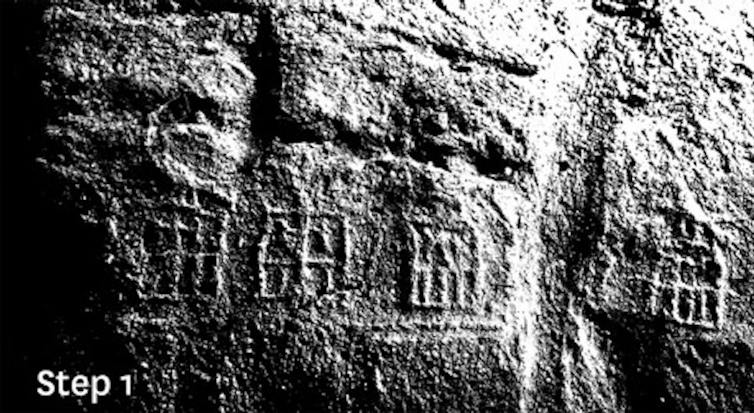
Our new research, published in the journal Prague Egyptological Studies, might do just that. Using a new digital technique, we examined hieroglyphs in the photo of a long-lost artefact, and the signs clearly point to Meretneith being one of the early rulers of Egypt.
A muddy dispute
Currently, the only possible text that could resolve the dispute over Meretneith’s status is a hieroglyphic inscription in a black-and-white photograph of a mud stopper (a plug used for pottery jars and other vessels).
The text in question was originally found on 13 mud stoppers excavated from an unknown tomb in Saqqara in the 1940s. Only one photo of an inscription remains.
That photo is found in the records of Egyptologist Walter B. Emery from the Egypt Exploration Society in London. The location of the original artefact or glass plate of the photo is unknown.
The text consists of a row of four royal signs, known as serekhs. This hieroglyphic sign is written combining an image of a royal building, a patron deity and the ruler’s name.
Emery said that only the first and fourth sign belonged to the ruler Djer. However, many scholars at the time rejected Emery’s claim that the other two serekhs named Meretneith.
Among the many arguments against Emery’s theory was that the poor quality of the original published photo made it impossible to confirm what the signs on the mud stopper depicted.
Clearing up the debate
In collaboration with digital technician Crystal Miller at Macquarie University in Sydney, we came up with a new technique to digitally clear up the signs. The goal was to determine if the inscription provides definitive evidence that Meretneith held the same marker as male rulers – as Emery claimed.
We applied a multi-step process to a digital image of the scanned archive photograph.
By isolating the hieroglyphs, inverting the colours, and converting the image to a scalable vector (a computer graphic based on mathematical formulas), we produced a crisp digital replica – much like a high-tech pencil rubbing over a coin.
Author provided
The enhanced image quality significantly improved the clarity of the text and is much more accurate than the original hand illustration Emery drew of the symbols in the photo.

Author provided
Our technique has revealed that in the second and third serekhs, the signs in the name portion of the emblem are consistent with the main sign used to write Meretneith’s name.
In our opinion, the result identifies Meretneith with the primary mark of rulers in this period.
This means she really was a female king (not simply a “queen”, but a true equivalent to a male ruler, hence “king”) during the First Dynasty, and the second female ruler of ancient Egypt whose name was recorded in the royal serekh emblem.

Author provided
A body of evidence
There are other markers that build a body of evidence for Meretneith’s royal career: her lavish funerary complex in the royal cemetery, inscriptions that document her name alongside administrative titles and departments, and impressions on royal tomb seals. In fact, studies estimate she ruled Egypt for at least 30 years in one capacity or another.
However, for all the evidence we do have, the jigsaw puzzle of her career remains incomplete. This latest research contributes a new hypothesis: that Meretneith’s political career should be divided into distinct stages matching the different forms of evidence.
The different types of texts allow us to categorise different political roles of her career. The royal serekh beside Djer’s identifies her as a co-regent, while tomb seals confirm her later role as a regent king’s mother.
Egyptians acknowledged her political status by naming her on the tomb seal of a subsequent ruler, Semerkhet. Other texts indicate that she held authority over the treasury and officials, governing as a ruler without a political title.
The ability to change her political roles across her career was only possible because of her gender and position in the ruling family.
We suggest Meretneith had the advantage of stepping in and out of the political domain as necessitated by the needs of the political environment, unlike male rulers who succeeded her, reigned, died, and were buried by their successors.