In the opening scene of the 2001 blockbuster film The Mummy Returns, two women of Egypt’s royal court engage in spectacular hand-to-hand combat.
The scene is dramatic rather than historical, but it raises an interesting question: were Egyptian women really trained with weapons, similarly to Viking shieldmaidens?
A new study of royal skeletons, published in Frontiers in Environmental Archaeology, suggests there may be an element of truth to this idea.
The sisters and daughters of pharaoh Amenemhat II, who died around 1900 BC, were buried with bows, maces and in at least one case a dagger. The new research, led by Zaineb Hashesh at Egypt’s University of Beni-Suef, suggests these weren’t just for decoration.
The women behind the treasures
Few Egyptian artefacts are as striking as the dagger buried with Princess Ita almost 4,000 years ago. Its handle, made of lapis lazuli, turquoise and gold, is a masterpiece of Middle Kingdom craftsmanship. Yet the real mystery is the princess who was buried with it.
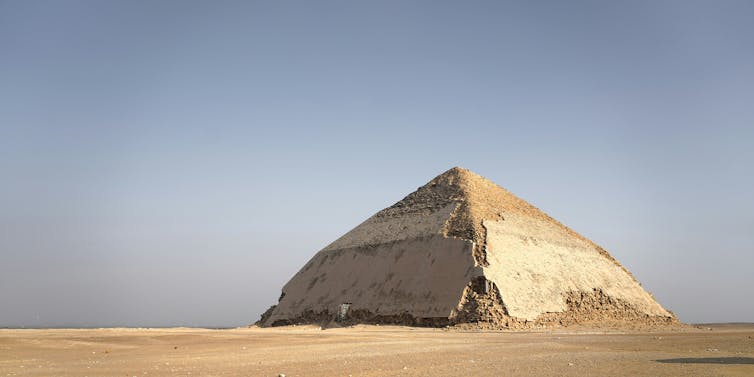
Princess Ita was one of five royal women interred in richly furnished underground tombs at Dahshur, the royal necropolis south of modern Cairo, as part of the family group associated with Amenemhat II. The pharaoh was buried nearby in the White Pyramid complex, named for its dazzling Tura limestone casing.
These women were members of Egypt’s Twelfth Dynasty, one of the most powerful periods of the Middle Kingdom.
Jens Aber / Unsplash
Excavated by Jacques de Morgan in the 1890s, the matching burial chambers contained extraordinary jewellery and cosmetic objects. They also held weapons – bows, arrows, maces and Princess Ita’s exquisite dagger.
This has intrigued Egyptologists for more than a century, as weaponry has traditionally been associated with elite men rather than female burials.
Reading lives written in bones
The study of a person’s life through their skeleton is called osteobiography. The combination of burial context, artefacts, historical records and skeletal evidence means osteobiography can be a compelling way to reconstruct ancient lives.
Archaeologists often favour large studies comparing hundreds of skeletons to understand health, diet and lifestyle across a population. Yet individuals from the deep past who have an identity – a name, family relationships, a burial context – are rarer, but scientifically powerful in their own way.
One of the most famous examples is the Viking cemetery at Birka, Sweden. Here, a 10th-century grave containing weapons and a board game was long assumed to belong to a male warrior – until DNA confirmed the skeleton was that of a woman.
Were the Dahshur princesses really archers?
The Twelfth Dynasty burials reveal an equally surprising story. Despite careful mummification, most soft tissue has turned to dust over the millennia, and the skulls were lost in the early 1900s.
However, many long bones and muscle attachments survived well enough for modern osteological analysis of the princesses’ physical activity.
The six skeletal remains – King Hor and five princesses, Ita, Khenmet, Itaweret, Nubhetepti-Khered and one unnamed woman – show muscle attachment areas associated with repetitive motions of precision gripping and pulling, consistent with archery.
Bones are remodelled continually in response to biomechanical strain. The repetitive high-intensity gripping needed to stabilise and draw a bow has been shown to leave lasting marks on bone structure. These markers can’t prove a single activity, but they are good indicators of long-term movement patterns.

Hashesh et al. / Frontiers in Environmental Archaeology, CC BY
Princess Noub-Hotep offers the clearest example, with bowing of her second metacarpal (a hand bone) and arrows among her burial goods.

Hashesh et al. / Frontiers in Environmental Archaeology, CC BY
Combined with the weapons found in the tombs, the study’s authors argue these skeletal signatures point to regular, habitual use of weapons. In other words, they say, these were not merely ceremonial burial goods.
A royal life may not have been an easy one
Fracture patterns in the bones add another dimension. Princess Itaweret shows healed trauma in a rib and foot-bone consistent with a fall or a forceful blow. King Hor has a hand fracture and skull trauma, both healed. This suggests a more physically demanding life than the sedentary existence often imagined for ancient elites.
Elite status didn’t buffer them from other hardships either: the eye sockets of King Hor show potential signs of nutritional stress and infectious disease. The shinbones of Princess Nubhetepti-Khered have features often linked to repetitive activity such as food preparation – but perhaps in this instance tied to ritual or court function.
Where next for the Dahshur royals?
The princesses may have been buried decades after their father, as part of a ritual system securing the king’s eternal rebirth. This study is unlikely to be the final word on their lives.
If DNA can ever be recovered from the skeletons, it could clarify family relationships, including for the unnamed woman in her 20s.
Further microscopic analysis (histology) of the bones could reveal how activity changed over a lifetime – whether the strain of drawing a bow declined with age, particularly in the older princesses, Khenmet and Noub-Hotep.
Comparing these elite burials with working-class remains from the same period could also show whether ordinary Egyptians bore similar patterns of biomechanical stress and disease.
Together, these approaches have the potential to transform these remarkable burials from archaeological discoveries into rich, detailed biographies of the people themselves.
Royal women whose stories have often been eclipsed by the reigns of male kings can take their place as actors in Egypt’s history, rather than passive figures in the archaeological record.