
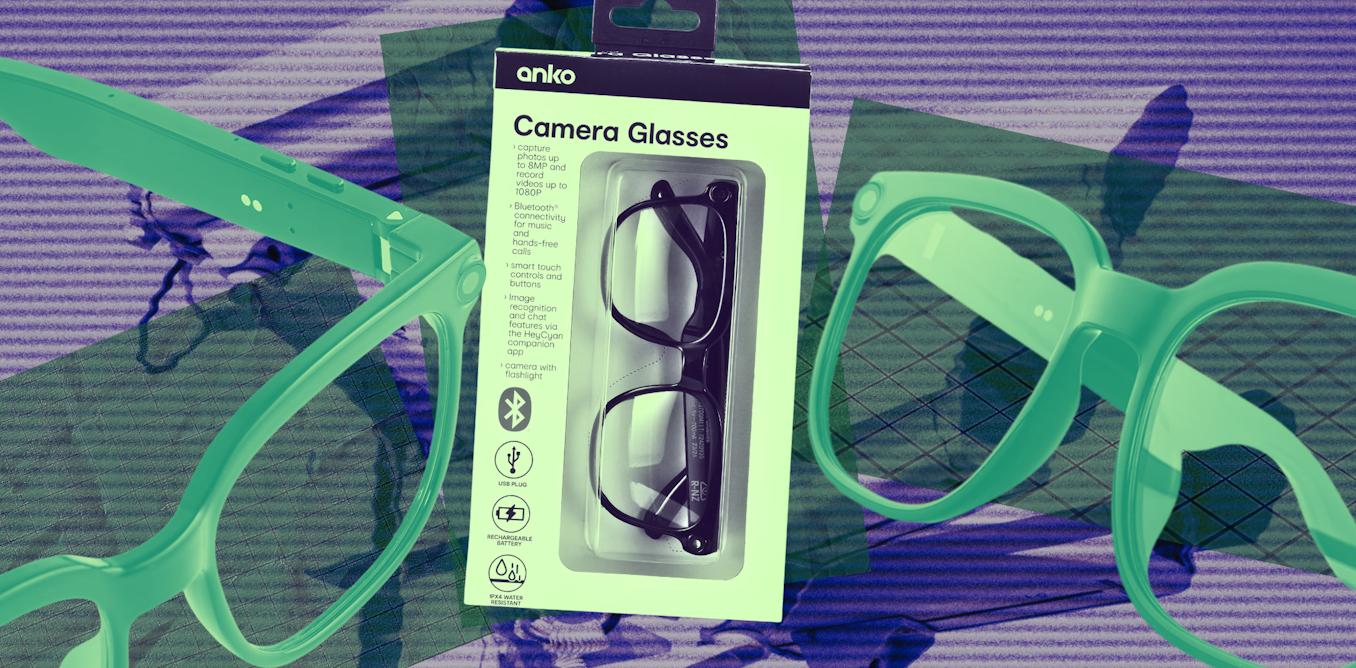
There are now many more people walking the streets in Australia wearing glasses that can subtly film and record the world around them. That’s in large part thanks to Kmart, which recently introduced – and then rapidly sold out of – cheap “camera glasses”.
These glasses are from Kmart’s in-house brand, Anko. They sell for only A$89 – quite the discount from similar products offered by Meta and Ray-Ban, which start at $337.
The push to make camera glasses a major consumer trend comes at a cost to the privacy of the wearer, and everyone around them. We know little about what happens with data from the devices, or who will see the images. Indeed, on Friday, federal Attorney-General Michelle Rowland asked Australia’s privacy commissioner to urgently review the technology.
So are current privacy laws strong enough to handle this new wave of wearable tech?
More than a decade of development
Smart glasses themselves are not new. Google launched Google Glass in 2013 to much media fanfare and celebrity endorsement.
Yet that basic variant failed to break into the market because the technology was underwhelming, the clunky and obvious appearance left much to be desired, and users were widely derided as “glassholes”.
Modern iterations are far more aesthetically pleasing. And they are less obtrusive: it is less obvious to you and everyone else that you are wearing a high-tech computer on your face.
Kmart’s budget camera glasses perform similar functions to the higher-end models (albeit perhaps in a slower, more limited way).
Running on HeyCyan software, they have embedded cameras to analyse and record photos and videos of what the wearer sees, microphones to record sound, and speakers to enable the wearer to take phone calls and listen to podcasts or music.
Images, video and sound are recorded onto memory in the device, but can be downloaded into a connected app on the wearer’s phone, enabling recorded content to be edited, shared and uploaded to websites.
From covert filming to falling over
The risk receiving the most attention is the capability of these glasses to covertly film bystanders and unsuspecting women in public for social media content, potentially leading to a rise in harassment, voyeurism and stalking in public for social media content.
Uploaded videos compound the abuse. And there’s the potential harm from distraction if the wearable tech “augments” the wearer’s view with digital information in their line of sight, creating a very real potential for physical risks such as falls, trips and car accidents.
Companies and employers should also consider the risks, for example, that smart glasses will record confidential information, trade secrets or bank account details.
It’s also worth noting Meta is reportedly developing “super-sensor” glasses that could record even when you aren’t interacting with them. This would provide companies with unprecedented access to the most private parts of your life, whereabouts and preferences.
Such data could be sent to data-labelling firms and, depending on the product and terms, used to train AI models.
So, what of the law?
It isn’t clear how Australia’s highly fragmented, partial and out-of-date privacy laws apply to advances in privacy-intrusive and ambient technologies such as camera glasses.
Most of the federal Privacy Act, including the parts about collection, storage and use of personal data, apply only to public and private-sector organisations (the latter only above a certain size). The activities of individuals who wear camera glasses and record and share video or photos are not covered – although a company that collects and uses personal data, including photos, through the apps would need to obey privacy law.
But wearers might face other legal risks.
The Privacy Act does include a a right to sue in cases where a person seriously invades your privacy by intruding on your seclusion or misusing information relating to you – if you have a reasonable expectation of privacy.
It can also be illegal to record conversations without consent under surveillance laws. These laws vary from state to state.
In New South Wales, for example, it’s illegal to record or publish private conversations without consent (with some exceptions).
Online publication of personal information about a person (or members of some groups) “in a way that reasonable persons would regard as being, in all the circumstances, menacing or harassing” is an offence under the new federal anti-doxxing provision.
The eSafety Commissioner has also powers to seek to take material offline where it is bad enough to be considered cyberbullying or cyberharrassment.
In other words, we have laws, even if they are a bit all over the place. And victims of the worst kinds of abuse of camera glasses’ capabilities could have some way to get recourse.
It’s time for privacy by design
But do we really want to live in a world full of constant low-grade recording?
As we are surrounded by technologies that degrade the privacy of people who never even got the chance to click through a privacy policy, do we want to be constantly second-guessing our conversations, or confronting strangers about their recording? Are there better options? Should the technology be banned?
In our view, a more nuanced conversation would be better. After all, these technologies can be a life-changer for people with disabilities, opening up spaces and opportunities otherwise closed to them.
There are ways to more actively balance different rights and interests as this new wave of technology hits us.
Major employers and social institutions (such as schools or universities) could consider policies that protect their shared spaces.
And perhaps, rather than putting all the responsibility on individuals to negotiate this new world, what Australia also needs is a more serious discussion about making sure our privacy (and other consumer) laws really push for better privacy by design in consumer and commercial products.
After all, the form technology takes is not inevitable, it is a choice: one where we should have some say over the terms.