Victoria’s election on November 28 has taken on a drama and significance we wouldn’t have anticipated a year ago.
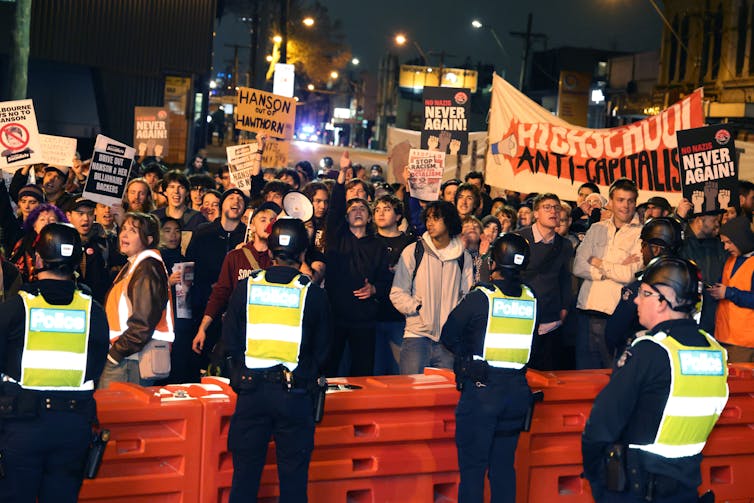
A sudden late change of premier, following an earlier switch of Liberal leader, and the big push by the strongly polling One Nation, with leader Pauline Hanson planning a major campaigning role, have transformed the climate and the playing field for the contest.
The national implications have grown, even acknowledging that voters distinguish between federal and state choices. If state opposition leader Jess Wilson can win, the Liberal party, presently on its knees around the country, will receive a shot of confidence federally. But if One Nation does well, especially in the upper house but also securing a clutch of lower house seats, its momentum nationally will continue and the Liberals’ and Nationals’ crises will worsen.
The outcome of the battle between the right of centre parties – the Liberal National Coalition versus One Nation – is crucial for the conservatives’ chances of governing the state after November 28. If the Coalition won but in minority, it would likely be dependent on One Nation for supply and confidence. But speculation about the Liberal-Nationals going into some sort of formal coalition with One Nation appears far-fetched.
If Labor hung on, say in minority government, it could truly claim a Scott-Morrison type “miracle”.
The election is made harder to predict because, on one hand, the government has a huge buffer (the opposition needs 16 seats for majority government) while on the other, the Labor brand is toxic.
As if to underline the latter point, the Independent Broad-based Anti-corruption Commission’s report on a secret deal between the Andrews government and the firefighters’ union was released on Wednesday. This painted an ugly picture of reprehensible conduct by the government and standover tactics by the union.
The eight-year inquiry did not find corruption – IBAC’s legislation was too narrow to allow that. An IBAC finding of corrupt conduct must involve conduct that would breach the criminal law. But it identified:
serious and concerning conduct by senior public officers, including ministers, members of Parliament and public servants, relating to the negotiation of the CFA [Country Fire Authority] EBA, which increased the risk of corrupt conduct.
This included actions contrary to policy, procedure and codes of conduct, deliberate attempts to conceal and mislead, and the misuse of information.
Premier Ben Carroll condemned the behaviour exposed by the report, which has played into the opposition’s hands. Andrews, and the head of the United Firefighters Union, Peter Marshall, seized on the fact there was not a finding of actual “corruption”.
Labor installed Carroll to, at least, try to “save the furniture” – that is, minimise the party’s losses. His approach has been to go for broke, wisely if shamelessly distancing himself as far as he can from his predecessors.
“I am not Daniel Andrews,” he declared. “I am not Jacinta Allan.” And “integrity will not be optional”.
He immediately announced a royal commission into alleged corruption in the construction sector, which will probe the role of the CFMEU and criminal elements that led to massive rip-offs of taxpayers’ funds in the Big Build program Allan presided over as a minister and premier. He has also said he’ll legislate before the election to toughen IBAC’s powers.
Carroll is open to amendments on Allan’s work-from-home legislation that’s before parliament, as well as to possibly fine-tuning the controversial suburban rail loop.
Carroll’s problem, of course, is that he served in both the Andrews and Allan governments, so he remains tied to the past even as he attempts to escape to a different future.
Nevertheless, Carroll is performing well compared with his predecessor. Which begs the question: why didn’t Labor put him in much earlier? The answer, of course, is factional numbers: Carroll is from the right in a left-dominated caucus. It was only when some on the left put fear ahead of faction that a move was possible.
Carroll is Labor’s third leader since the 2022 election; Wilson is also her party’s third leader this term. She took over an opposition with all the dysfunction that churn implies. Only recently did the Liberals finally put to rest the saga over controversial upper house member Moira Deeming, when they took the opportunity of her unsubstantiated claims against former leader Matthew Guy to disendorse her. She then quit the party.
With the smell of possible victory in their nostrils, the fractured Liberals are at last holding together, although the glue is thin and the team is weak. Aged only 36 and still in her first parliamentary term, Wilson (who once worked for former federal treasurer Josh Frydenberg) will have to carry an enormous load over coming months, not least because she is also shadow treasurer. She recently completed a tour of every seat in the state.
Pauline Hanson on Monday announced her Victorian leader, Warren Pickering, who is running in the outer suburban seat of Pakenham, and a bunch of upper house candidates. But the signs are One Nation’s support in the state may be coming off the boil.
One Nation has dozens of candidates still to announce, and will also be under much more heat as campaigning ramps up.
David Crosling/AAP
A Redbridge poll published in the Australian Financial Review this week, taken after Labor’s leadership change, had the Coalition on 30%, Labor 23%, One Nation 22% and the Greens 14%. This gave a two-party preferred vote of Coalition 57% to Labor 43%. In a Redbridge poll taken in June, One Nation had been on 27%, leading Labor and Coalition, which were tied on 26%.
On leadership, Carroll had a net rating of minus 15, Hanson minus 17 and Wilson plus 13. In June, Allan’s net rating had been minus 42, with Wilson plus 13 and Hanson minus 9.
Redbridge’s Kos Samaras says while the scandals are part of state Labor’s problem, there is a deeper element: voters are still dealing with Victoria’s record COVID lockdowns. He says the lockdowns didn’t take their toll at the 2022 election (when Andrews increased his majority) because that was too close. But now this “deep psychological trauma” is playing into the election, Samaras says, and that’s very bad for Labor.