Magnetic fields are a fundamental part of the universe. They govern how small particles – the building blocks of planets, stars, and ultimately galaxies – move through space.
We still don’t know how magnetic fields came to exist in the universe, but we do know they’re everywhere. Earth itself has a magnetic field that compasses and migrating birds respond to.
With radio telescopes, astronomers can use the light from distant galaxies to illuminate these otherwise invisible areas in space.
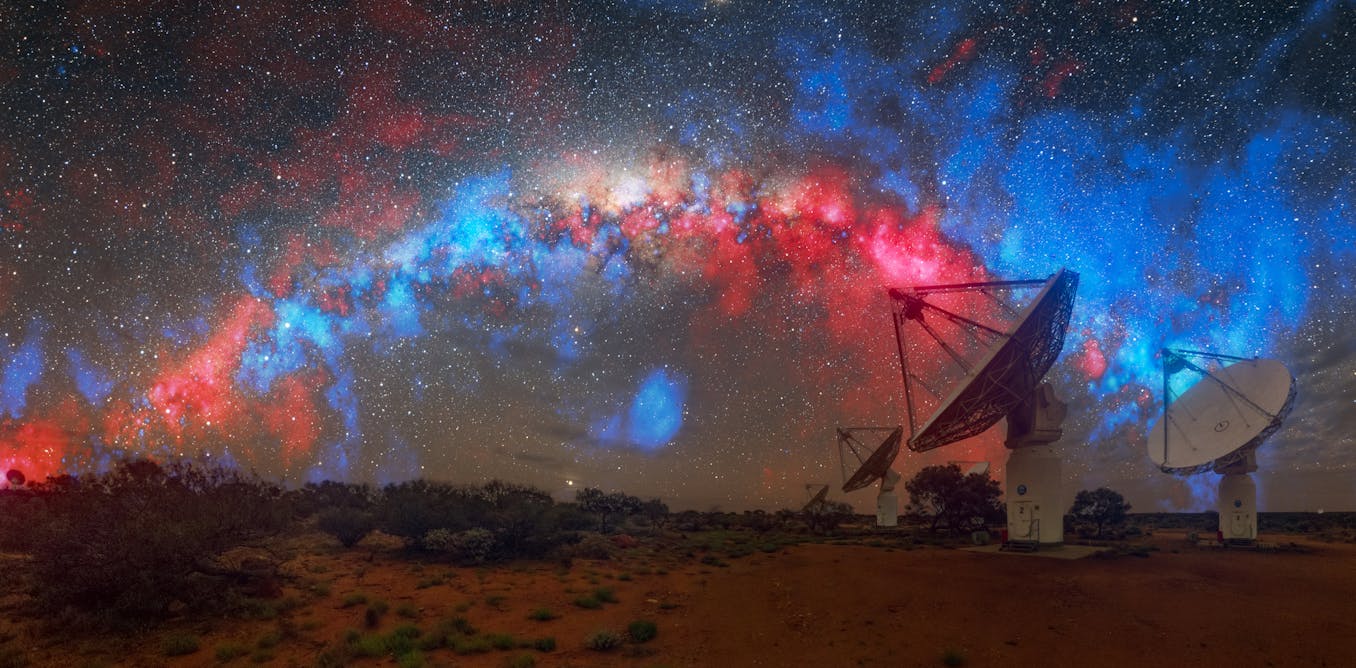
In our study, published today in Publications of the Astronomical Society of Australia, we’ve used Australia’s most powerful radio telescope to create the largest and most detailed map of cosmic magnetic fields ever made.
Alec Thomson et al.
Giant batteries that control galaxies
Magnetic fields greatly vary across the universe. Extremely dense objects, such as neutron stars and black holes, have magnetic fields thousands of billions times stronger than Earth’s own.
In the space between stars we’ve also measured magnetic fields a million times weaker than Earth’s. Despite their weakness, we know these fields are incredibly important for controlling how galaxies evolve. They act like giant batteries and store huge amounts of energy, slowing down or even preventing the formation of new stars.
But to us, magnetic fields are invisible. To find them in space, astronomers are limited to using light from distant stars and galaxies. That’s because light is a wave of electric and magnetic fields (that’s where the “electromagnetic spectrum” gets its name).
As light travels across the universe, it interacts with any magnetic fields it passes through. This will twist the direction the light is waving – we call this “polarisation”. So, light waving up and down has a different polarisation to light waving side to side.
Astronomers can catch this polarisation, especially when looking at the sky in radio waves, which are part of the electromagnetic spectrum.
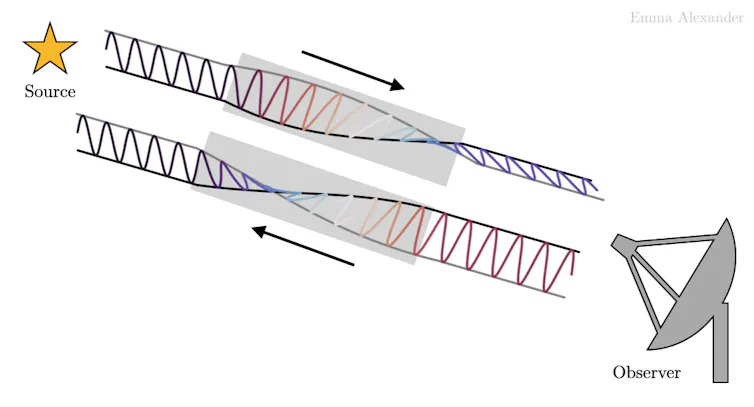
Emma Alexander, CC BY
Seeing the invisible
Australian telescopes have been at the forefront of both radio astronomy and detecting magnetic fields since their first detection. Murriyang, CSIRO’s Parkes radio telescope, was the first to detect the twisting polarisation of light from magnetic fields beyond Earth in 1962.
Ever since, astronomers have been pushing to find more and more sources that show us this twisting light. With enough measurements, we can create a map of magnetic fields in the universe.
Each point in the map is an object detected by our telescope, and the object’s light has illuminated the magnetic fields between us and that distant source. The more sources we detect, the more detailed our map becomes.
The last large map of magnetic fields was made in 2009. It has not seen a true successor in the intervening 17 years, limiting the depth and scope of the inquiries astronomers have sought to answer.
Across different areas of the universe, including our own Milky Way galaxy, we’re yet to understand the full strength and structure of cosmic magnetic fields. Not only do we not know how they came to exist, we don’t know how they’ve changed across time since the Big Bang.
To begin solving these problems, we need a new class of radio telescope.
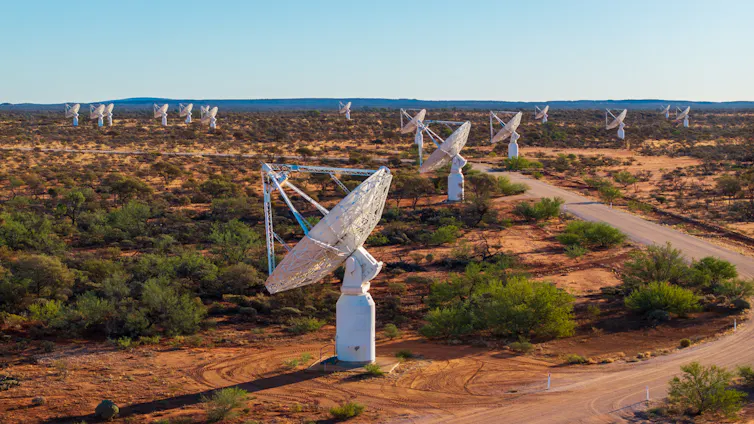
CSIRO
A telescope built for speed
Radio astronomy is currently undergoing a revolution as the SKA Observatory is being built in South Africa and Australia. In preparation, a generation of telescopes, known as SKA precursors and pathfinders, are already operating around the world.
The ASKAP radio telescope is one of these precursors. Located at Inyarrimanha Ilgari Bundara, the CSIRO Murchison Radio-astronomy Observatory on Wajarri Yamaji Country in Western Australia, it’s made up of 36 12-metre dishes. These dishes can each see a huge section of the sky at once, giving astronomers an ultrawide view of the universe.
The flagship project to make a map of the universe’s magnetic fields is known as the Polarisation Sky Survey of the Universe’s Magnetism (POSSUM).
In preparation for it, the telescope’s team produced the Rapid ASKAP Continuum Surveys (RACS). It’s like making an atlas of the universe. The most recent versions of these surveys have identified nearly 4 million distant galaxies, with about 2 million having never been seen before.
The magnetic sky
Our new map, called SPICE-RACS, has come from a collaboration between the two survey teams.
Our goal was to look towards every galaxy found by RACS, and observe the signs of changing polarisation caused by magnetic fields. Using the latest release of the survey, we found 350,000 galaxies of the original 4 million we could use for this.
Our collection of sources is nearly ten times larger than the previous largest, and five times larger than all observations ever combined together. As a result, we’ve obtained the largest and most detailed map to date.
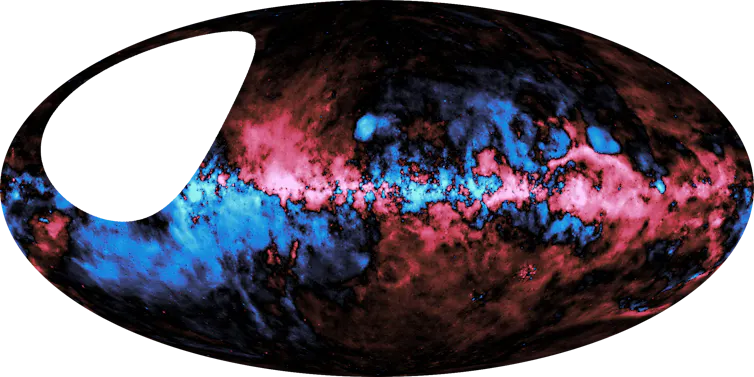
Alec Thomson et al. (2026)
The map has red colours showing magnetic fields pointing towards us, and blue pointing away, like the North and South of a compass. Most of the swirling and bubbly structure we can see is from our own Milky Way galaxy. In the fine details of the map are the signatures from even more distant parts of the universe.
The new map is already enabling new science around the world, and the data is publicly available to the research community online. In the future, we plan to combine all versions of RACS to create an even larger and more detailed map.
Meanwhile, the POSSUM project is expected to finish observations by 2030. The sharper magnetic map from this survey will open up a new window on distant cosmic magnetic fields, allowing us to see further back into the history of the universe.