Labor national conference has been a textbook exercise in managed democracy.
This reached its pinnacle when the powers-that-be – ministers and factional heavyweights – worked behind closed doors to squash an attempted revolt over the party’s draft platform on Israel and Gaza.
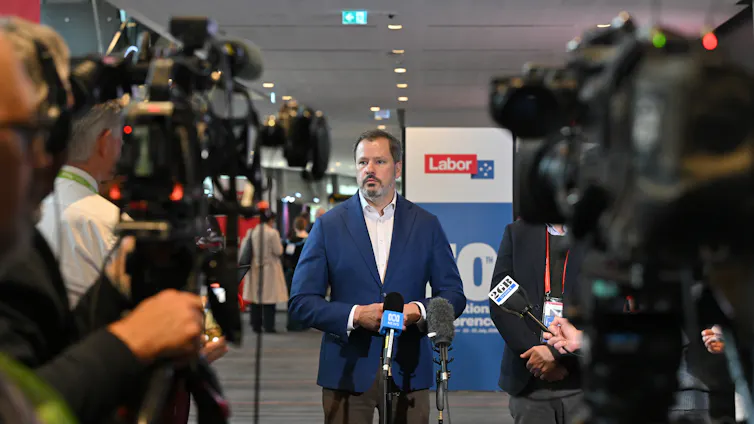
Labor’s rank and filers are strongly pro-Palestine. Former minister Ed Husic (who is Muslim), the rebel of the conference’s corridors, wanted to make the draft much tougher on Israel, including, among other points, a reference to a United Nations inquiry that spoke about genocide.
Intense negotiations and arm-twisting ensured this came to nothing. Husic’s mooted seconder evaporated. No one else proposed a change in the draft platform (that, however, is still too robust for the Israeli government, which earlier this week issued a public attack via its embassy).
Mick Tsikas/AAP
The hard-won consensus was carefully orchestrated with a two-speaker plan that started being hatched weeks ago. It saw addresses from two Victorian federal MPs: Josh Burns, the Jewish member for Macnamara (who could face a backlash in his seat), and Basem Abdo, member for Calwell, son of Palestinian refugees.
Burns told delegates:
Today, this conference has a choice. We can continue to focus on the divisions that pull us further apart, or we can do something far more important. We can stand together. We can choose empathy over outrage, dialogue over division. We can uphold Evatt’s vision for two states, for two peoples living side by side with equal rights, dignity, and security for every single person. Because that is the only pathway to peace that the world longs for.
Abdo said:
This motion is not designed to encompass everything […]. It does not seek to prescribe, to describe, or ascribe every responsibility to every party, nor does it seek to list every circumstance or point that needs addressing. It’s been an incredibly difficult few years on what is an already very difficult issue. No single motion can do justice to it. What it is is a motion of the Australian Labor Party, a party of government and a party for all Australians.
The pair ended with an embrace.
That was that. Debate on the controversial AUKUS agreement, about which many in the Labor rank and file are deeply sceptical, had been headed off well ahead of the conference.
In general the voice of dissent was confined to the conference environs – outside the hall and in the back rooms – with its flag carrier Husic equally unsuccessful with his push for a new gas tax.
Mick Tsikas/AAP
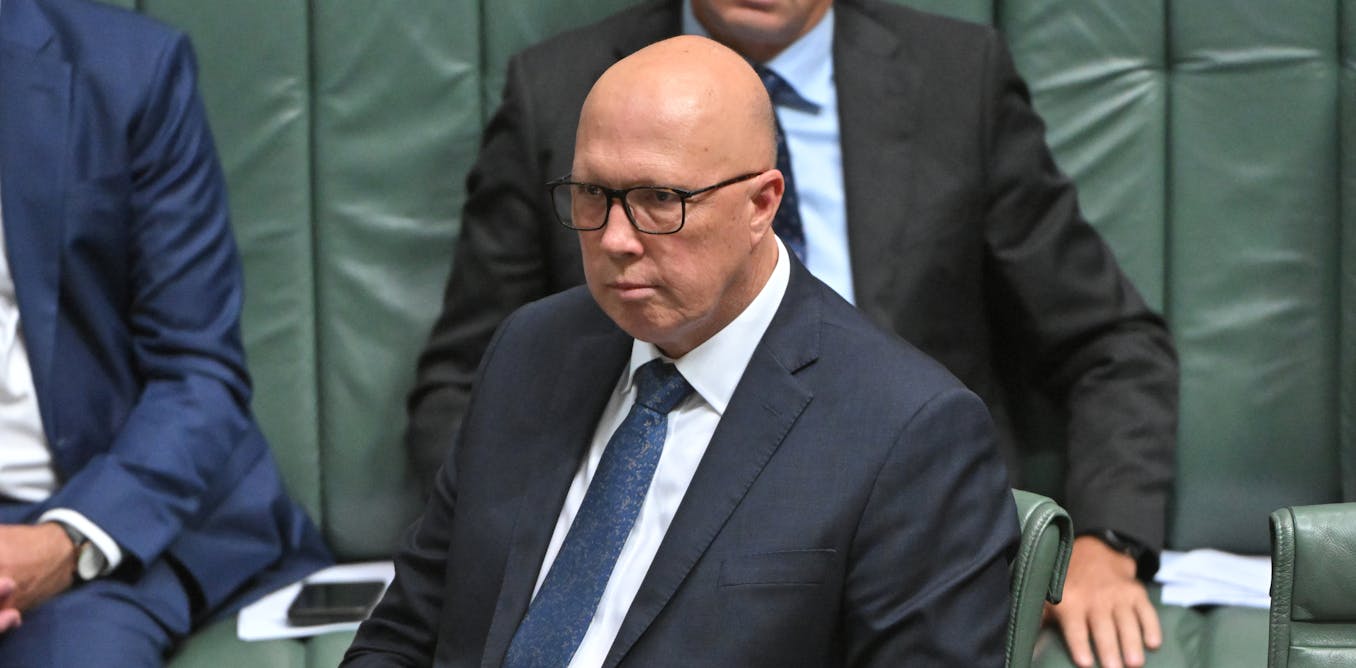
Husic’s chances of ever returning to the frontbench, from which he was dumped in factional manoeuvring after the election, have been likely extinguished by his strident rebellion over recent months. He is making his mark by publicly challenging the government, and has lamented the tight control that operates in Labor, particularly over caucus.
On Saturday, in relation of the Middle East, he condemned that “no other views could be taken into account”, saying this was unhealthy for Labor and suggesting such an attitude would assist One Nation.
“They can put me in the freezer – I don’t give a shit,” he declared, though his tone suggested he does.
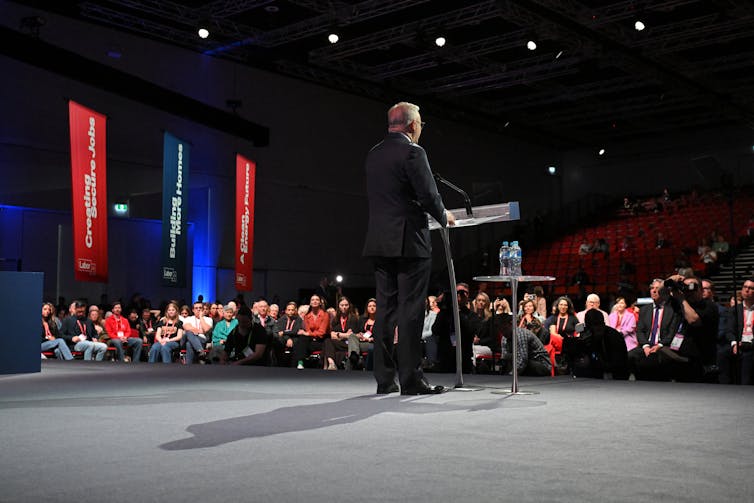
Managed democracy was the organising principle the leadership brought to the whole event, which ended Saturday. Its operation delighted Prime Minister Anthony Albanese, who in his summing up told delegates, “this is the most purposeful and united national conference I have attended since I joined the Labor Party back in 1979”.
He favourably contrasted the three-day timeframe with the week-long conferences of old. (The counter, of course, is those conferences did more real work.)
Amendments flowed for every chapter of the draft platform. But extraordinarily, only one saw a delegate speak against on the floor. The amendment , which passed anyway, urged allowing the use of telehealth in voluntary assisted dying care.
This conference had a slim left majority among the 400 delegates but a more distinct left lean in content. The union dominance was obvious in what was passed and said. In the government’s pre-conference negotiations, accommodating unions was more important than dealing with the branch membership.
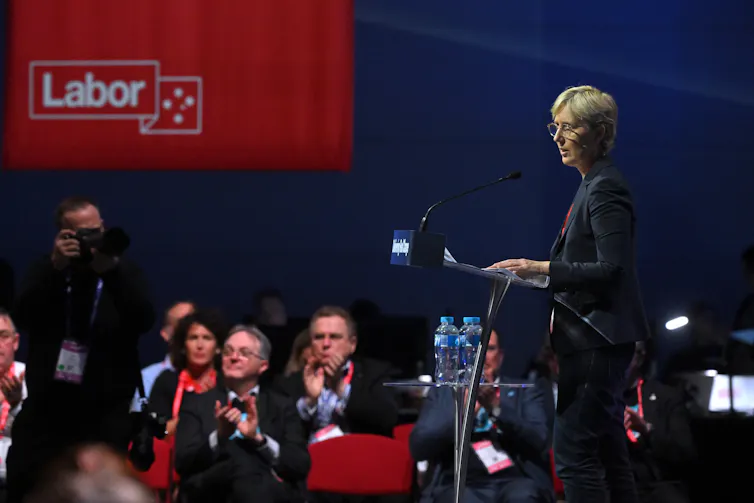
The conference endorsed a raft of amendments sought by the unions, and Albanese promised to set up a Fair Work Court. Australian Council of Trade Unions secretary Sally McManus, invited to address the conference, praised the plethora of workplace measures that have come from the government.
They have shifted bargaining power back to workers. They’ve helped deliver the first real wage growth in fifteen years, and they’ve helped working people start regaining their share of our nation’s wealth.
But that progress, as we all know, has stalled, and when wages stall, when rents rise, when mortgages rise, when groceries and power bills keep pressure on families, working people, we can’t be told to wait, and that is why Labor must keep moving.
Mick Tsikas/AAP
Business will be critical of much that has come out of the conference. But the business observers’ physical presence was certainly acknowledged. Large amounts of funds for the party were harvested thanks to frontbenchers “speed dating” them. It’s unlikely the observers received value for money.
A notable feature of the conference was the degree to which it seemed preoccupied with One Nation, which loomed in speakers’ contributions from the top down. Pauline Hanson will be flattered, seeing it as a measure of the concern she is raising in Labor.