
The study, published today in the Cell Press journal Molecular Cell, details a method of germ resistance they’ve coined ‘antibody-directed xenophagy’ (ADX).
When we think of the immune system, most people imagine white blood cells putting up a fight against invading germs within our bloodstream.
But researchers from the Medical Research Council Laboratory of Molecular Biology (MRC LMB) have shown that cells can consume germs that cross the cell membrane, including Salmonella and adenoviruses.
Molecular mechanism
Leo James, group leader at the MRC LMB explained:
People have talked about viral xenophagy before as a sort of concept, but if you look in literature, there aren’t any good examples where people have shown this operating to potently block infection.
In our single study, we’ve gone from the discovery of something completely unknown [ADX], all the way through molecular mechanism, its function in cells into animals, and demonstrated physiological importance.
Specialised proteins
Typically, during an infection, the body will create antibodies to latch onto the invaders in the blood to alert immune cells, like white blood cells, to destroy them.
However, sometimes, those antibody-bound pathogens evade immune cells and infect healthy cells.
Using CRISPR-Cas9 and quantitative imaging, the team determined that once an antibody-labeled pathogen enters a cell, ADX begins with a specialised protein called TRIM21.
TRIM21 will flag the pathogen with a marker called ubiquitin that signals to the cell that it has been invaded.
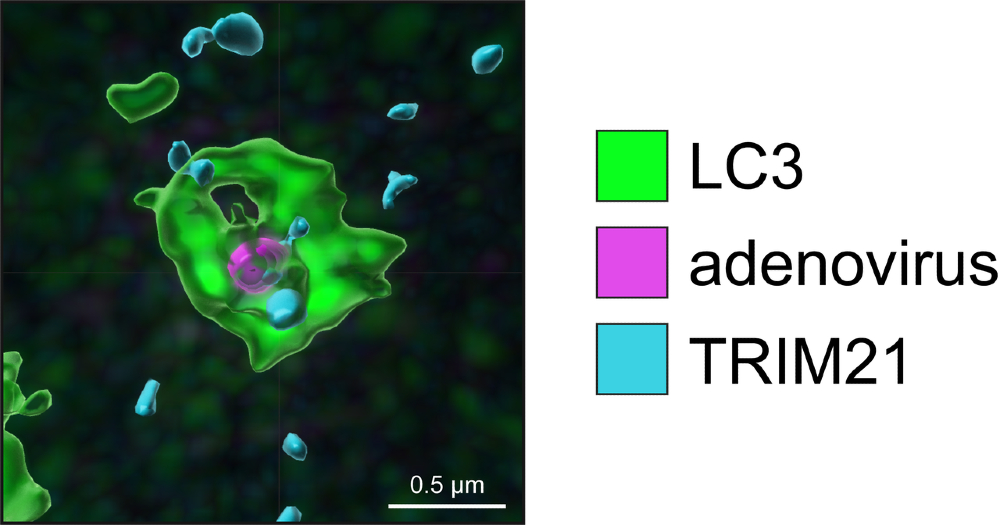
Super-resolution image of an LC3-positive autophagosome engulfing a TRIM21 and antibody-coated adenovirus. Credit: Claudia Puri, Matthew J. Gratian, Anna Albecka, and Tyler Rhinesmith
Labelling cells
Leo continues:
TRIM21 is unique because it uses the antibodies attached to the invading virus or bacteria to alert the cell.
So, in this case, a virus comes in and the cell is initially not aware of it, but since there’s an antibody on the virus, TRIM21 sees that and goes, ‘aha, that’s a virus, that’s a pathogen,’ then labels it so that the cell degrades it.
The immune effect of TRIM21 and ADX appears broad, as it can mark and destroy both adenoviruses and the bacterium Salmonella from infected cells.
Wide-ranging
This ability for cells to fight back from the inside doesn’t appear limited to specific cells within our body.
The research team tested for the presence and action of TRIM21 against adenovirus in a range of human cell lines, as well as living mouse models in the case of Salmonella.
These experiments indicated that ADX-mediated immunity is likely ubiquitous throughout the human body.
Primary mode of defence
TRIM21 is expressed from what is called an ‘interferon-stimulated gene’ which means that it is upregulated during infection, so the body makes it all the time, everywhere
The reason for this is so that bodies can potentially protect any cell or tissue.
Though ADX may sound like a ‘back-up’ for our immune system for when pathogens evade our first lines of defense, the authors note that this could be an equally important primary mode of protective immunity.
TRIM 21
Their research shows that without TRIM21, a significant component of protective immunity in vivo against viruses is lost.
In practice, immunity works because there are different mechanisms operating together.
TRIM21 is the first intracellular protein discovered to stimulate ADX immunity, but there may be others that have equally broad or specific pathogen targets.
Part of the research team’s next steps is determining the existence of other ADX-stimulating proteins and what limitations there may be to TRIM21’s function.
Key step
Co-author Tyler Rhinesmith, also of the MRC LMB, added:
We show in the paper that on top of non-enveloped viruses, it’s also able to target bacteria along the same pathway.
It seems that you trigger ubiquitination of whatever pathogen has antibodies around it through TRIM21, and this is the key step that leads to autophagy of the bacteria or the virus.
Future treatments
The discovery of the ADX pathway does have potential future medical implications.
Antibody or small molecule therapeutics could be used to treat infections by marking pathogens in the blood so TRIM21 can recognise and jumpstart ADX once they enter cells.
Still, much more research must be done before therapeutic options become a reality.