
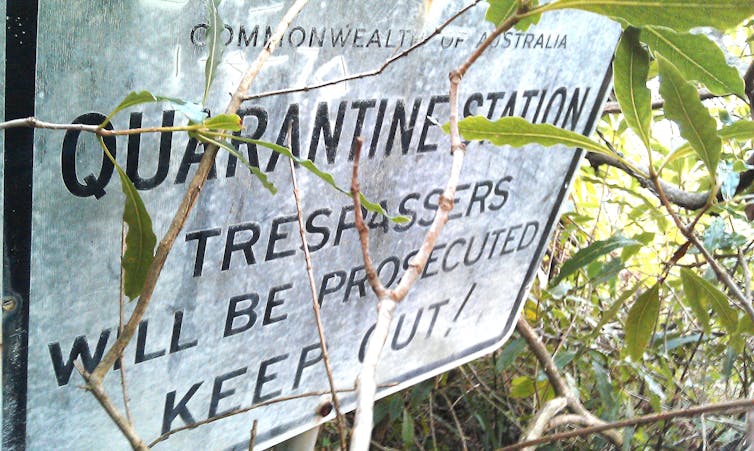
Her name was Mary Quarantine Chapman.
Seriously.
To the best of my knowledge, Mary is the only Australian named after the experience of being detained to limit the spread of infectious disease.
Today, five Australians and a New Zealander were released from hantavirus quarantine in Western Australia. They had spent the past six weeks at the purpose-built Perth quarantine facility after travelling on MV Hondius, the cruise ship linked to the hantavirus outbreak.
So Mary’s unique name prompts a question.
What does the experience of being quarantined mean once you return to everyday society?
History, as usual, helps us.
Let’s start with Mary
Mary’s parents, John and Jane Chapman, were among the 466 passengers aboard the sailing ship Samuel Plimsoll, which arrived from England in June 1879. The ship’s doctor reported numerous cases of typhus fever and several deaths at sea.
All the immigrants were ordered ashore at Sydney’s North Head Quarantine Station. Mary was born there the day after they disembarked.
Some passengers remained at North Head for three months, creating an intense, closed community that bred rumours about preferential treatment, and resentment at the lengthy detention.
Since the ship’s surgeon was too ill to continue caring for the passengers, a shore-based quarantine doctor was appointed. Within a month, 24-year-old Charles Lacey was accused of sexual impropriety with two teenage Irish immigrants at North Head.
In the moralistic Victorian era, an official inquiry stained the women’s reputations but cleared the doctor’s name. Lacey went on to become a respected local doctor in Kiama, a coastal town south of Sydney.
The Chapman family, though, were among the healthy immigrants from the Samuel Plimsoll who were detained for “only” four weeks. Mary was not christened until after the family’s release from quarantine. Her unique middle name lived on until Mary died in 1957.
Peter Hobbins
Sickness and a lifetime of suffering
In the heyday of Australian quarantine, from the 1830s to the 1930s, quarantine was an elaborate and rigorously enforced system. The process was made easier because all travellers arrived from overseas by ship.
Most vessels were not quarantined, but a health officer checked each new arrival to limit the risk of deadly maladies coming ashore.
When sickness broke out on a voyage, ill people were quarantined in a hastily prepared hospital on board. Their ship would fly a yellow flag to indicate the risk of communicable disease. On arrival, both healthy and sick passengers were usually brought ashore.
Then the waiting began. This was quarantine as an intense, communal experience.
Sick arrivals were transferred to quarantine hospitals, at a time when medical understanding of infection was vastly different from today.
Diseases such as smallpox, bubonic plague, scarlet fever, measles and influenza were often fatal. With treatment options limited, many patients died or took months to convalesce.
Smallpox was notorious for scarring victims’ faces. Measles, influenza and plague might lead to long-term lung injuries. Release from quarantine might be just the beginning of a lifetime of suffering.
For some unfortunate people, quarantine became a final resting place. Infected corpses were buried on site. It was too risky to release them into community cemeteries.
For mourners, cemeteries in quarantine stations were – for obvious reasons – difficult to access. Quarantine survivors, therefore, often had to battle bureaucracy to visit their loved ones’ graves.
Ann’s story
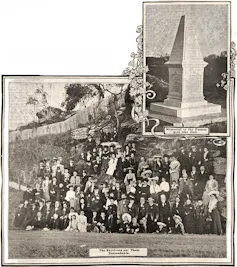
Ann Fuller survived after being quarantined in 1839.
However, her husband William died of typhus fever en route from Ireland aboard the ship North Briton. Their two-year-old daughter Charlotte then died at North Head.
Australian Town and Country Journal/Trove
Ann was released from quarantine with her six surviving children, and lived until 1868. But her monument in Kiama Cemetery keeps their traumatic story alive.
Some detainees erected their own monuments at North Head, such as the 341 passengers from the ship Constitution, quarantined for smallpox in 1855.
Half a century later, survivors and their families gathered at the quarantine station for a “merry” reunion.
A donkey called Hot Beans
Occasionally, though, Australia’s rigorous attempts to contain the threat of infectious diseases from arriving ships broke down.
Perhaps the most high-profile recent example was when the Ruby Princess docked in Sydney in 2020 with COVID on board, leading to clusters of cases on land as passengers dispersed.
But there was another crisis that emerged almost a century ago. In 1929 the ocean liner RMMS Aorangi arrived in Sydney with smallpox aboard. The disease went undiagnosed until its passengers had travelled home across the country, even as far as Perth.
Desperate attempts at contact tracing were not always successful, especially where passengers had given false addresses. Most, however, were rounded up into a delayed quarantine.
Several influential travellers were furious.
City of Vancouver Archives
Nobody died from smallpox in the 1929 episode. But a group of young Australians who arrived on RMMS Aorangi had a loss of a different kind.
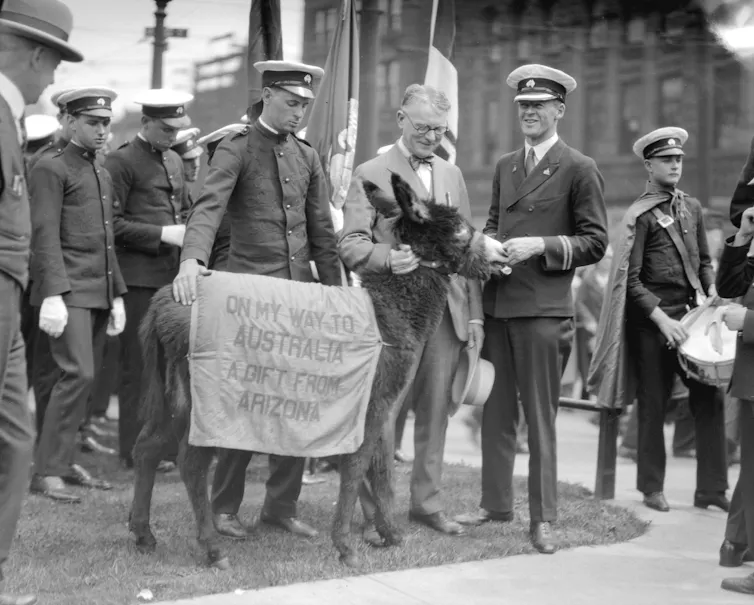
They brought with them an Arizona-born donkey named Frijoles Calientes (Hot Beans). He was subject to Australia’s animal quarantine laws, so was temporarily impounded at Taronga Park Zoo, as it was then known.
Since zoo animals could not be released into the community, Hot Beans was instead transferred to Perth Zoo. And there – somewhat pampered – the quarantined donkey lived out the rest of his long-eared life.
For some, quarantine was just a blip
For some arrivals in Australia, quarantine is just a temporary disruption. Once released from detention, they return to their everyday lives and we hear no more about them.
But the records show that for others, quarantine leaves its mark for life. Such marks can be physical or psychological, and traces may be captured in diaries or monuments.
Just occasionally, as Mary Quarantine Chapman found, quarantine can shape your very identity.