
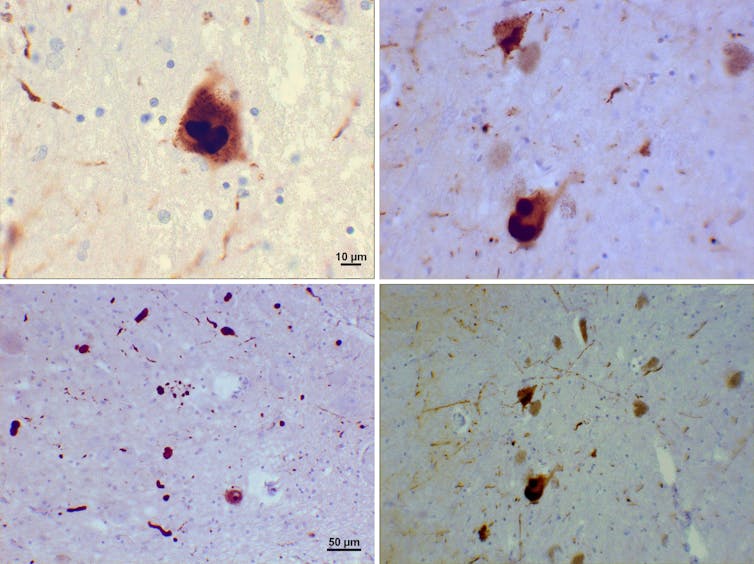
Current therapies for Parkinson’s disease and related conditions primarily treat symptoms but don’t stop the underlying process causing the disease.
Increasing evidence suggests that toxic clumps of proteins called alpha-synuclein are among the primary drivers of damage to neurons. My team and I developed a synthetic molecule that can block these proteins from clumping and spreading in the brains of mice, ultimately reducing symptoms of disease.
This molecule, called SK-129, acts like a molecular brace: It binds to several parts of alpha-synuclein and holds the protein in a shape that makes it less likely to stick to other ones. It binds especially strongly to early forms of these toxic clumps, preventing them from growing and forming new ones.
Why it matters
Beyond SK-129, our research highlights the broader potential of the class of molecules to which it belongs: foldamers.
Foldamers are laboratory-designed molecules that fold into predictable shapes, much like natural proteins. Because they’re so stable, scientists can tailor them to recognize and bind to specific biological targets.
Suraj Rajan/Wikimedia Commons, CC BY-SA
This versatility is particularly important, because many proteins involved in neurodegenerative diseases have long been considered “undruggable.” Unlike other disease proteins with pockets that conventional drugs can bind to, proteins involved in neurodegenerative diseases, such as alpha-synuclein, are highly flexible and lack well-defined binding sites. Synthetic foldamers offer larger surfaces that can engage these difficult targets and disrupt the abnormal protein interactions that lead to toxic aggregation.
Foldamers could open new treatment avenues not only for Parkinson’s disease, but also for other neurodegenerative disorders driven by toxic protein aggregation, including Alzheimer’s disease and ALS.
What still isn’t known
Although SK-129 showed strong promise in its ability to target Parkinson’s in cell and animal models, we have yet to test its effectiveness in people.
Important questions remain regarding its long-term safety, optimal dosing and how it travels through and interacts with the human body. Additional studies are needed to understand how the molecule works and how to further optimize it to stop or slow Parkinson’s disease from worsening in people.
More broadly, researchers are still working to fully understand how different forms of alpha-synuclein drive neurodegeneration and disease spread. My team is also investigating how selectively targeting these toxic protein clumps influences their spread, inflammation in the nervous system and brain cell survival across different brain regions.
What other research is being done
Researchers are actively developing other therapies that target the toxic alpha-synuclein clumps that cause Parkinson’s and related diseases.
These approaches include molecules designed to clear these protein clumps or reduce their production, as well as molecules that can stop them from aggregating. Several of these strategies have advanced into clinical trials.
Each major approach to treatment has important limitations. Some struggle to selectively bind to the toxic proteins, while others are unable to penetrate the brain.
Through the collaboration of neuroscientists, biophysicists, clinicians and translational researchers, researchers like me hope to develop new ways to treat diseases that conventional drugs haven’t been able to before.
The Research Brief is a short take about interesting academic work.