
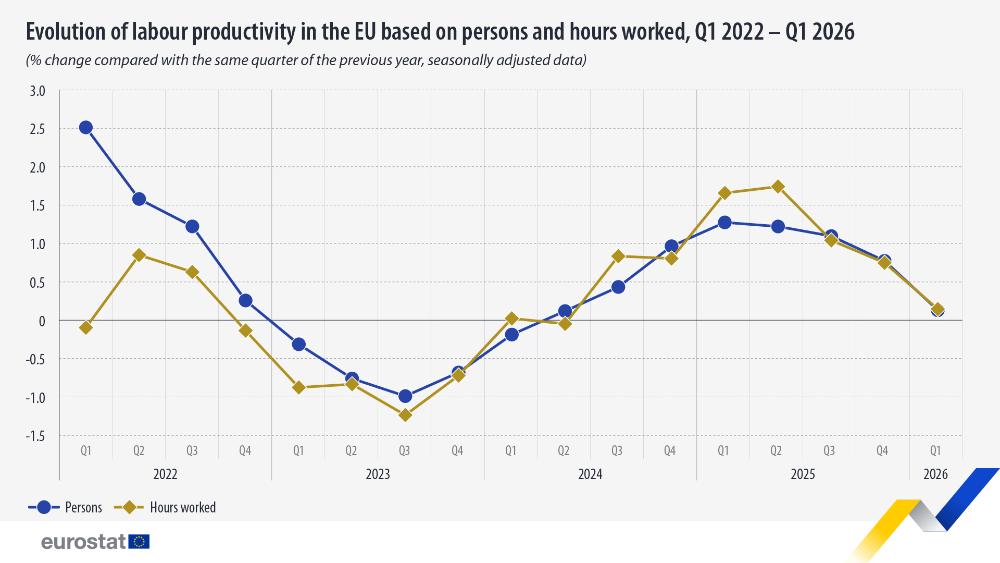
In the first quarter of 2026, labour productivity in the EU increased slightly by 0.1% based on both persons and hours worked, compared with the same quarter of the previous year. In the fourth quarter of 2025, labour productivity had increased by 0.8% based on persons and 0.7% based on hours worked compared with the same quarter of the previous year.
This calculation combines gross domestic product (GDP) and employment data to show the real output produced per employed person, or per hour worked.
Source dataset: namq_10_lp_ulc
Labour productivity increased in most EU countries
Denmark recorded the largest increase in labour productivity based on persons, with a 4.8% rise compared with the first quarter of 2025. Lithuania followed with a 3.5% increase and Slovenia with 2.7%. Only 2 countries registered declines in labour productivity based on persons: Ireland (-16.9%) and Italy (-0.3%).
Denmark had the largest increase in labour productivity based on hours worked (+5.1%), followed by Sweden (+3.0%) and Poland (+2.8%). Labour productivity based on hours worked dropped in 6 EU countries, with the largest declines in Ireland (-17.1%), Latvia (-1.3%) and Czechia (-0.8%).

Source dataset: namq_10_lp_ulc