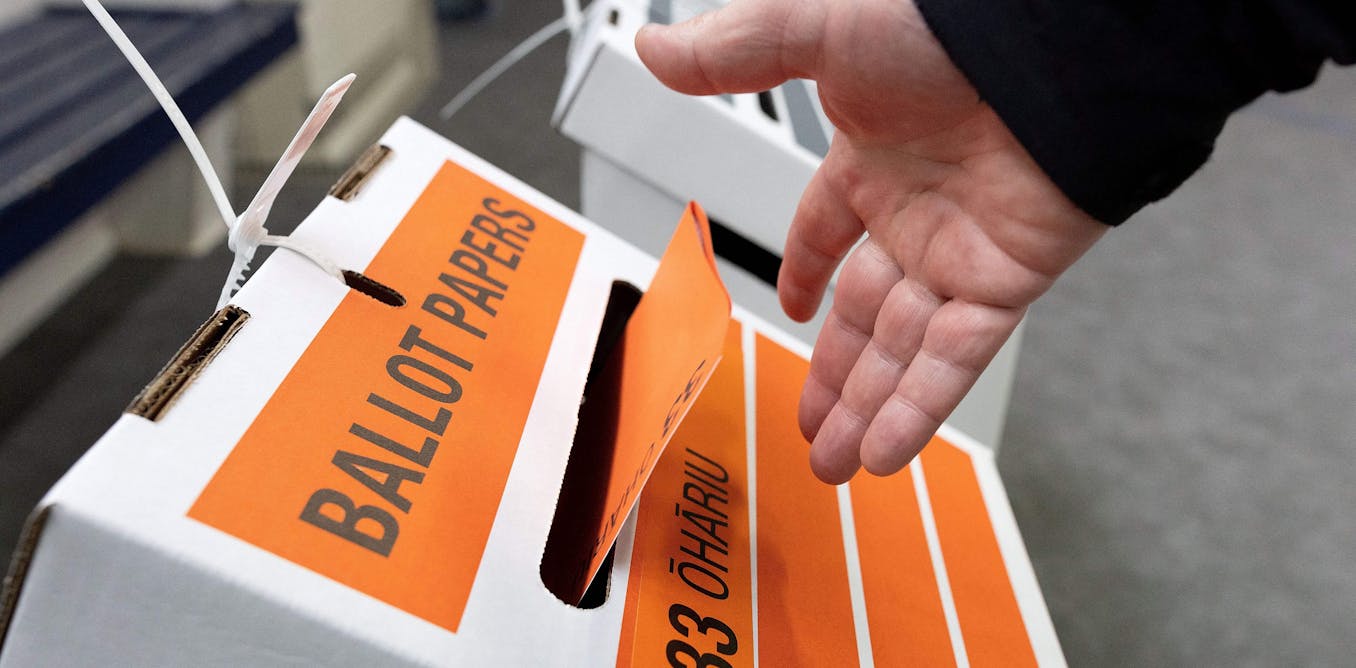
New Zealand has a voter turnout problem. Although enrolment is compulsory for all eligible voters, casting a ballot is optional. And the number of people voting has been falling in both general and local body elections since the 1980s.
Enrolment is high, however, hitting 94.7% at the 2023 general election, the highest rate since 2008. But only 77.5% of those enrolled cast a ballot, considerably below 20th century averages, which hovered around 85%.
Participation among younger voters was even lower: 74.17% of 18–24 year olds, and 69.1% of those aged 25–29. Turnout in Māori electorates was 68%.
Older voters, by contrast, are far more likely to participate. In 2023, 84.94% over 60s turned out – meaning they had a much greater influence on who formed the government.
When almost a quarter of enrolled voters – 22.49%, or 829,326 people – don’t vote, there is a real risk that governments don’t accurately reflect society.
Low voter turnout can skew other outcomes, too. For example, the Brexit referendum that led to Britain leaving the European Union was based on just a 72% turnout rate.
But while research suggests compulsory voting can be a “cost-efficient institutional remedy” to low turnout, we would need to carefully weigh up the costs and benefits before implementing it in New Zealand.
Voting as a community event
It’s compulsory to vote in around 13% of the world’s democracies, including ten of the 30 OECD countries.
Australia celebrated a century of compulsory voting in 2024, with its Commonwealth Electoral Act stating, “It shall be the duty of every elector to vote at each election.” Compulsory enrolment was introduced in 1911 but turnout remained voluntary.
Australian voter participation sat at 71% in 1919 and fell below 60% in 1922, but it jumped to 91% in 1925 after the introduction of compulsory voting. It has remained around 90% ever since.
At the 2025 federal election, Australia’s turnout was 90.7%, with enrolment (also compulsory) very high at around 98%.
New Zealand, by contrast, has not exceeded 90% turnout in a general election since 1984.
Compulsion helps, but enforcement amplifies the effect. Research suggests compulsory voting without penalties increases turnout by around 7.5 to 10 percentage points. Where sanctions are enforced, turnout rises by a further 14 to 18 points.
In Australia, failure to vote without a valid reason is an offence punishable by a modest fine (around A$20). The penalty is light, but apparently sufficient.
More importantly, voting has become culturally normalised in Australia as a form of civic participation and community connection, epitomised by the famous “democracy sausages” sold at polling booths. As one submitter to an Australian electoral reform inquiry observed in 2013:
Election day is a community event, a common civic enterprise – and one in which most people are happy to participate.
What are the objections?
New Zealand already accepts compulsory jury service and compulsory voter enrolment. Is there any principled reason not to follow Australia’s lead and extend compulsion to voting itself?
Four objections are usually raised, starting with the assertion that you can’t force people to vote.
In practice, compulsory voting doesn’t compel anyone to make a political choice. The obligation is to attend, be marked off the roll, and receive a ballot paper. Casting a blank or informal vote remains an option.
Second, compulsory voting requires the act of voting to be as easy and accessible as possible, which has raised questions about potential fraud. But digital cross-checking and identity verification processes have largely eliminated the risk in Australia.
Research over decades has shown countries with some form of compulsory system see increased voter turnout without corresponding increases in electoral fraud.
Compulsory voting in Australia is 100 years old. We should celebrate how special it makes our democracy
Third, there is the question of people who genuinely can’t vote. Compulsory systems rely on maximising access and the acceptance of reasonable excuses for opting out.
Advance voting, mobile polling, phone voting for blind voters, and exemptions for illness or incapacity are standard (and already familiar to New Zealanders through jury service).
Fourth, and crucially in an era of declining trust in institutions generally, would
compulsion be a spark that ignited another culture war about government overreach?
The COVID pandemic demonstrated how social cohesion can suffer when governments mandate certain behaviours. And research has shown this can affect lower socioeconomic groups more.
But the same research also showed people with a “high sense of belonging” were equally likely to participate in civic and social activities, and those who feel isolated are less likely to vote in voluntary systems.
While Australia has seen a slight rise in spoiled and “donkey votes”, evidence from Latin America suggests compulsory voting disproportionately increases turnout among the less socioeconomically advantaged.
Better democracy
To be widely accepted, compulsory voting would need to be presented as a shared, nonpartisan civic duty. As the American academic Shane P Singh has written (in the context of very low turnouts in the United States):
The promise of compulsory voting is that it would incentivize people to turn out and, in turn, bolster the quality of democracy.
Closer to home, it seems people share that optimism. Across five different surveys, more than 70% of Australians have consistently said compulsory voting has been good for their country.
New Zealanders might be generally reluctant to acknowledge their nearest neighbour has got something right, but perhaps it’s time to make an exception.