
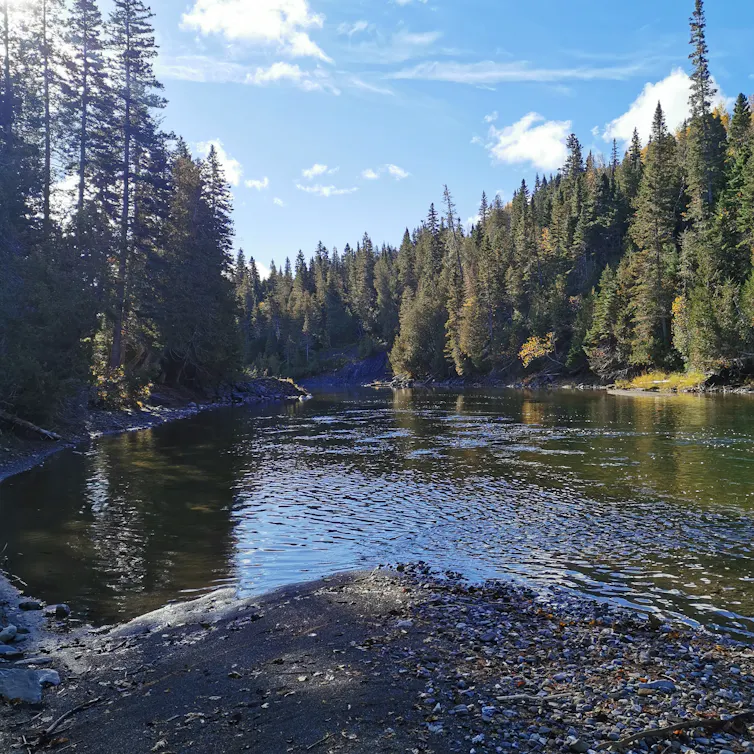
Every summer, Québec rivers increasingly reach water temperature levels that threaten Atlantic salmon (Salmo salar). Just a few extra degrees can make the difference between a favourable and hostile habitat for this iconic species.
Because of climate change, the issue is no longer simply predicting how much rivers will warm, but determining where to take action to protect them.
One possible solution is the reforestation of riparian zones, the edges of streams and rivers. Trees lining waterways provide shade, which limits sun exposure and keeps temperatures cooler.
But how can we determine what areas will actually benefit from reforestation?
Our study, conducted on the Dartmouth River in the Gaspé Peninsula — a major waterway in the region known for its Atlantic salmon population and recreational fishing — provides a new tool to answer this question.
When water temperature is a problem
A river’s water temperature depends on several factors including air temperature, flow rate and groundwater inflow. However, solar radiation remains one of the main sources of energy responsible for rivers warming during the summer.
More sunlight reaches the water’s surface in areas where riparian vegetation has been degraded by human activities. The consequences of this are particularly significant for Atlantic salmon, a species adapted to cold waters.
Atlantic salmon growth and performance are generally optimal at temperatures below 20°C, and signs of physiological stress appear when the water temperature exceeds 20–23°C. Beyond these critical thresholds, this stress can affect the growth, feeding, and reproduction of the species.
Protecting thermal refuges has therefore become a major conservation topic.
Mapping shaded areas
To better understand the effect of riparian vegetation on water warming in the Dartmouth River, our research team at the INRS’ Eau Terre Environnement Research Centre launched a project funded by The Foundation for Conservation of Atlantic Salmon.
The goal of this study was to assess the role of riparian vegetation in providing shade and controlling solar exposure — two key factors that determine the quality of salmon habitat.
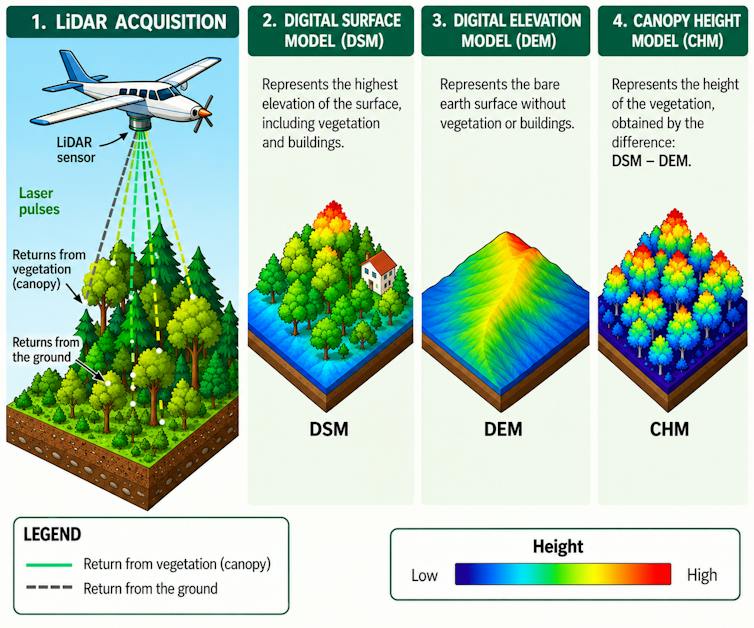
We used a remote sensing technology called LiDAR (Light Detection and Ranging), which produces a highly detailed three-dimensional representation of the terrain and surrounding vegetation. The analysis was conducted at a resolution of just one metre, allowing us to identify the most exposed sections of the watercourse with high precision.
By combining LiDAR data with spatial modelling tools, we were able to simulate the amount of solar radiation reaching the surface of the Dartmouth River. We then compared these results with water temperature data.
Author provided (no reuse)
Shading varies
The results showed that wide, sparsely shaded sections receive more solar energy, while areas that are steep-sided or bordered by dense vegetation are naturally protected.
To take this further, we calculated an indicator called “unitary radiation,” which represents the amount of solar energy received within a given volume of water. This measure helps identify the areas most vulnerable to warming.
We observed that certain narrow, shallow and sparsely shaded sections received up to 25 times more energy than other parts of the river. These areas appear to be particularly sensitive to summer heat waves.
Author provided (no reuse)
Reforesting riverbanks
We then simulated a restoration scenario in which a 30-metre-wide riparian strip would be re-established with a tree canopy at least 12 metres high. This simulation was applied only to degraded sections of the river, where the loss of riparian vegetation limited natural shading. It therefore represents a realistic reforestation scenario that could be implemented as part of salmon habitat restoration projects.
The results are encouraging.
Reforestation leads to a widespread reduction in the amount of solar radiation absorbed by the water. In some areas, the reductions reach nearly 40 per cent. This reduction helps maintain cooler water temperatures, which is particularly beneficial for Atlantic salmon.
Our study has identified certain river sections with a much higher potential for reducing solar radiation. It’s precisely these locations that should be prioritized during restoration efforts.
Targeting investments more effectively
The economic resources allocated to reforestation are limited. In a river system that spans hundreds of kilometres, it’s not possible to take action everywhere. Our study proposes a spatial prioritization method to identify the areas where every dollar invested in restoration could yield the greatest reductions in water temperature.
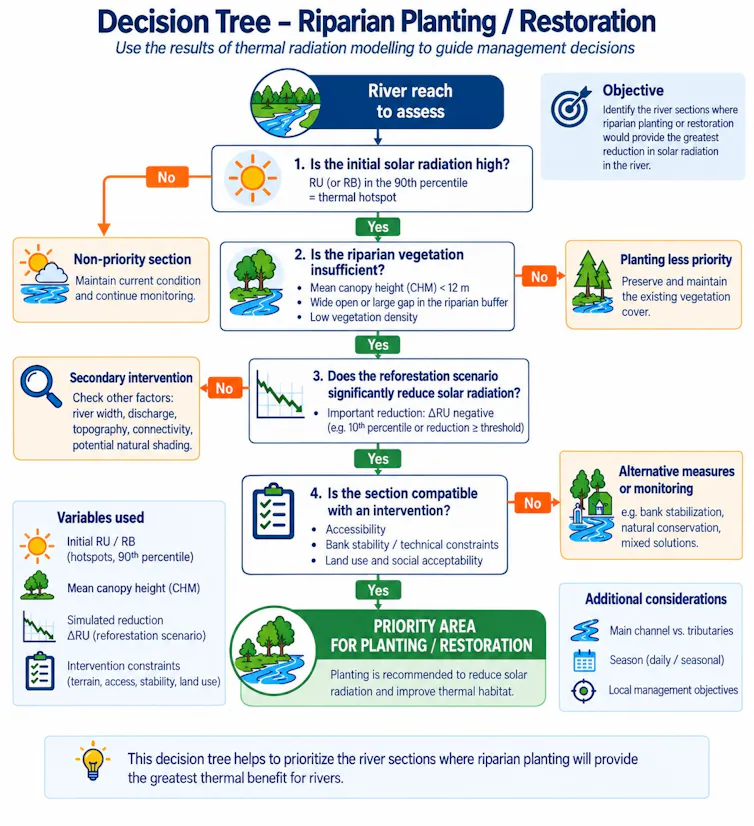
Author provided (no reuse)
On the Dartmouth River, these priority areas are concentrated mainly in the upstream sections as well as in certain tributaries, where the river connects to another watercourse that is particularly exposed.
This approach could be applied to other watersheds in Québec to support conservation organizations, river managers and public decision-makers in their efforts to adapt to climate change.
In Scotland, similar tools are already being used to identify river sections where tree planting offers the greatest potential for cooling the water and protecting Atlantic salmon in the face of global warming.
A promising adaptation strategy
Riparian reforestation is one of the concrete solutions that can be implemented locally as an adaptation measure starting today. By restoring the trees that line rivers, it’s possible to create more shade, protect thermal refuges and increase the resilience of Atlantic salmon habitat in the face of increasingly hot summers.
At a time when every degree counts, trees could well become essential allies for the future of Québec’s salmon rivers.
We would like to acknowledge the contribution of Mathias Cabal, a master’s student, as well as Professors Normand Bergeron and André St-Hilaire of the INRS’ Centre Eau Terre Environnement Research Centre, and Carole-Anne Gillis of the Gespe’gewa’gi Institute of Natural Understanding (GINU). Their expertise, collaboration, and commitment were essential to the completion of this research project.