Primavera 2026 is an exhibition about loss that somehow leaves you lighter than you came. The losses it gathers are heavy ones: Stolen Generations histories, genocide, lives erased from the record. But it is grief metabolised into making, sorrow turned toward creative invention rather than frozen in time.
This alchemy holds the show together.
Primavera is the annual showcase of leading Australian artists under 35 at the Museum of Contemporary Art Australia, this year curated by Antares Wells.
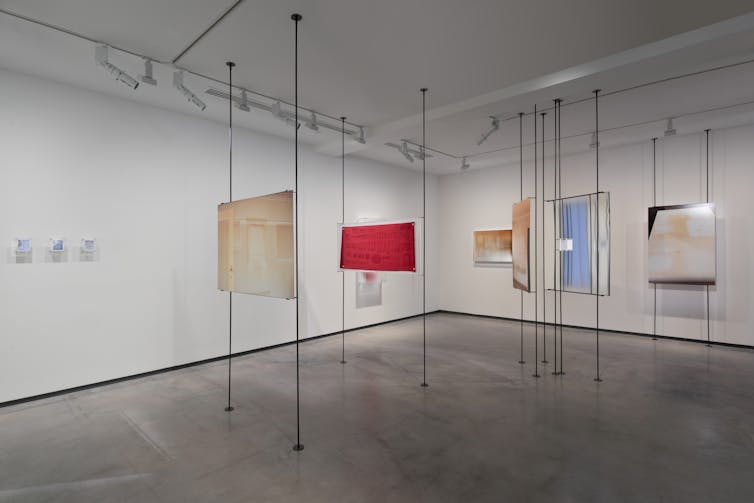
Works hang in a gallery.
An invitation to exhibit in Primavera is often the biggest national platform of the included artists’ career to date. This year’s theme is “traces”, the material residue of the past. At the entrance each of the eight artists offers the object that sparked their work: a handwritten note, a brain-scanning device, a rock, a photograph of an empty hall.
These seemingly odd artefacts frame the whole show as a question of raw material, each pointing to something that was lost.
We need to enter the exhibition to see what was made of that loss.
Reconstruction as invitation
The work I found most immediately compelling is Linda Sok’s Deities in Temples, a suspended silk weaving that appears to be coming undone in mid-air.
Sections of weft have been drawn out to leave only the warp exposed. The cloth reads as a series of ghost-images held aloft on hand-formed resin chain links. It responds to a found registration card in the National Museum of Cambodia documenting a temple textile presumed destroyed under the Khmer Rouge, the regime Sok’s family fled.
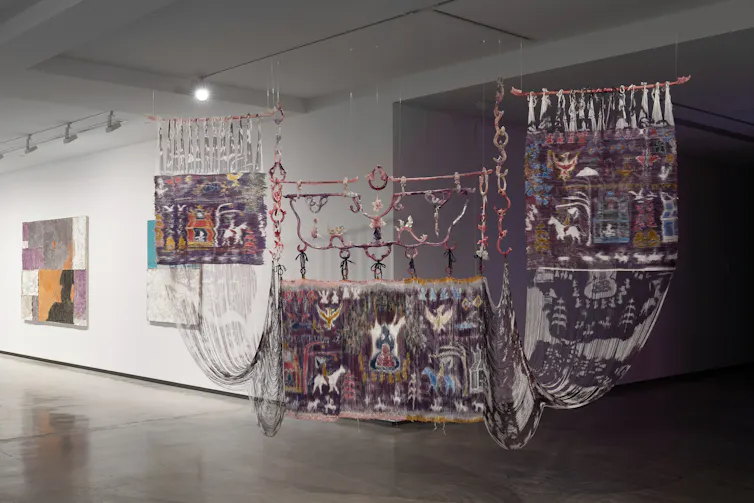
Denied the object, she invited relatives to sketch what they recalled, then printed, dyed and rewove their drawings on her loom, each piece building on the last.
In Sok’s work, a destroyed thing is reconstructed not as replica but as collective invention.
Jahkarli Felicitas Romanis’ two-screen video Skin to Skin is the emotional centre of the exhibition.
A young woman (the artist) addresses the camera with unnerving composure. Through the course of her speaking, we come to understand she is looking for someone. Ultimately we learn she is speaking to her great-grandmother Dolly, a member of the Stolen Generations removed to Palm Island. Romanis was refused access to photographs of Dolly while developing the work for this exhibition.
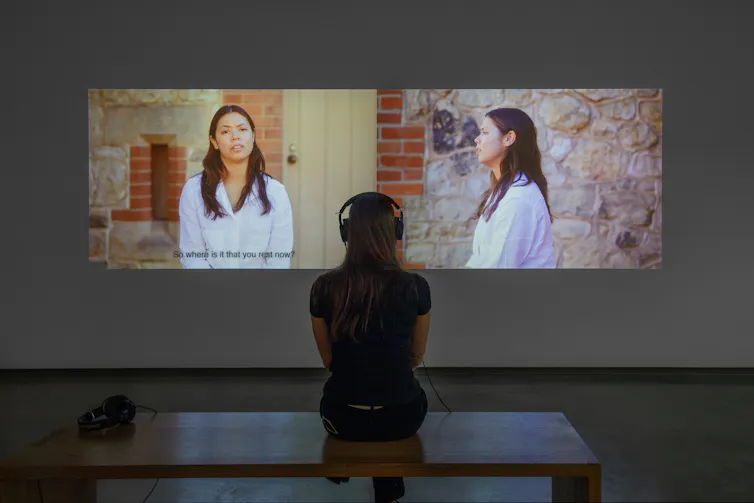
On one screen she speaks to us; on the other we watch her in profile, voyeurs on a private grief. A single tear, no swelling soundtrack, just the steady honesty of the address: it is devastating in its restraint and simplicity.
This is a film built in the gap where the archive should have been, an act of speech standing in for images withheld.
Tasting the bittersweet
Jack Wansbrough’s Meteorite Enquiries won me over more slowly. At first glance it is a low table of pebbles and yellowing files, easy to walk past. Then I found a 1991 note tucked underneath one of the rocks: “if this proves not to be a meteorite”, the writer asks, “might it be returned for use as a paperweight?”
The installation gathers “meteorwrongs”, rocks hopefully but wrongly sent to the Western Australian Museum as fallen stars, each returned to sender.
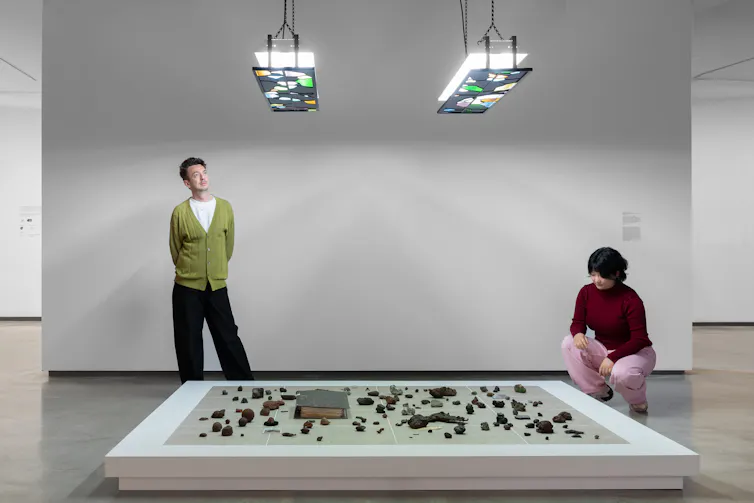
Wansbrough tracked down substitutes through industrial estates and crystal shops and remade the collection, lit by stained glass cut from microscope images of real meteorites.
In such an earnest show, Wansbrough’s rock collection is the only genuinely humorous work, though the humour is bittersweet: each rock a small monument to a minor disappointment.
Other artists extend the same logic. Rudi Williams photographs the pale ghosts left on gallery walls where artworks once hung, then builds them into elegant sculptural displays.
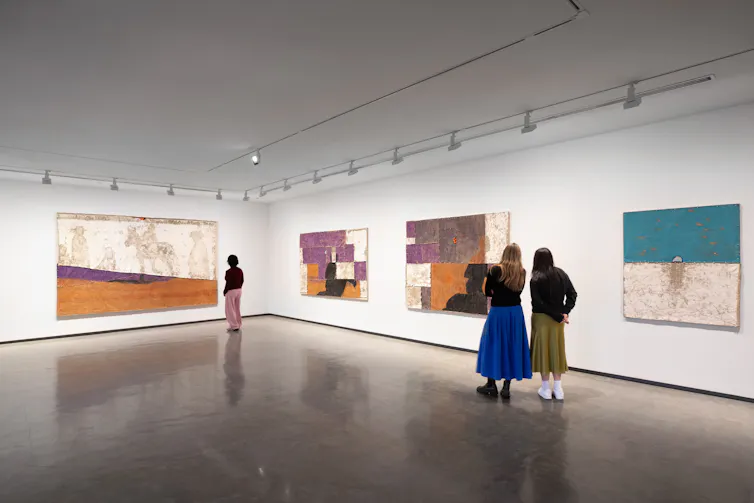
Mark Maurangi Carrol scrapes back layers of his own paintings with boiling water to summon an all-but-forgotten Cook Islands traditional horse race.
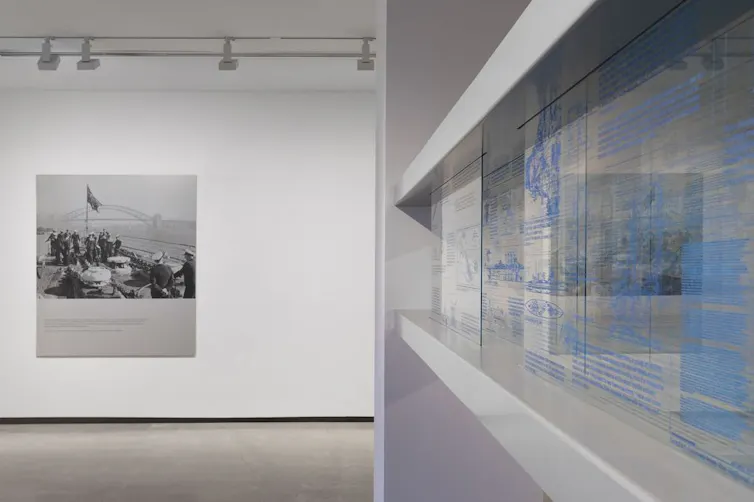
Callum McGrath forensically pieces together, in laser-etched glass, the fragments of a 1942 queer murder mystery aboard HMAS Australia II.
Stanton Cornish-Ward and Trent Crawford’s film Synchresis (Part I) turns to the strange history of “thought-to-image” technologies and what they might do to memory.
Each work in the exhibition begins from a found trace and labours it into something new.
Moving the viewer
Every work here is a new commission. What unites them is a conviction that the way to meet loss is to make something from it, using invention, not retrieval, as a creative response to a damaged record.
The inventiveness pays off for the viewer: you do not need to know any of the stories to appreciate these works. They reveal themselves through texture, rhythm, material and quietness.
This is the curator’s answer to the kind of research-heavy show that lays the past before us as evidence, and asks us to do the sifting ourselves.
These artists do not exhibit the archive; they remake it.
I left not wrecked but moved, which this time felt like the more honest response.
Primavera 2026: Young Australian Artists is at the Museum of Contemporary Art Australia, Sydney, until September 28.