
Annie Dillard is rightly celebrated as a pioneer in creative nonfiction after her death on Sep. 15, 2026, at age 81. But the dazzling, disorienting feel of Dillard’s work might be best understood as the often overlooked influence of poetry on her prose.
Dillard published her first full-length work of creative nonfiction, “Pilgrim at Tinker Creek,” when she was only 28. Winning her the 1975 Pulitzer Prize, this early book set the tone for her later work in creative nonfiction: the essay collection “Teaching a Stone to Talk,” and full-length works “Holy the Firm” and “For the Time Being.” They all attend closely to the natural world, with a theologian’s eye and a poet’s idiom.
Dillard’s creative nonfiction about nature owes a debt to the lyrical prose of transcendentalists like Henry David Thoreau, whom Dillard cited as a major influence in her work. She was also overt about the central role that fiction played in her thinking in her book of literary criticism, “Living by Fiction.”
But Dillard’s nonfiction, though undeniably prose, can have “the shape and intensity of a poem,” as her New York Times obituary puts it.
As a writer and writing professor, I think often about how blurred the boundary between poetry and prose really is. Annie Dillard’s work embodies this permeability.
Prose and poetry, in combination
Not all writing is the same. Prose typically features continuous sentences arranged in paragraphs. Poetry tends to be differentiated from prose by a deliberate organization of language that’s not determined by the page itself.
Prose poetry, the lyric essay and other hybrid forms of literature play at the intersection of genre, which usually defines these separate categories of writing. Creative nonfiction likewise aims to accurately convey reality while emphasizing literary style. The literary features of creative nonfiction are often drawn from fiction, with devices such as dialogue, scene and flashback.
But one of the distinctions of Annie Dillard’s nonfiction is how much her prose owes to poetry.
Sophie Park/The Washington Post via Getty Images
Poetry can be defined in many ways, but it tends to be characterized by honed, heightened language. Poems are often noted for their memorable images, rich sounds and foregrounding of emotion. Dillard’s nonfiction is shot through with images that arrest readers with their beauty or confront readers with their terror – as in her Harper’s essay “The Death of a Moth,” where the insect is drawn to a candle flame, becomes stuck in the wax and is transformed into a burning wick. In Dillard’s words:
“She burned for two hours without changing, without swaying or kneeling – only glowing within, like a building fire glimpsed through silhouetted walls, like a hollow saint, like a flame-faced virgin gone to God, while I read by her light, kindled, while Rimbaud in Paris burnt out his brain in a thousand poems, while night pooled wetly at my feet.”
It’s no accident that Dillard describes herself as reading the work of French poet Arthur Rimbaud by the light of the moth. She previously wrote that she loved how language sounds in French symbolist poetry, and Rimbaud was known to combine prose with his poetry in a way Dillard herself does.
Writing prose as a poet
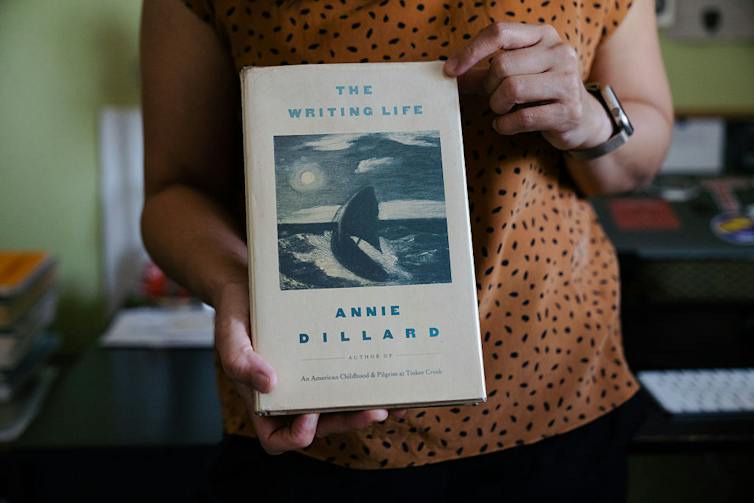
In “The Writing Life,” Dillard describes the process of writing “a favorite, difficult book” – likely “Holy the Firm” – as akin to writing poetry. She notes that the writing was “so intense and accented, and the world it described was so charged with meaning,” that the idea of going further exhausted her.
To help her write, she read Conrad Aiken’s poetry aloud, describing it as “pure sound unencumbered by sense.” She would read a poetry anthology’s index of first lines because “the parallels sounded strong and suggestive.”
She also describes repeating a single line of Wallace Stevens’ poetry “for hours, like a song” while writing.
Dillard purposefully channeled poetry’s sonic density in her writing process; it comes as no surprise that the heightened register of these poems made its way into her prose.
Inspired by ineffable nature
Dillard’s virtuosic, visionary style isn’t for everyone. Writer Eudora Welty praised Dillard in her review of “Tinker Creek,” but Welty also admitted “not (knowing) what she’s talking about” at times and that her writing “leaves something to be desired.” That something was what Welty called “straight narrative,” the clarity of “point, direction, and shape” more often demanded of prose than poetry.

Mandel Ngan/AFP via Getty Images
The solitude of the narrator in Dillard’s nonfiction and her apparent disengagement with society also was a source of criticism. As critic William Deresiewicz put it, “There is no economy and no society” in “Tinker Creek.” “We don’t know how Dillard lives, or how she makes a living, or much of anything about her circumstances.” Her mix of cultural disengagement and theological concern smacked to Deresiewicz of “hypocrisy and spiritual snobbery.”
In the contained world of lyric poetry, especially nature poetry, this hermetic perspective would be less of a fault. Her mystical encounters with the divine through the natural world are reminiscent of poets like Gerard Manley Hopkins, Wendell Berry and Mary Oliver. The narrow lens of her attention can be viewed as a poetic feature played out at length over her nonfiction essays and books.
Like an expressionist painting, poetry draws attention to how something is being depicted, not just what is being portrayed. Prose can do this, too – creative nonfiction, especially, and Annie Dillard’s writing most of all.