The same year that Christopher Nolan’s “The Odyssey” has broken box office record after box office record, Canadian poet, essayist and translator Anne Carson has been awarded the Nobel Prize in literature at the age of 76.
Although Nolan and Carson differ in approach, medium and critical reception, both have sought to make works of ancient Greece new for a contemporary audience.
This creative accessibility is likely at least part of why the Nobel committee has seen fit to honor Carson’s “bold and inventive” body of work, which defies genre: Her poems, essays, translations, stage productions and collaborations often evoke another time and place but speak freshly and vividly to audiences today.
Translation made original
Take, for example, her 2019 staged performance, “Norma Jeane Baker of Troy.” In it, Carson overlays Helen of Troy with Marilyn Monroe in order to explore the destructive power of beauty. By revisiting an ancient figure blamed for the Trojan war through the lens of a 20th-century sex symbol, Carson invites audiences to reflect on the ways both women have come to represent glamour and tragedy.
Her 2015 translation of the play “Antigone,” which toured internationally, hews closer to Sophocles’ original. Yet her lively version inflects this ancient tragedy with a contemporary voice. Creon’s lament over his dead wife, which Richard C. Jebb translates as “O miserable that I am, and steeped in miserable anguish!” is rendered in her translation “now I am perfectly blended with pain.” Jebb’s Antigone says “ah me unhappy! who have no home on the earth or in the shades” whereas Carson’s says “I’m a strange new kind of inbetween thing aren’t I” about her dilemma.
Other projects of hers veer into forms the ancient world would have had trouble recognizing. She collaborated with artist Rosanna Bruno on a 2021 graphic novel adaptation of Euripides’ play “The Trojan Women,” first performed in 415 B.C.E. In 2025, she even read her poems on an album for the indie rock band Rheostatics. Dave Bidini, one of the band’s founding members, described Carson as an artist who “hasn’t been afraid to experiment with language, to carve a place that’s her own with her work.”
Leaving space for imagination
The originality of her contribution can also arise from a refusal to do what many tend to expect from translations of ancient works in particular.
“If Not, Winter,” her 2002 translation of Sappho, drew attention to the fragmentary nature of Sappho’s surviving work.
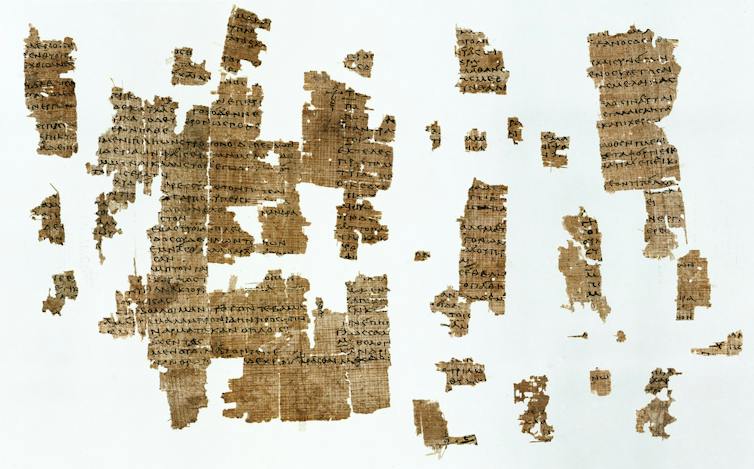
Only one complete poem of Sappho’s entire corpus exists: her “Ode to Aphrodite.” Of the remaining fragments, some are lengthy, some only a word or two long, often quoted by other ancient authors. A number were found in shreds of papyri likely recycled to wrap mummies.
In her translation, where papyri were tattered or a word obscured, Carson indicates this by using brackets and white space. Rather than eliding them, Carson ends up bringing attention to these absences – an utterly distinctive choice.
Oxford, Bodleian Library MS. Gr. class. c. 76 (P)/1-2
Carson states in the introduction to the translation that the brackets “imply a free space of imaginal adventure,” an invitation to fill in the blank of language now lost to us. Additionally, as classicist and translator Emily Wilson notes, Carson “adds no possessive pronouns or definite articles” that are not present in the Greek, another way she lets contemporary readers meet Sappho’s fragments head on.
Where Carson lets an ancient voice speak without interposition, some have found “her particular kind of austerity” wanting. Wilson, for instance, is critical of Carson’s refusal to tilt her translation in a way that acknowledges the important role that Sappho’s gender and sexuality have played in her reception over time.
Wilson further critiques Carson’s “An Oresteia,” her 2010 translation and adaptation of plays by Aeschylus, Sophocles and Euripides.
Wilson writes that Carson “is acutely conscious of the differences, in mood, worldview and style, among the three tragedians she translates. It is, then, a disappointment that she does not entirely succeed in making them sound properly distinct from one another.”
A running dialogue with literary greats
It may be that the most distinctive voice in Carson’s translations of ancient authors is her own. But even her original work owes an evident debt to the words of others. She writes with and through other literary voices throughout her work.
Her long poem “The Glass Essay” explores romantic heartbreak and familial sorrow in dialogue with the life and work of Emily Brontë.
“Nox,” an art book and work of poetry created after her brother’s passing, is also an exploration of the elegy that the Roman poet Catullus wrote to his own brother over 2,000 years before.
And this is what Carson so often does so well: She draws the past into the present and refreshes it for us with a poet’s capacity for language and a classicist’s awareness of the long legacy of literature.