
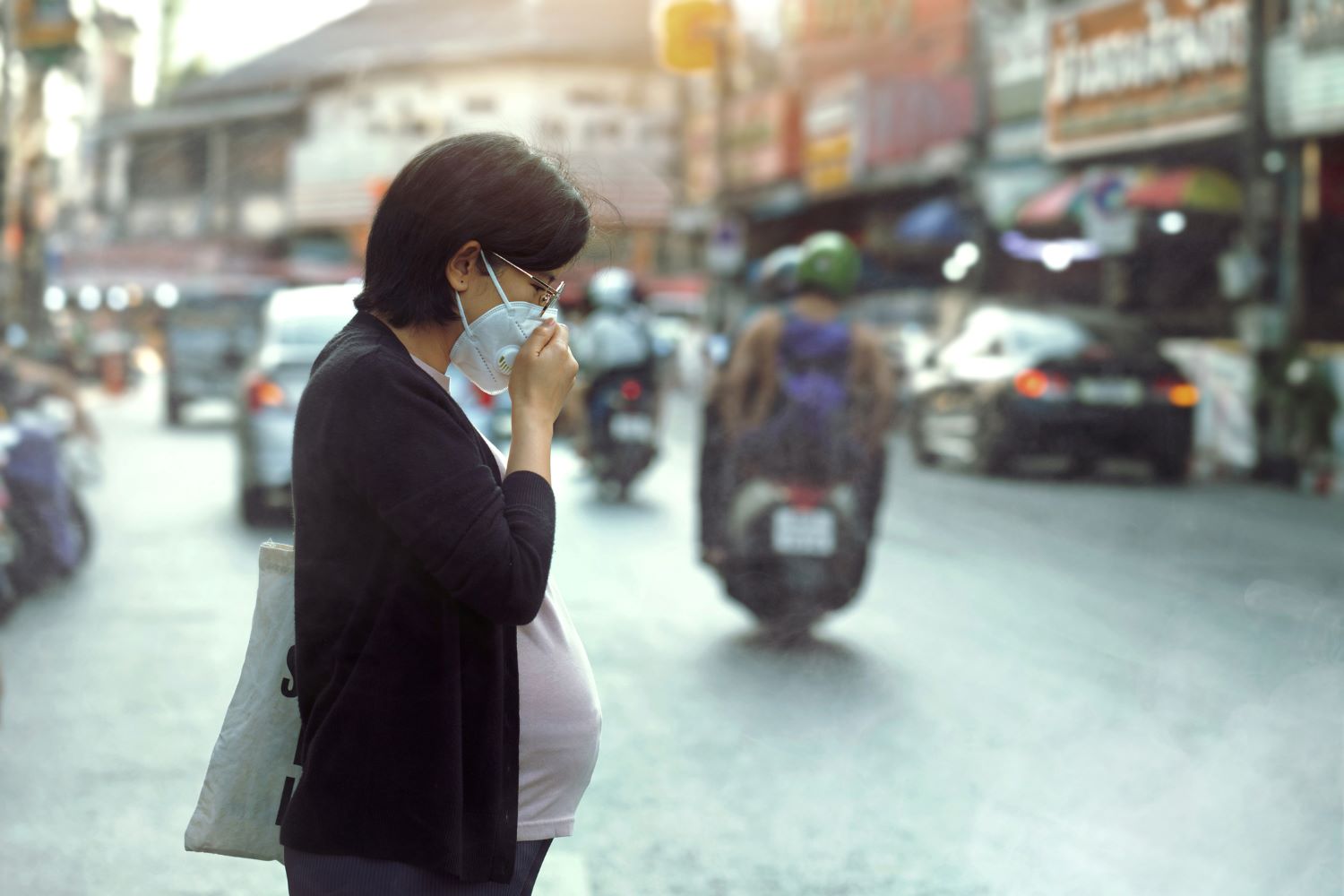
The King’s College London study, funded by the Medical Research Council (MRC), is the first to investigate pollution exposure and development in Greater London.
The study measures language and motor skills of infants whose mothers were pregnant.
Pollution exposure during the first trimester of pregnancy (conception to week 12 to 13), emitted from sources such as traffic, was linked to worse language skills at 18 months.
Premature infants
The research is also the first to address whether being born prematurely changes the impact of pollution exposure during pregnancy.
The study found that pollution had an even greater impact on babies born pre-term, with this group showing poorer motor as well as language skills.
The research follows the same group of babies found to have different brain structure sizes, attributed pollution exposure in the womb.
Critical period
Lead author Dr Alexandra Bonthrone, School of Biomedical Engineering & Imaging Sciences, at King’s College London, said:
We wanted to establish if air pollution levels related to cognitive, language and motor abilities in this critical period of early childhood.
The first 1,000 days from conception to age two shape long-term brain health and behaviour.
The babies
A total of 498 infants from Greater London were involved in the study, recruited from St Thomas’ Hospital between 2015 to 2020.
Of the cohort, 125 were born prematurely, and within that group 54 born less than 32 weeks, known as ‘very and extremely preterm’.
The infants underwent a standard clinical test of development, known as Bayley Scales, which measures cognitive, language and motor skills, with scores of 100 reflecting population average.
Early exposure
Those exposed to high pollution in the first trimester of pregnancy scored on average five to seven points lower compared to babies exposed to low pollution on language tests.
There was no association with pollution in second and third trimesters.
Premature babies exposed to the highest pollution levels in the womb across all of pregnancy, scored on average 11 points less than those exposed to low levels for motor skills.
Clinical factors
Dr Bonthrone said:
While preterm babies are already more likely to have difficulties with motor development, we adjusted for different clinical factors, like time spent on support for breathing, to confirm the relationship between air pollution and motor development.
Measuring pollutants
The King’s team collaborated with the Environmental Research Group at Imperial College London to measure pollutants.
The London Air Pollution Toolkit models pollution levels based on amount of traffic and average speeds travelled.
This enabled researchers to estimate the amount of pollution mothers were exposed to during pregnancy based on their home postcode.
Annual limits
Dr Bonthrone said:
The levels in this study of toddlers born in greater London from 2015 to 2020 were within the annual limits set out by the Government in the 2010 legislation on air quality, although they are higher than the safe levels set out by WHO in 2021.
The pollutants
Pollutants analysed included particulate matter and nitrogen dioxide, which are emitted by traffic exhausts.
Tiny particles of these molecules can be breathed in by humans.
Breathing in air pollution is the second largest risk factor for death in children under five globally, second only to malnutrition, according to the State of Global Air Report.
Closing the gap
Dr Bonthrone added:
At this stage, it is too early to say whether these babies will catch up with their peers, the only way will be to study them later in childhood.
It could be that the development differences have effects into education and information processing, but we won’t know for sure until we do future studies.
Indoor pollution
Professor Stephen Holgate, Principial Investigator of MRC and National Institute for Health and Care Research Net Zero Health Research Network, said:
Prenatal exposure to air pollution directly impacts foetal development and setting the stage for lifelong health issues.
While we’ve known about the respiratory and birth weight risks for a while, the shift toward neurodevelopment is revealing.
This key study adds to the growing body of evidence uncovering just how vulnerable the developing brain is to environmental toxins.
However, in taking account of only outdoor air pollution exposure, these findings are likely to underestimate pollution effects since pregnant mothers spend over 70% of their time indoors, where most of their exposure to air pollution will occur.
Indeed, the indoor environment is the new frontier for pursing early life health effects of air pollution.
New approach
Professor Frank Kelly, Deputy Director of the MRC Centre for Environment and Health, added:
This study shows that even within what we currently call ‘legal’ levels of air pollution, we are seeing measurable impacts on the developing brain.
That should fundamentally change how we think about ‘acceptable’ air quality for pregnant women and young children.
Improving air quality is not just about cleaner skies; it is about giving every child the best possible start in life.
Public health priority
Senior-author Professor Serena Counsell, School of Biomedical Engineering & Imaging Sciences, King’s College London, added:
This works adds to a growing body of evidence that maternal exposure to high levels of air traffic pollution may be associated with altered outcomes in their offspring.
Reducing maternal exposure to air traffic pollution should be a public health priority.
Research
The latest study forms part of wider research following a cohort of children who underwent brain MRIs before or soon after birth, known as the Developing Human Connectome Project.
The full study is published in the Journal of Physiology.
This research was also supported by the European Research Council under the EU’s Seventh Framework Program, the Wellcome-EPSRC Centre for Medical Engineering and a King’s Together Award.