
The 2026 Nobel Prize in chemistry concerns a property called chirality, which may sound like an abstract science term but is actually all around you, all the time.
Picture a spiral galaxy rotating in space, or follow the outline of a snail’s shell as it spirals clockwise to the tip. In each case, you can draw a mirror image of the spiral that won’t overlap with the original picture.
You can even see this property on your own body: Hold out your hands, palms up. Your hands are mirror images of one another, yet however you turn them, you can never lay your right hand exactly on top of your left with both palms facing the same way.
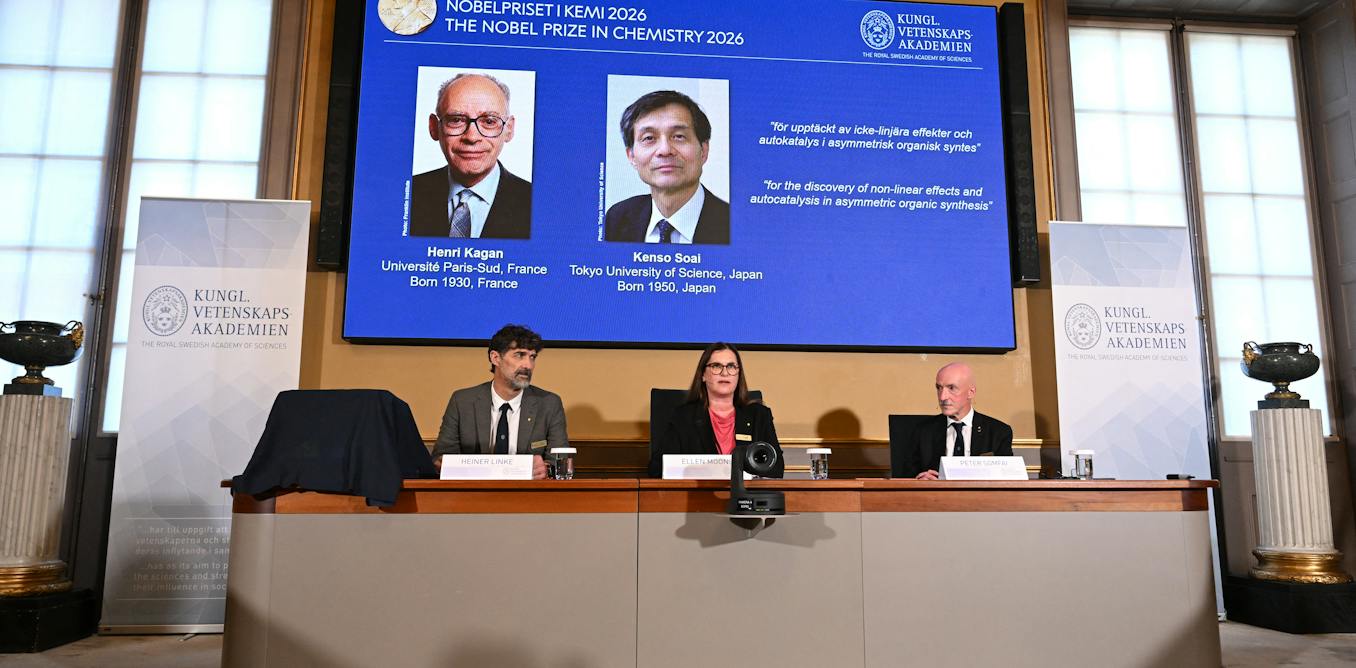
All of these are examples of chirality. Chiral objects have a mirror image that cannot be superimposed directly on them. This concept shows up in geometry in the shapes of organisms and, most consequentially, in the molecules that make up living things. This week, the 2026 Nobel Prize in chemistry went to Henri Kagan and Kenso Soai for their work on how chemistry can favor one chiral version, or “hand,” over the other.
Why handedness matters
As chemists who design and measure chiral molecules, we work with this mirror-image problem every day. Molecular handedness has far-reaching implications, and you can see why when you consider how chiral objects interact with one another in daily life.
A regular claw hammer is an achiral, or nonchiral, tool. It works identically whether you hold it in your left hand or right hand. But a pair of scissors is often made to favor a right-handed user. If you are left-handed and have used right-handed scissors, you know the result: Squeezing them with your right hand pulls the blades inward against each other, while squeezing them with the left pushes the blades outward, so they fold the paper instead of cutting it. Scissors are chiral tools designed to interact with the human hand, which is also chiral.
DariaRen/iStock via Getty Images Plus
Nearly every protein on Earth is built from one mirror-image form of each amino acid, and DNA and RNA from one form of sugars. DNA assembles to form helices of one, and only one, chirality. Similarly, snail shells almost always spiral in the same direction for every snail species. This omnipresent single-handedness of every known living thing is called homochirality.
When chemists make chiral molecules without adding any external chiral agents, they get a racemic mixture: an even 50:50 blend of both hands. So how did the primordial soup that formed life on Earth, which presumably had this exact balanced chemistry, end up one-handed?
The Nobel Prize
This question remained open until the groundbreaking discoveries honored by the 2026 Nobel Prize in chemistry, awarded to Kagan and Soai.
In the 1980s, Kagan found that a catalyst, a helper that speeds up a reaction, does not have to be entirely made of molecules with the same handedness to make a purely single-handed product. In some reactions, a partly pure catalyst yielded a product purer than the catalyst itself.
In the 1990s, Soai found a molecule that makes copies of itself and favors its own hand over its mirror-image version. Start with a 51:49 imbalance, and after a few rounds the mixture is overwhelmingly one-handed. Later versions of the reaction amplified an imbalanced mixture of just 0.00005% to better than 99.5%.
While the Soai reaction is a laboratory system and not a recreation of early Earth, it shows one possibility for how life may have chosen one-handedness.
Handedness in health
Because life evolved under homochirality, the human body is a highly chiral environment. Cell receptors and enzymes are built from single-handed proteins. Consequently, a pharmaceutical molecule enters the body like a key looking for its lock. If a drug is administered as a racemic mixture of both hands, one mirror image may fit the receptor perfectly, while its mirror twin doesn’t. This twin can trigger unintended side effects, or it may fit as a key into an entirely different enzyme and disrupt your body’s usual processes.
Throughout medical history, controlling chirality has meant the difference between therapeutic breakthroughs and medical tragedies. Chemists label the two mirror-image forms with letters, D and L for sugars and R and S for most drugs, so the letter tells you which version you’re holding. Four chiral molecules in particular can illustrate why handedness matters in medicine.
The first is thalidomide. Sold in the late 1950s as a 50:50 mixture to treat insomnia and morning sickness, thalidomide was widely prescribed in Europe, Canada and Australia. After its manufacturer withdrew it in 1961, more than 10,000 children were found to have been born with severe malformations, in which their limbs were shortened or failed to form.
A 1979 study in mice pointed to thalidomide’s S-form as the culprit. But thalidomide’s molecules are chemically flexible, meaning they can convert between the two forms while inside your body.
Even a purely single-handed version would not have been safe.
Another example is ibuprofen. Ibuprofen was developed at the British company Boots in the 1960s and has become one of the most widely used pain relievers in the world.
Ibuprofen’s S form does the work, blocking enzymes that produce chemical signals for pain and swelling. The R-form is largely inactive and does nothing against these signals.
Luckily, the body corrects the mix: An enzyme in your body converts a share of the R-form into the S-form, which is why a pill containing both forms works anyway.
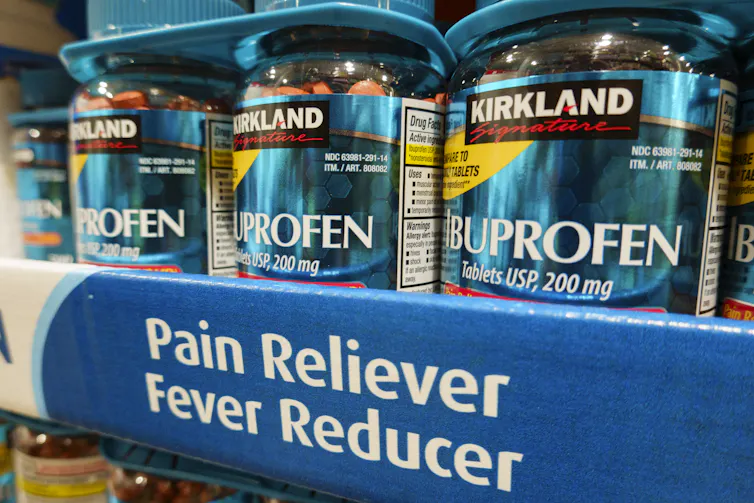
Photo by Kevin Carter/Getty Images
A third example is L-DOPA. In 1969, neurologist Oliver Sacks gave L-DOPA to patients who had spent decades nearly motionless after the encephalitis epidemic of the early 20th century. Many patients woke up, spoke and moved in the episode later told in his book and the film “Awakenings.” The effect proved largely temporary, but the drug remains a mainstay of Parkinson’s treatment.
In Parkinson’s disease, neurons producing a chemical messenger called dopamine degenerate, and the dopamine itself cannot cross from the bloodstream into the brain. L-DOPA can, and enzymes in the brain then convert it into dopamine.
Its mirror image, D-DOPA, is not a fit for that enzyme, so it does not make the transition. However, making only the L-form at scale was a challenge. In the 1970s, William Knowles at Monsanto solved this issue using a special chiral catalyst. This work earned him a share of the 2001 Nobel Prize in chemistry.
A final example is glucose. Corn or grape sugar is commonly known as glucose, but the term actually refers to specifically one form, called the D-enantiomer, of this sugar. Cells run on D-glucose. The first step of glycolysis, the chain of reactions cells use to pull energy out of sugar, uses an enzyme that recognizes only that form.
Its mirror image, L-glucose, has the same physical properties, such as melting point, appearance and sweet taste. Yet, cellular enzymes cannot process it, so it supplies no calories and does not raise your blood sugar. In the 1980s, researchers explored it as a low-calorie sweetener for people with diabetes, but high production costs made it financially unviable.
Beyond biology
Handedness matters well beyond the body. Chiral molecules emit and absorb light that is circularly polarized, meaning it twists to the left or right as it travels. Researchers are developing displays that produce this type of light directly, which could be used to make screens that work in very bright environments, such as direct sunlight.
The same property is useful for security. A tag made with chiral molecules can look like an ordinary mark in normal light but reveal a hidden pattern through a filter that passes only left-twisting or right-twisting light. This property could make it harder to counterfeit.
Chirality also shapes how electrons move. Electrons have a built-in property called spin, which you can picture as a tiny compass needle pointing up or down. When electrons pass through chiral molecules, one type of spin can get through more easily than others. Because spin can carry information, controlling it could lead to electronics that waste less energy and to new quantum devices, although scientists are still debating how the effect works.
Kagan’s and Soai’s work showed how a faint asymmetry between two chiral forms can grow into a decisive preference. Chemists are learning to build that preference into materials, not just medicines.