

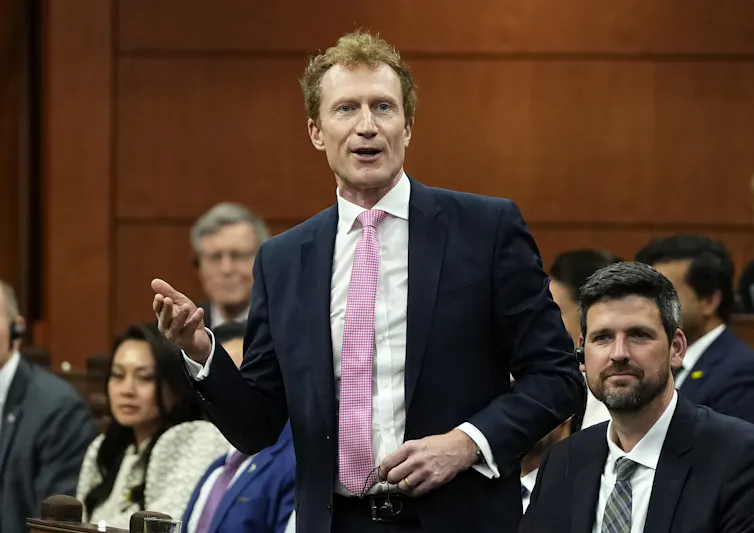
Introduced in June 2026 by Canadian Culture Minister Marc Miller, Bill C-34 would ban social media for users under 16.
In the past year alone, tech giants have spread a slew of problematic content, including TikTok posts promoting extreme thinness, ads for cocaine on Facebook and sexually explicit deepfakes created by the Grok chatbot and shared on X.
Bill C-34 raises a key question: Are we merely trying to keep children away from these platforms, or do we also want to transform the digital environments they use?
As an associate professor at the Université du Québec à Montréal’s School of Media and a doctoral student who has been studying social media for several years, I have looked closely at these issues.
Regulating tech giants
Beyond simply banning children’s access to social media, the proposed legislation would regulate certain online services, holding providers accountable for them, and restrict access to content deemed harmful. It would apply to social media, as well as chatbots, porn websites and live-streaming platforms.
(AP Photo/Kin Cheung)
Bill C-34 would force platform operators to take a number of measures: implement age verification or estimation measures, reduce the risk of exposure to hateful or violent content, provide blocking and reporting tools, identify posts generated by artificial intelligence and incorporate safer design mechanisms.
In addition, the most problematic content — particularly that related to the sexual exploitation and victimization of minors — would have to be rendered inaccessible within 24 hours of being reported.
To enforce these measures, the bill would establish the Digital Safety Commission of Canada. This organization would handle complaints, have investigative powers and be able to impose sanctions in accordance with rules set by the government.
However, some activities would be excluded from the proposed framework, including private messaging services, online video games and search engines. Some platforms could also be exempted if they demonstrate that they have implemented the necessary measures to protect children.
Good intentions with blind spots
At a first glance, Bill C-34 appears to be coherent. But the bill has flaws. For starters, many tech giants already have terms of service that are similar to the bill’s provisions but are proving insufficient.
Most platforms have a minimum age requirement for access, though this is often set at just 13 years old rather than 16. And many of them, including Meta, YouTube and TikTok, claim to restrict or ban certain harmful, violent or sexual content from news feeds and algorithmic recommendations and to provide reporting mechanisms.
Yet despite all this, most Canadian teens have seen violent or gory scenes online, according to a study conducted in 2026 for the academic organization DIY: Digital Safety and the Canadian Centre for Child Protection.
Most Canadian teens have seen graphic violence online, and algorithms — not searches — are to blame
Furthermore, provisions aimed at verifying users’ ages are raising significant concerns about privacy both in Europe and Australia. Last March, more than 350 international researchers went as far as calling for a moratorium on different projects aimed at verifying the age of internet users, which they consider highly intrusive.
Chatbots
AI-powered chatbots must clearly do a better job at preventing the spread of harmful content in the absence of banning their use for those under 16. But according to Miller, studies have not yet sufficiently demonstrated their harmful effects on young people.
The fact remains that unlike social media, we know very little about what young people see and consume in their private interactions with these bots. Yet the government seems to be relying on the good will of companies to ensure their safety.
What can we take away from C-34 at this stage?
The bill appears to be an incomplete draft. If it passes second reading, its review in committee will hopefully allow social media and artificial intelligence experts — free from conflicts of interest — to shed light on these many gray areas.
THE CANADIAN PRESS/Justin Tang
The Australian example
Australia preceded Canada in this regard: since December 2025, eSafety, a regulatory body in place since 2015, has been overseeing several social media platforms, which are no longer allowed to offer accounts to users under the age of 16.
But not all platforms are automatically targeted: eSafety prioritizes those with the largest number of Australian underage users and whose features may expose children to harm.
More than 80% of kids still using social media despite ban, new eSafety report finds
The services affected include Facebook, Instagram, Kick, Reddit, Snapchat, Threads, TikTok, Twitch, X and YouTube. Conversely, Discord, Messenger, Pinterest, Roblox, WhatsApp and YouTube Kids are not currently subject to these regulations.
In the wake of this, other countries, including Brazil, Indonesia, France, Greece, Norway, the United Kingdom and Sweden are implementing or considering similar restrictions.
But the situation is far from simple for Australian Commissioner Julie Inman Grant. In its March 2026 report, eSafety raised several concerns: certain messages sent to young people by the platforms facilitated multiple attempts at age verification or allowed users to change their declared age after detection. Age-estimation tools also remain imperfect, especially around the relevant age thresholds.
Added to this are circumvention strategies: young people are shifting their activity to other digital spaces, where problematic content may also exist. Even more telling is that nearly seven out of 10 children in Australia who already had a social media account continued to maintain one on at least one of the targeted platforms. For now, the expected results have yet to materialize.
If Bill C-34 receives royal assent, the benefits of this legislation could take years or even a decade to materialize, given the limited short-term impact observed in Australia. Ultimately, the bill is less likely to eliminate the problems than to delay their emergence in future generations. And adults will remain the guinea pigs for these technologies.

(Ralph Olazo/Unsplash)
Pavlov’s dog, Skinner’s rat
Pavlov’s experiment — in which a dog that hears a bell ring every time it is presented with food eventually begins to salivate at the mere sound of the bell — has helped us understand how a notification can become a signal that almost automatically grabs our attention.
But another principle, the Skinner box, is even more helpful in understanding the effects of social media.
This experiment, well known in behavioural psychology, involves placing an animal — often a rat or a pigeon — in a box equipped with a lever or a button. When the animal presses it, it receives a reward, like food, but only at random intervals. It learns to repeat this action over and over, hoping to obtain a reward that arrives unpredictably. This experiment has shown that reinforcing behaviours with intermittent rewards makes them particularly persistent.
Digital platforms are obviously not just Skinner boxes applied to humans. But several factors — including notifications, social rewards and the variability of interactions — echo these mechanisms: they encourage frequent, sometimes compulsive returns by capitalizing on the anticipation of uncertain gratification.
Add to that an endless, personalized stream of vertical videos driven by algorithmic recommendations and you have a formidable architecture for capturing attention. It’s on this basis that Meta and Google were found liable earlier this year following two lawsuits filed in the United States.
Meta and Google just lost a landmark social media addiction case. A tech law expert explains the fallout
This is precisely where C-34 shows its limitations.
The bill regulates access to online environments without challenging the mechanisms that make them so powerful. It may temporarily keep children off social media platforms, but it does not alter the business models of tech giants, their algorithms or their power. As a result, it merely delays entry into the system without ever seeking to truly change the system itself.