
The Canadian government’s discussion paper, Getting Major Projects Built in Canada, represents a significant and long overdue shift in how it approaches major infrastructure and energy development.
After years of slow, fragmented and unpredictable project approvals, the recognition that Canada’s regulatory system has undermined competitiveness and discouraged investment is both accurate and welcome.
Investor surveys in Canada’s resource sector consistently identify regulatory uncertainty and approval delays as major deterrents to investment.
If implemented effectively, the proposed reforms — particularly efforts to reduce duplication, co-ordinate consultations, establish clearer timelines and move toward a “one project, one review” framework — could enhance Canada’s appeal to energy investors and move the country closer to its ambition of becoming an “energy superpower.”
But regulatory reform alone won’t solve Canada’s deeper problem.
Mark Carney wants to make Canada an energy superpower — but what will be sacrificed for that goal?
The discussion paper assumes that major project delays are primarily due to inefficient processes that can be corrected through administrative streamlining. That’s only partially correct.
Many of the barriers facing Canadian energy development are structural, deeply embedded in the country’s constitution, federal system, legal environment and institutional culture. These obstacles cannot simply be resolved through compressed timelines and updated procedures.
Constitutional constraints
The first challenge is constitutional and legal. Indigenous rights and the duty to consult are entrenched in Canada’s Constitution, Supreme Court rulings, modern treaties and commitments under the United Nations Declaration on the Rights of Indigenous Peoples.
Landmark Supreme Court decisions such as the 2004 Haida Nation v. British Columbia and the 2005 Mikisew Cree First Nation v. Canada rulings established that governments must meaningfully consult Indigenous communities when government decisions may affect asserted or established rights.
This makes Canada fundamentally different from jurisdictions like the United Kingdom or Australia, where governments face fewer constitutional constraints in fast-tracking infrastructure approval.
The federal government’s proposed One Crown Consultation Process may reduce duplication and consultation fatigue. But it doesn’t eliminate litigation risk.
The Trans Mountain pipeline expansion offers a clear warning. In 2018, the Federal Court of Appeal quashed the project’s approval because the consultation process with Indigenous communities was deemed inadequate. A project considered nationally strategic was significantly delayed not by engineering failures, but by procedural legitimacy.
The government’s fast-tracking proposals are therefore at risk of backfiring: pushing timelines too hard could slow projects down if courts keep intervening.
THE CANADIAN PRESS/Darryl Dyck
Canada’s federal system
The second challenge is federalism. Major energy projects in Canada require collaboration among Ottawa, provinces, municipalities and local regulators. The discussion paper assumes a level of federal-provincial co-ordination that may prove difficult in practice.
Will the federal government confront provinces that oppose nationally significant energy projects? Will Ottawa pressure British Columbia to recognize that its ports and coastal infrastructure serve national economic interests, not solely provincial ones? Will it challenge Québec’s long-standing resistance to certain pipeline and energy developments?
Provinces have several tools to delay projects through permitting processes, environmental conditions and parallel regulatory assessments. Recent history offers examples.
Energy East collapsed amid political and regulatory uncertainty. Northern Gateway was overturned through legal and political resistance. Even Trans Mountain, despite federal support, encountered significant provincial and legal barriers.
Federal efficiency isn’t enough.
Regulations alone didn’t sink the Energy East pipeline
Bureaucratic inertia, institutional resistance
The third challenge is institutional inertia. Research in public administration suggests institutional delays are often driven not only by formal rules, but by bureaucratic risk aversion and organizational inertia.
For almost 10 years of Liberal rule under former prime minister Justin Trudeau, the federal public service expanded significantly, with the number of employees growing by more than 40 per cent.
Large administrative systems develop their own cultures, norms and decision-making habits. For Prime Minister Mark Carney’s Liberals, the challenge is not only the size of the bureaucracy, but its ability to adjust to a different governing philosophy and priorities.
In bureaucracies, officials are often more likely to be criticized or penalized for approving a controversial project than for letting things stall. Changing laws alone doesn’t fully change that reality.
The government’s proposed solutions are structurally sound, but they assume officials will stay committed under pressure. This is where leadership matters: implementation depends on whether commitments are seen as firm or flexible.
Institutional inertia is shaped by how federal employees and officials read their leaders’ behaviour. If ministers hold firm on timelines despite pushback, officials treat them as binding; if ministers retreat or soften them, processes expand and timelines slip.
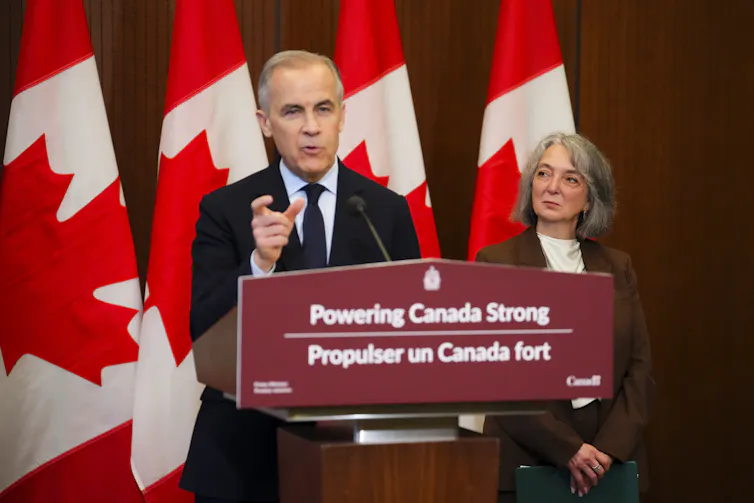
THE CANADIAN PRESS/Sean Kilpatrick
The need for committed leadership
Many of the aforementioned structural barriers cannot simply be resolved through procedural reform unless Canada undergoes far more fundamental constitutional and institutional change, which isn’t likely.
The central challenge facing Canada today is therefore not regulatory design, but leadership. Will the prime minister and Liberal officials champion these reforms if they become politically costly? Will they make decisions that may prove unpopular — particularly among voters in seat-rich provinces like Ontario, Québec and British Columbia — defend those decisions publicly and deal with the political consequences?
The government’s discussion paper is ambitious, but ambition on paper isn’t the same as execution. Reforms of this scale will face resistance from provinces, courts, advocacy groups and the bureaucracy itself. Success will depend less on design than on whether the federal government remains committed throughout implementation.
Becoming an energy superpower requires sustained political resolve, institutional drive, strength of character and the ability to stick to decisions under pressure without backing away or reframing them. Political will can create the appearance of reform; strength of character determines whether it’s actually carried out.
Short-term heat for long-term gain
For Canada’s regulatory reform to work, federal leaders need to stick to tight timelines even when faced with lawsuits and provincial pushback. Without that commitment, new bodies like the Federal Review Coordinator and Crown Consultation Hub could end up adding process rather than speeding up approvals.
As Nelson Mandela’s example shows, long-term national goals often require taking political heat in the short term.
The real question is no longer whether the problems are understood — they are — but whether the federal government has the resolve to push through resistance from provinces, the bureaucracy and political opponents.
Without that kind of sustained leadership, these proposed reforms risk becoming another set of well-meaning changes that add co-ordination but don’t meaningfully speed up energy development.