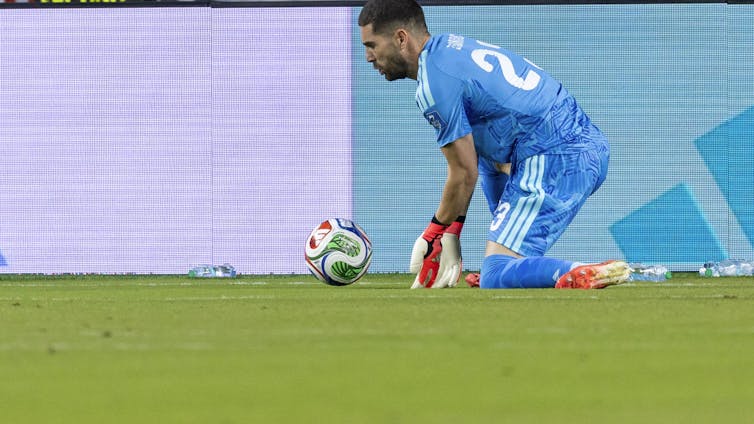
Not every World Cup goal is a classic. Sometimes a half-hearted shot goes in as a result of little more than goalkeeper error. And on those occasions, goalies may be inclined to find an excuse.
During the 2026 tournament, some members of what is jokingly referred to as the “goalkeepers’ union” have pointed toward the performance of the ball. Joe Hart, a former England goalkeeper and serving BBC pundit, noted after one blunder: “The ball is coming into the keepers a lot faster than it feels when it comes off the foot.”
But are his concerns justified? The Conversation turned to John Eric Goff, who has been studying the physics of World Cup balls for two decades and previously wrote about what to expect from the Trionda ball being used at the 2026 FIFA World Cup.
What did your lab tests predict?
Colleagues of mine at the University of Tsukuba in Japan took the World Cup ball, put a little hole in it, stuck it on a rod, attached force sensors and then set it up in a wind tunnel to obtain all kinds of aerodynamic data. They sent that data to me to look at what the trajectory modeling for the ball suggested about how it would perform in comparison to its predecessors.
Central to the performance is the airflow around the ball and how it changes as the speed of the ball increases. For the Jabulani ball used in the 2010 World Cup, for example, this airflow change happened at a speed that was right in the middle of typical free kicks and corner kicks. That caused problems for goalkeepers, as it moved in the air unpredictably as a result.
Among the recent World Cup balls we tested, Trionda has the lowest critical speed at which that airflow change takes place. That led us to predict free kicks and corner kicks with fairly consistent, stable flight.
But we also found that Trionda’s drag coefficient was slightly larger than that of its predecessors, which implied a slightly rougher surface. So there was a possible trade-off; it might fall a couple of meters short.
Has the real pitch experience followed those predictions?
It has depended a little on conditions. Take the Mexico vs. England game at Estadio Azteca in Mexico City, which took place at high elevation.
That meant the ball had less air drag on it, so it could actually go farther than it would when kicked with the same launch speed in lower-altitude conditions. It also meant that because the sideways, or Magnus forces, are proportional to air density, it would curve less.
During the England vs. Mexico game, what I noticed, especially early on, was many of England’s kicks tended to go a little long. They would kick the ball down the pitch in those first 20 minutes and it would be just out of reach of teammates.
The sense I got was they weren’t quite adjusting for the higher elevation and lower air density.
Some have questioned the flight. Do they have a point?
I have heard the complaints by former England goalkeeper Joe Hart about the ball. But I haven’t heard a whole lot of detail about the substance of those complaints.
In other words, I’ve heard about the ball not being their favorite, but not why. The scientist in me really wants to interview a goalkeeper and find out: “Do you think it’s moving in erratic ways? Or is it something to do with the color scheme that’s flummoxing you on the pitch?”
Bob Kupbens/Icon Sportswire via Getty Images
I think goalkeepers are always going to complain about a new ball. But the Nike Flight, which was used in the 2024-25 English Premier League season, has an aerodynamic profile most similar to that of the current World Cup ball. So players who used that ball might already be somewhat familiar with the motion of Trionda.
As far as I can tell, the ball appears to be flying in ways that not only we predicted but that don’t look completely out of touch with what players would have seen with other balls.
As the World Cup has progressed, I’ve been watching the ball come in toward the goalkeepers, and it could be that the reds, blues and greens twirling in front of the goalkeepers’ eyes are confusing them.
There’s been talk of more long-range goals. Is the ball playing a role?
I have read there are more goals coming from farther out than in previous World Cups. But I don’t know if I could attribute it specifically to the ball.
It’s possible, of course. But I would really have to see what the actual number is and see what the percentage increase has been, because, for a sport like soccer where you only get two or three goals in a match, the sample size is so small.
It would certainly be a very interesting research question to pursue. But I don’t think the ball alone can be credited for these longer-range goals.
Overall, how has this ball performed?
I think the ball has been fine. It is an attractive ball, with the colors of the original version representing the three host countries – all of whom are now out of the tournament, so it didn’t bring them much luck, unfortunately.