
Elon Musk’s SpaceX has been authorised to launch 1 million satellites into orbit to establish AI data centres, despite potentially severe environmental consequences. The scale of the proposed constellation will require a huge increase in rocket launches, while the satellites themselves will eventually burn up in the atmosphere when they stop being useful.
In fact, pollution from burning satellites could soon dwarf meteorites as the biggest source of material entering Earth’s upper atmosphere. This will fundamentally change the chemistry of one of the last remaining largely natural parts of the planet. Yet there is very little information in SpaceX’s original filing to allow a comprehensive assessment of the environmental impact.
The 1 million satellites that SpaceX plans to launch into already congested low-Earth orbit is orders of magnitude more than the roughly 12,000 operating in orbit at the end of 2025. Sending them into space would require the number of rocket launches to increase from just shy of one per day currently to 10-20 each day.
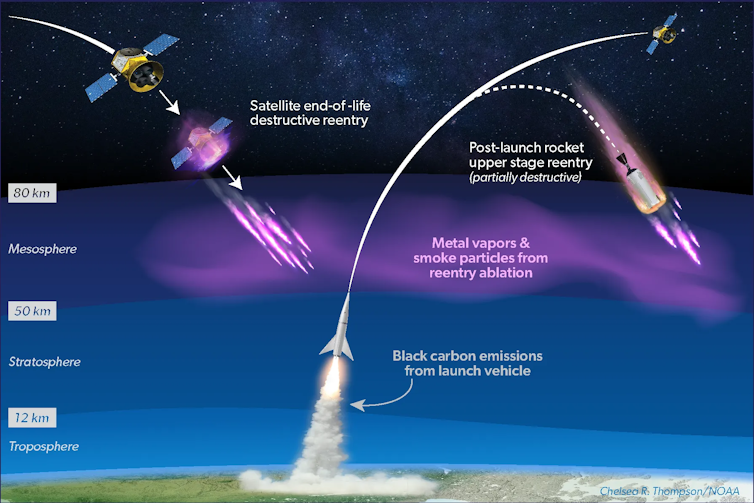
Rockets burn large amounts of fuel, producing chemicals that are released into all layers of the atmosphere. Many of these satellites will also need to be discarded at the end of their three to five year operational lifetime.
NOAA CSL
Satellites are decommissioned at the end of their lives so they don’t become space junk. The upper atmosphere acts like an incinerator, burning up satellites into the original fundamental chemical compounds that they are made of. This is currently the main way to dispose of satellites safely, preventing debris from reaching the ground or accumulating in orbit.
The pollutants produced are too small to be visible to the naked eye, but are potentially very harmful to the atmosphere, especially at the scale SpaceX is planning. A major concern is the ozone layer that protects us from harmful ultraviolet radiation from the sun. The ozone layer is slowly recovering following the Montreal Protocol, a 1987 international treaty that phased out ozone-depleting substances.
But many of the airborne pollutants from rockets and burning satellites can also destroy ozone, potentially undermining this progress. Rocket launch pollution isn’t regulated under the Montreal Protocol.
Pollutants from rockets and satellite re-entries can also affect the climate, either by reducing the amount of sunlight that reaches the surface of the Earth, a bit like geoengineering proposals to inject reflective particles into the upper atmosphere, or by trapping heat in the atmosphere, like greenhouse gases. Climate change could in turn speed up the chemical reactions that destroy ozone and alter large-scale air circulation patterns, further disrupting the ozone layer.
A fundamental shift in the upper atmosphere
It’s not yet possible to do a comprehensive environmental impact assessment of the million satellite plans, but my colleague Connor Barker and I have assessed what we can, with the limited information available. A study we have submitted for peer review to the journal Earth and Space Chemistry determined that material released by re-entering satellites could far surpass natural inputs from meteorites. This would fundamentally shift the chemistry of one of the last remaining chemically-natural regions of the Earth system to one predominantly influenced by humans.
Pollutants released into the upper atmosphere don’t stay there forever. Within about two or three years they make their way back to Earth, as air currents deposit them in the Arctic and Antarctic during their respective winters. Many of the metals are toxic, like arsenic, lead, cadmium, and chromium. But it is impossible to estimate how much of these and other metals could eventually reach Earth’s surface because SpaceX’s filing does not include any information about the materials that might be used to make the satellites.
Environmental costs down on Earth
More frequent rocket launches will also increase air pollution near spaceports, affecting people living nearby. If SpaceX succeeds in establishing a launch base in Louisiana, this could worsen the already severely unequal exposure to air pollution in the state.
The Starship rockets that will presumably launch the data centres to space use liquid methane fuel. According to SpaceX, some of this methane leaks to the atmosphere when fuelling the rocket engines and when the reusable rocket stages return to base with unburned fuel. At the launch rates needed for a million satellites, these leaks could rival those from major oil and gas extraction basins in the US. Methane is a powerful greenhouse gas, so this would add significantly to the climate impact of the project.
SpaceX had previously said that it takes these concerns “very seriously” and that environmental impacts could be studied as the satellites are rolled out. But in September the US Federal Communications Commission (FCC) adopted new rules exempting space-based operations from environmental review. And in approving SpaceX’s million-satellite proposal, the FCC said it would not require further environmental review, arguing that concerns over atmospheric impacts “remain speculative”.
It is of great concern that orbital data centres of this scale are approved by national regulators, leaving future generations to deal with the environmental consequences. Greater international oversight is urgently needed to ensure these potential impacts are properly assessed before a project like this is deployed, rather than after the damage may have been done.