
I used to teach high school science in Oklahoma, and one day I brought in a stalk from a cotton plant with bolls of cotton still attached. Students asked me why I glued cotton balls to a stick.
My students and I lived in a rural town surrounded by pastures of cattle and goats and fields of wheat, soybeans and cotton. I was amazed to learn how little my students understood agriculture. After a few related incidents, I started incorporating agriculture into my science classes.
When the United States was formed, about 80% of the population lived and worked on farms. Within a century the number had fallen to 40%. Today, less than 2% of the population lives on farms.
When most Americans lived on farms, agriculture was part of daily life. Most kids did farm chores, and planting and harvest seasons dictated the schedule of the school year. Today, most Americans are several generations removed from agriculture, and agriculture is seen as a career instead of a part of daily life.
As an agricultural extension specialist focused on horticulture, I’ve found that gardens can be an excellent teaching tool. By integrating gardens into schools, students can grow up learning about agriculture and the food systems that shape their daily lives.
Many researchers have cataloged the benefits of school gardens, and they go far beyond seeing how food grows.
Gardening for education
As people increasingly left the farms in the early 1900s and became disengaged from agriculture, a gap began to emerge between the public’s perception of farming and the nuts and bolts of the practice. In 1981, the U.S. Department of Agriculture created a task force to address agriculture illiteracy. This task force resulted in the formation of the National Agriculture in the Classroom program, which provides educators with lessons and tools to improve students’ understanding of raising farm animals and crops, including gardening.
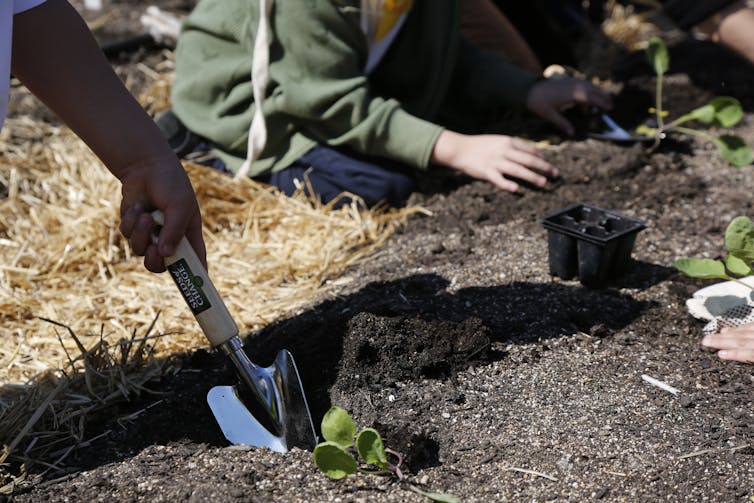
Gardening also has benefits beyond agricultural literacy. For very young children, gardening increases hand-eye coordination, which is linked to success in handwriting, math and reading. Gardening, instead of sitting in a classroom, increases students’ physical activity during the school day.
Ross Dettman/AP Images for Seeds of Change
During a typical indoor class, children sit about 84% of the time. While in the garden, children sit only about 15% of the time.
Getting outside and doing hands-on learning is more engaging than sitting in a classroom passively learning by lecture, because active learning engages more regions of the brain, resulting in better understanding and retention of concepts. Active learning also allows students to follow their own curiosity, which motivates them to learn and remember concepts.
A study showed that allowing more individual freedom in gardens led to an increase in positive attitudes toward school. Children involved in school gardening are also more active outside of school hours.
While working in a garden, students are involved with science and nature, and that involvement leads to more science literacy and positive attitudes toward science and the environment.
Gardening is, in essence, a science experiment with variables, such as water, temperature and sun exposure. Each variable has an effect on the success of the garden. Manipulating the variables and seeing the resulting consequences boosts students’ science process skills.
Gardening fosters life skills, such as teamwork, patience, self-confidence and responsibility.
School gardening also promotes an increase in vegetable consumption. If students grow something, they’re more likely to eat it.
Challenges with school gardens
However, establishing and maintaining a school garden program isn’t easy.
Many teachers feel they don’t have the time or funding to use gardening in their teaching, especially when their districts set goals based on test performance.
Many teachers also report they don’t feel confident enough in their understanding of gardening to teach it effectively.
Gardens don’t have to be flashy or expensive to help students learn, but they still cost some money that schools may not have. Space can also prove an issue, because some school administrators see even tiny gardens in 5-gallon buckets as encroaching on their schools’ playgrounds.
Aesthetics can create another hurdle. Many administrators whom I’ve spoken to think school gardens are messy, and rightfully so. Often they have weeds, they don’t look well manicured like a botanical garden, and a lot are neglected during the summer.
But that messiness is how students learn. Students grow their skills when they have the freedom to experiment with different gardening techniques, see how much room different plants need to grow, and determine what variables they will have to rethink for the next growing season.
If volunteers or teachers visit after the students and clean up or fix their mistakes, the students don’t see the outcomes of their decisions, and they don’t see any reason to change the inputs or growing methods.
Through gardening, students can gain an appreciation for farmers and their food supply. When coupled with lessons about agricultural systems, students learn to make informed food purchases and better understand the economic and political challenges that farmers face.
And nothing beats a garden-grown tomato.