Ahead of the 81st session of the United Nations General Assembly, which opens Sept. 8, people across 37 countries view the UN more favorably than unfavorably. However, views in some countries have turned more negative in recent years.
Views of the UN across 37 countries tend to be more positive than negative
% who have a(n) __ opinion of the United Nations

Note: Those who did not answer are not shown.
Source: Spring 2026 Global Attitudes Survey
PEW RESEARCH CENTER
Views of the UN across 37 countries tend to be more positive than negative
% who have a(n) __ opinion of the United Nations
| Country | Region | Unfavorable | Favorable |
|---|---|---|---|
| Canada | North America | 32 | 65 |
| U.S. | North America | 43 | 54 |
| Sweden | Europe | 24 | 74 |
| Germany | Europe | 32 | 66 |
| U.K. | Europe | 33 | 65 |
| Poland | Europe | 29 | 60 |
| Netherlands | Europe | 35 | 60 |
| Italy | Europe | 38 | 60 |
| Hungary | Europe | 29 | 59 |
| France | Europe | 43 | 51 |
| Spain | Europe | 48 | 47 |
| Greece | Europe | 50 | 43 |
| Indonesia | Asia-Pacific | 27 | 72 |
| Thailand | Asia-Pacific | 28 | 67 |
| Philippines | Asia-Pacific | 29 | 67 |
| Sri Lanka | Asia-Pacific | 14 | 66 |
| South Korea | Asia-Pacific | 35 | 61 |
| Singapore | Asia-Pacific | 42 | 57 |
| Malaysia | Asia-Pacific | 43 | 57 |
| Australia | Asia-Pacific | 44 | 55 |
| Bangladesh | Asia-Pacific | 35 | 53 |
| India | Asia-Pacific | 18 | 40 |
| Pakistan | Asia-Pacific | 48 | 38 |
| Japan | Asia-Pacific | 59 | 36 |
| Turkey | Middle East | 61 | 32 |
| W. Bank/E. Jerusalem | Middle East | 69 | 20 |
| Israel | Middle East | 79 | 18 |
| Kenya | Africa | 26 | 72 |
| Ghana | Africa | 22 | 64 |
| Nigeria | Africa | 24 | 63 |
| South Africa | Africa | 38 | 49 |
| Colombia | Latin America | 31 | 55 |
| Peru | Latin America | 37 | 48 |
| Mexico | Latin America | 43 | 48 |
| Brazil | Latin America | 37 | 47 |
| Chile | Latin America | 45 | 38 |
| Argentina | Latin America | 38 | 36 |
| 37-country median | 37 | 55 |
Note: Those who did not answer are not shown.
Source: Spring 2026 Global Attitudes Survey
PEW RESEARCH CENTER
A median of 55% have a favorable opinion of the UN, according to a spring Pew Research Center survey. A median of 37% have an unfavorable opinion.
About half of adults or more in Canada, the United States and most European countries surveyed have a positive view of the UN. Opinions are also generally more favorable than unfavorable across 12 Asia-Pacific nations. In India, favorable views are about twice as common as unfavorable views, though 41% do not offer an opinion.
People in Kenya, Ghana, Nigeria, South Africa, Colombia, Peru and Brazil also see the UN in a more favorable than unfavorable light.
Opinions are more mixed in Spain, Mexico, Chile and Argentina.
People view the UN more unfavorably than favorably in Pakistan, Greece, Japan, Turkey, the West Bank and East Jerusalem, and Israel.
Israelis have the most negative opinion of the UN in the survey: 79% see the organization unfavorably. But there are significant differences by ethnicity, with Israeli Jews reporting much more negative views than Israeli Arabs (87% vs. 50% unfavorable).
Related: 8 in 10 Israelis view United Nations unfavorably
Views of the UN over time
Favorable views of the UN are down in 10 countries over the past few years
% who have a favorable opinion of the United Nations
Note: Only statistically significant decreases are shown.
Source: Spring 2026 Global Attitudes Survey.
PEW RESEARCH CENTER
Favorable views of the UN are down in 10 countries over the past few years
% who have a favorable opinion of the United Nations
| Country | % fav in 2024 | % fav in 2025 | % fav in 2026 | Difference |
|---|---|---|---|---|
| Nigeria | – | 80 | 63 | 17 |
| Philippines | 83 | – | 67 | 16 |
| South Korea | – | 74 | 61 | 13 |
| Thailand | 77 | – | 67 | 10 |
| Peru | 58 | – | 48 | 10 |
| Australia | – | 63 | 55 | 8 |
| South Africa | – | 57 | 49 | 8 |
| Ghana | 71 | – | 64 | 7 |
| France | – | 57 | 51 | 6 |
| U.S. | – | 57 | 54 | 3 |
Note: Only statistically significant decreases are shown.
Source: Spring 2026 Global Attitudes Survey.
PEW RESEARCH CENTER
Views of the UN have become more negative in 10 countries since we last asked this question. For example, 80% of Nigerians had a favorable view of the UN in 2025, compared with 63% in 2026. And the share of Filipinos with a favorable view decreased by 16 percentage points between 2024 and 2026.
In South Korea, the share of adults with a favorable view of the organization in 2026 is the lowest we have measured since our surveys began there in 2007. In the U.S., the share has decreased by 3 points since 2025.
In some countries, the share with a favorable opinion has not shifted much over the past year but is down from relatively favorable ratings in 2020 or 2021 – during the COVID-19 pandemic. In France, for example, 51% of adults today view the UN positively, down from 63% in 2021. We also observed this in the Netherlands and Sweden, as well as in Singapore, where our favorability data only goes back to 2021.
Views of the UN improved in only one country surveyed: Sri Lanka. About two-thirds of Sri Lankans (66%) now view the UN favorably, up from 58% when we last surveyed there in 2024.
Views by age
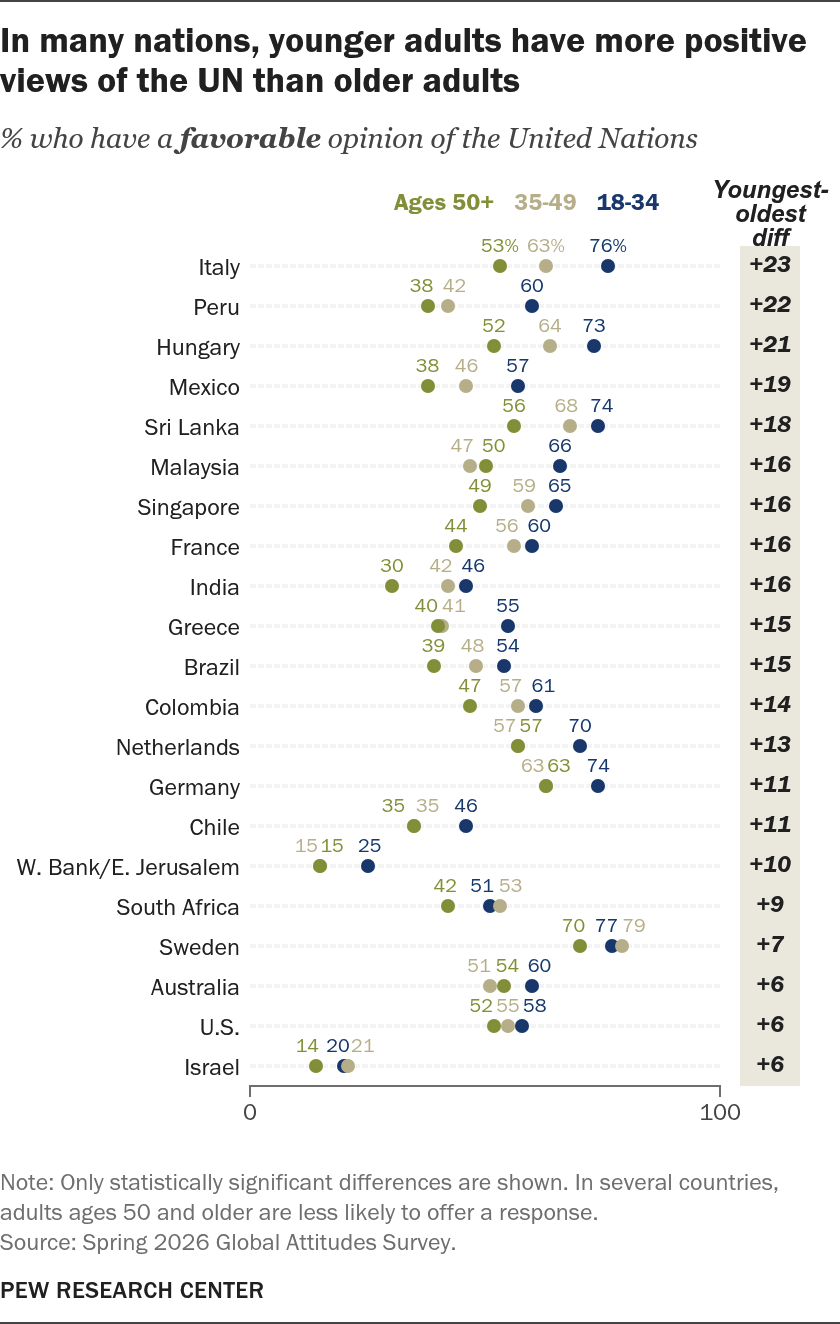
In many nations, younger adults have more positive views of the UN than older adults
% who have a favorable opinion of the United Nations
Note: Only statistically significant differences are shown. In several countries, adults ages 50 and older are less likely to offer a response.
Source: Spring 2026 Global Attitudes Survey.
PEW RESEARCH CENTER
In many nations, younger adults have more positive views of the UN than older adults
% who have a favorable opinion of the United Nations
| Country | 18-34 | 35-49 | 50+ | Youngest-oldest diff |
|---|---|---|---|---|
| Italy | 76 | 63 | 53 | 23 |
| Peru | 60 | 42 | 38 | 22 |
| Hungary | 73 | 64 | 52 | 21 |
| Mexico | 57 | 46 | 38 | 19 |
| Sri Lanka | 74 | 68 | 56 | 18 |
| Malaysia | 66 | 47 | 50 | 16 |
| Singapore | 65 | 59 | 49 | 16 |
| France | 60 | 56 | 44 | 16 |
| India | 46 | 42 | 30 | 16 |
| Greece | 55 | 41 | 40 | 15 |
| Brazil | 54 | 48 | 39 | 15 |
| Colombia | 61 | 57 | 47 | 14 |
| Netherlands | 70 | 57 | 57 | 13 |
| Germany | 74 | 63 | 63 | 11 |
| Chile | 46 | 35 | 35 | 11 |
| W. Bank/E. Jerusalem | 25 | 15 | 15 | 10 |
| South Africa | 51 | 53 | 42 | 9 |
| Sweden | 77 | 79 | 70 | 7 |
| Australia | 60 | 51 | 54 | 6 |
| U.S. | 58 | 55 | 52 | 6 |
| Israel | 20 | 21 | 14 | 6 |
Note: Only statistically significant differences are shown. In several countries, adults ages 50 and older are less likely to offer a response.
Source: Spring 2026 Global Attitudes Survey.
PEW RESEARCH CENTER
In many places, young adults view the UN more favorably than older people do. This is a consistent pattern we have observed in previous surveys. For example, 76% of Italians ages 18 to 34 have a favorable view of the UN, compared with 53% of those ages 50 and older.
Even in Israel and the West Bank and East Jerusalem – where we measure very unfavorable opinions of the UN – young people have more positive views of the organization than older adults do.
Views by ideology
In some countries, people on the ideological left tend to feel more favorably toward the UN than those on the ideological right. The divide is consistently wide in the U.S., where 76% of liberals and 35% of conservatives currently express a favorable view.
There are similar gaps between people on the left and right in Australia, Canada, Germany, Israel, the Netherlands, Poland, Sweden, Turkey and the United Kingdom.
Related: How the United Nations is funded, and who pays the most