
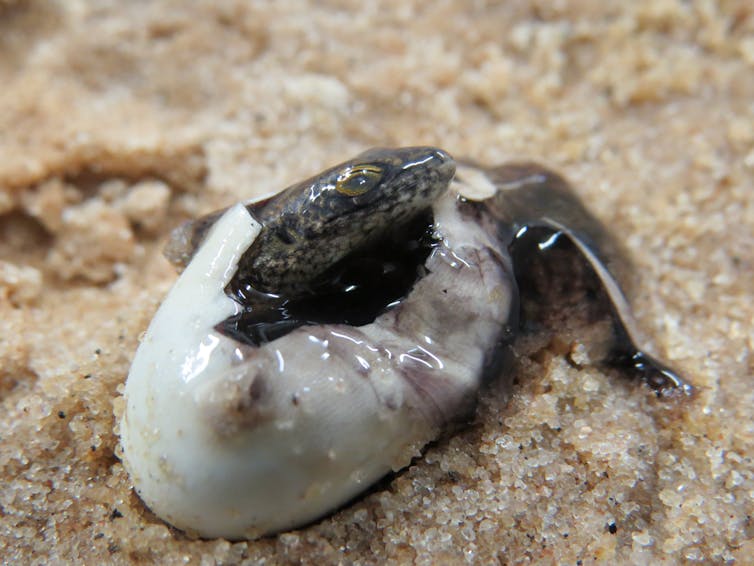
Visitors to the Fernando de Noronha archipelago, located about about 340 miles (545 kilometers) off the coast of Pernambuco in northeastern Brazil, soon notice a small lizard. Seemingly ubiquitous, it roams among rocks, trails, and urbanized areas, approaching people and stealing food in plain sight when it can, and rarely flees.
This animal is the Noronha skink (Trachylepis atlantica), a species found exclusively in this archipelago in the Atlantic Ocean.
By studying its reproduction in detail, we discovered that it exhibits one of the slowest reproductive strategies known among its relatives. This strategy likely evolved over a long evolutionary history in an island environment, but it may now become a problem in a rapidly changing world.
A Brazilian of African origin
At first glance, the Noronha skink may seem like just another tropical lizard. But its evolutionary history is unusual. Its closest relatives belong to a lineage of African origin. How, then, did this lineage end up isolated on a small Brazilian island in the middle of the Atlantic?
The most widely accepted explanation is that the species’ ancestors reached the South Atlantic by floating on masses of vegetation carried by ocean currents. This journey may not have taken place in a single direct crossing to Fernando de Noronha, but in stages, possibly via paleo-islands, which existed in past geological eras, that are now submerged.
Once established in the archipelago, these lizards remained isolated — likely for millions of years — and came to live under conditions very different from those found on the African continent.
Islands as natural laboratories of evolution
Oceanic islands are often called “natural laboratories of evolution.” Because they are small and isolated, they generally harbor fewer species than continental environments. This profoundly alters ecological interactions.
Often, there are fewer predators and fewer competitors from other species. At the same time, populations that manage to colonize the island can reach high densities.
This set of conditions can favor the emergence of the so-called “island syndrome”, an evolutionary pattern that affects aspects such as behavior, body size, diet, physiology, and reproductive strategies.
Fewer offspring can be advantageous
In continental environments, many animals have short life spans because of predators and other risks. In these contexts, producing many offspring increases the chance that at least some will survive.
On ocean islands, however, the scenario is often different. With less pressure from predators and often dense populations, competition for resources tends to be intense among individuals of the same species. Under these circumstances, investing more energy in fewer offspring can be advantageous. Larger offspring may have a better chance of competing for food and space in crowded environments. It was precisely this reproductive pattern that we found in the Noronha skink.
What we discovered about the Noronha skink
To understand the species’ reproductive strategy, we studied individuals collected in the field, specimens preserved in scientific collections, and specimens from zoos.
The pattern that emerged was clear. Reproduction occurs during a relatively narrow period of the year, in the dry season. Not all females reproduce annually: our data suggest that many reproduce only every two or even three years. When they do, they produce only two eggs at a time — a very low number for lizards in this group. These eggs, however, are large relative to the mother’s body size, indicating a high investment in each offspring.
Compared to related species on the African mainland and larger islands, the combination of a small number of larger eggs and low reproductive frequency concentrated in a short period of the year is unusual. This is the type of reproductive adaptation expected for species shaped by conditions typical of ocean islands.
In Noronha, this strategy may have been favored through a combination of less pressure from predators, high population density, and resource seasonality. There, food availability varies throughout the year and can influence when and how much the animals are able to invest in reproduction.
Changes on the island and the future of the species
For much of its evolutionary history, the Noronha skink likely lived in a relatively stable environment with lower predation pressure. Under these conditions, investing in a few larger offspring may have been a successful strategy.
The problem is that evolutionary adaptations reflect the past. They do not prepare species for rapid changes.
With human settlement, Fernando de Noronha began to harbor introduced predators, such as herons, domestic cats, rats, and the large invasive lizard known as “Teiú”. In addition, the environment has undergone changes associated with urbanization and a growing human population.
Species with “rapid” reproduction tend to recover more easily from population declines. In contrast, species that produce few offspring at long intervals have less leeway to compensate for sudden losses. Thus, the same reproductive strategy that was advantageous in the past, when adult mortality was lower, may now make the Noronha skink less resilient in the face of new threats.
In our study, for example, one of the few pregnant females found had been hit by a car, illustrating how new pressures can affect even seemingly abundant populations.
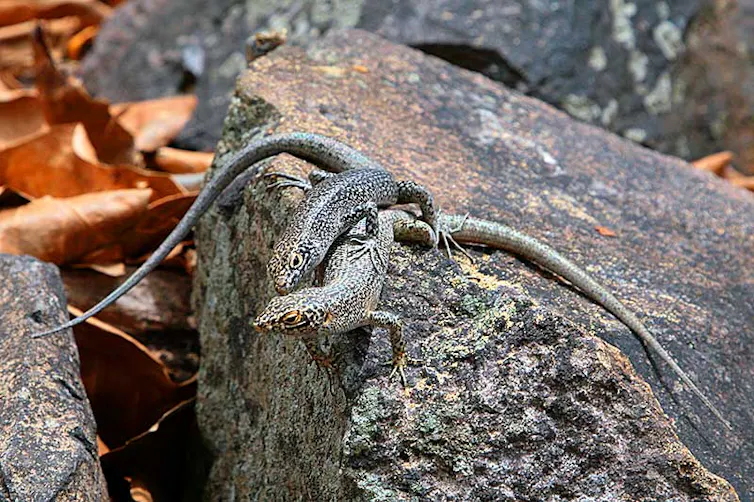
None of this means that the species is necessarily at immediate risk. However, understanding how it lives and reproduces is essential for interpreting its ecological status and guiding conservation efforts when necessary.
The Noronha skink demonstrates how isolated environments can profoundly shape a species’ biology. In this case, the combination of fewer but larger eggs and infrequent reproduction offers a clear example of how island life can transform reproductive behavior. It also highlights how adaptations that were advantageous in the past can become vulnerabilities in the present.