
After months of gas industry pushback, the federal government has made sensible changes to its much-vaunted gas reservation policy.
Instead of forcing gas exporters to supply 20% of their export volumes to the domestic market, they will be made to supply “up to” 20%, with the precise amount set each year based on domestic demand. These details are in the newly released draft legislation.
This has been seen as a concession in the face of an intense industry backlash. But it’s not a concession at all – this is how the scheme was originally designed to work.
As I argued in July, the 20% figure was always a ceiling, not a floor. Both supply of and demand for gas will fluctuate over time, and the resources minister needs to be able to respond to that.
The scheme lets the minister decide how much gas to reserve each year, up to the cap, based on the market’s needs. Even Australia’s gas and oil peak body calls that “sensible”.
But there are still big questions over key elements of the design.
Suriyapong Thongsawang/Getty
A carve-out for one producer?
One especially controversial element of the scheme is the minister’s power to reduce domestic gas obligations for individual companies.
This rule has divided the industry because one of the three east-coast exporters – GLNG – is unique in having signed contracts to export vastly more gas than it plans to produce until at least 2036.
Under the proposed law, the minister can reduce obligations on an individual company if meeting their obligations would require them to break their export contracts and if they are taking “active steps” to try to deliver domestic gas.
How this power is exercised in practice remains to be seen. The minister could use it to effectively exempt GLNG – or another producer – from domestic gas obligations.
An oversupplied market?
The government has not budged on a key element of its design: its supposed aim to push down prices by engineering a “modest oversupply” of gas.
Despite initially supporting the gas reservation, in recent months, domestic-only gas producers have pulled their support for the scheme over this proposal.
Their concern is that forcing an oversupply of gas into the market would force gas companies to sell gas below cost, making production unviable. This concern is not unfounded.
But again, the proposed legislation offers little clarity on what will actually happen in practice.
The minister will have the power to set the “oversupply” percentage each year somewhere between 0% and 10% of demand. In an east coast market using about 450 petajoules, that represents a huge range – anywhere from zero to 45 petajoules.
The government should cap this at 5% and codify how it will be set each year.
A truly national scheme?
The proposed gas reservation will really be two separate schemes – one for the east coast and one for the west. This is because the two systems are not physically connected and because Western Australia has long had its own scheme.
The obligations for each exporter will be set based on the demand in their system, not the nation as a whole. No one will be made to ship gas between coasts.
But in the hours since the draft legislation was released, the resources lobby in WA has rejected the goverment’s push to include the west. This is because the national scheme would be much stricter than the state’s scheme and would likely force WA exporters to deliver more domestic gas, more often.
Whether WA escapes the new tougher rules remains to be seen. Under the proposed rules, the federal resources minister can decide to reduce domestic gas obligations in recognition of existing state policies. This gives the minister carte blanche to exempt WA – or not. No one has any idea which way that decision will go.
A driver of decarbonisation?
The reservation law specifies that extracting gas from the ground is not the only way exporters can meet their domestic gas obligations.
First, they can also produce renewable gases such as biomethane, which can be collected from food waste or wastewater. Biomethane offers a critical way for many manufacturing businesses to decarbonise. Australia produces almost no biomethane at present. If the reservation policy creates demand for biomethane, it could accelerate this critical new industry.
Second, gas exporters can use demand reduction to meet their legal requirements. For example an exporter could fund a manufacturing business to electrify a gas boiler, permanently reducing demand for gas.
Designed right, the reservation could be a driver, not a dampener, on the shift to clean energy.
What problem is this meant to solve, again?
Gas is in structural decline in Australia.
The use of gas to generate electricity in the National Electricity Market has fallen by two-thirds over the past decade. Demand for gas on Australia’s east coast fell 6% last year alone – largely due to big batteries pushing out gas peaking plants. The number of households using gas for cooking and heating is now shrinking.
Despite declining demand and bountiful supplies of gas, Australia still risks running short. The energy market operator is still warning of looming shortfalls on both the east and west coasts.
In part, this is because traditional east coast supplies – the Bass Strait gas fields – are close to empty. But a bigger reason is the fact that 80% of all gas produced in Australia is exported.
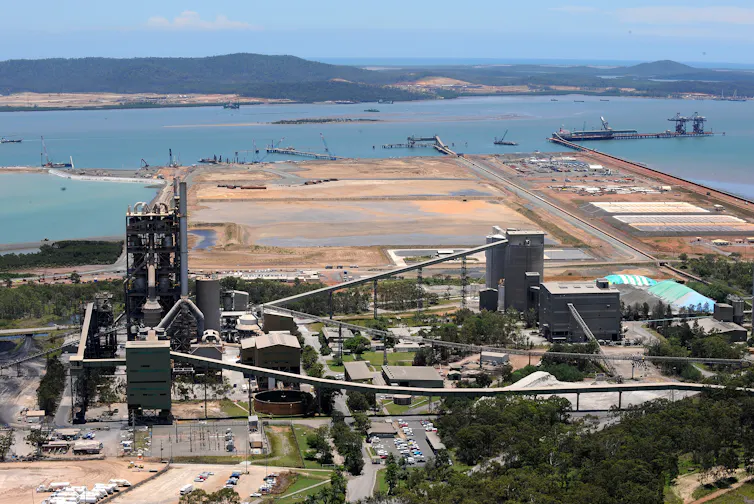
East coast gas exports only really began in 2015 when three giant LNG export plants opened on Curtis Island, near Gladstone in Queensland.
Because they can attract much higher prices selling gas to international customers, exporters have strong financial incentives to export gas instead of selling it to domestic customers.
So the goal of the gas reservation is a to deliver enough gas to avoid shortfalls, and keep prices low, without slowing the phase out of gas in Australia.
Dave Hunt/AAP
Is this a good outcome?
The government has framed these laws as sensible. This is largely correct.
They will let the government of the day ensure the domestic market is well supplied without risking heavy-handed intervention that could tank the industry.
Whether it works or not will comes down to how the minister of the day chooses to use it. With the scheme not due to start until 2028, we may still have a long wait to find out.