

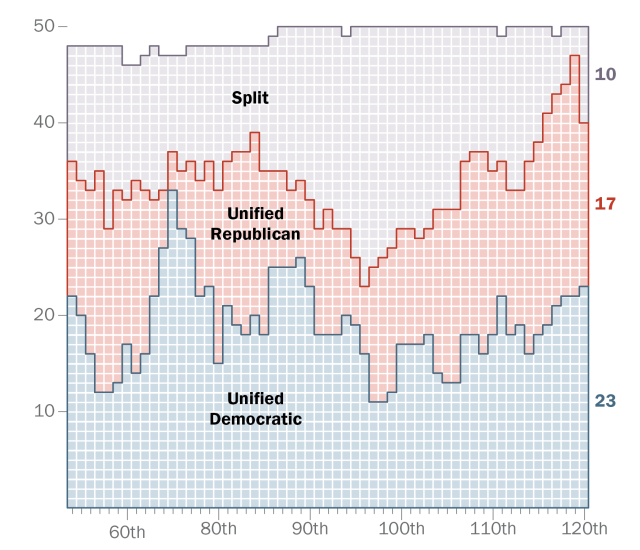
Another result of the Democratic wave that washed over the 2026 midterm elections: More states will have split U.S. Senate delegations than at any time since 2019.
New Congress will be first since 2013 with more all-Democratic Senate delegations than all-Republican
Number of states with unified or split delegations, by each Congress
Note: Figures are as of the start of each Congress. Third-party and independent senators are counted with the major party they caucus with, if any. Numbers may vary during the term of a given Congress because of disputed elections, temporarily vacant seats and other factors.
Source: Pew Research Center analysis of the Biographical Directory of the United States Congress.
PEW RESEARCH CENTER
New Congress will be first since 2013 with more all-Democratic Senate delegations than all-Republican
Number of states with unified or split delegations, by each Congress
| Congress | Unified Democratic | Unified Republican | Split |
|---|---|---|---|
| 64th | 22 | 14 | 12 |
| 65th | 20 | 14 | 14 |
| 66th | 16 | 17 | 15 |
| 67th | 12 | 23 | 13 |
| 68th | 12 | 17 | 19 |
| 69th | 13 | 20 | 15 |
| 70th | 17 | 15 | 14 |
| 71st | 14 | 20 | 12 |
| 72nd | 16 | 17 | 14 |
| 73rd | 22 | 10 | 16 |
| 74th | 27 | 6 | 14 |
| 75th | 33 | 4 | 10 |
| 76th | 29 | 6 | 12 |
| 77th | 28 | 8 | 12 |
| 78th | 22 | 12 | 14 |
| 79th | 23 | 13 | 12 |
| 80th | 15 | 18 | 15 |
| 81st | 21 | 15 | 12 |
| 82nd | 19 | 18 | 11 |
| 83rd | 18 | 19 | 11 |
| 84th | 20 | 19 | 9 |
| 85th | 18 | 17 | 13 |
| 86th | 25 | 10 | 14 |
| 87th | 25 | 10 | 15 |
| 88th | 25 | 8 | 17 |
| 89th | 26 | 8 | 16 |
| 90th | 23 | 9 | 18 |
| 91st | 18 | 11 | 21 |
| 92nd | 18 | 13 | 19 |
| 93rd | 18 | 11 | 21 |
| 94th | 20 | 9 | 20 |
| 95th | 19 | 7 | 24 |
| 96th | 16 | 7 | 27 |
| 97th | 11 | 14 | 25 |
| 98th | 11 | 15 | 24 |
| 99th | 12 | 15 | 23 |
| 100th | 17 | 12 | 21 |
| 101st | 17 | 12 | 21 |
| 102nd | 17 | 11 | 22 |
| 103rd | 18 | 11 | 21 |
| 104th | 14 | 17 | 19 |
| 105th | 13 | 18 | 19 |
| 106th | 13 | 18 | 19 |
| 107th | 18 | 18 | 14 |
| 108th | 18 | 19 | 13 |
| 109th | 16 | 21 | 13 |
| 110th | 18 | 17 | 15 |
| 111th | 22 | 14 | 13 |
| 112th | 18 | 15 | 17 |
| 113th | 19 | 14 | 17 |
| 114th | 16 | 20 | 14 |
| 115th | 18 | 20 | 12 |
| 116th | 19 | 22 | 9 |
| 117th | 21 | 22 | 6 |
| 118th | 22 | 22 | 6 |
| 119th | 22 | 25 | 3 |
| 120th | 23 | 17 | 10 |
Note: Figures are as of the start of each Congress. Third-party and independent senators are counted with the major party they caucus with, if any. Numbers may vary during the term of a given Congress because of disputed elections, temporarily vacant seats and other factors.
Source: Pew Research Center analysis of the Biographical Directory of the United States Congress.
PEW RESEARCH CENTER
When the 120th Congress convenes in early January, 10 states will each be represented by one Democrat and one Republican in the Senate. That’s more than at any time since the 115th Congress, which had 12 or 13 split delegations at various times in its 2017-18 term.
The new Congress also will be the first in 14 years with more unified Democratic delegations (23) than unified Republican (17).
Our analysis examines the composition of every Senate since the general election of 1914. That was the first Congress after ratification of the 17th Amendment, which provided for the direct election of senators.
The long view
It wasn’t that long ago that states like Arkansas, Louisiana and Nebraska routinely sent two Democratic senators to Washington, D.C., while Republicans won in states like Illinois, New York and Oregon. How and why did that change?
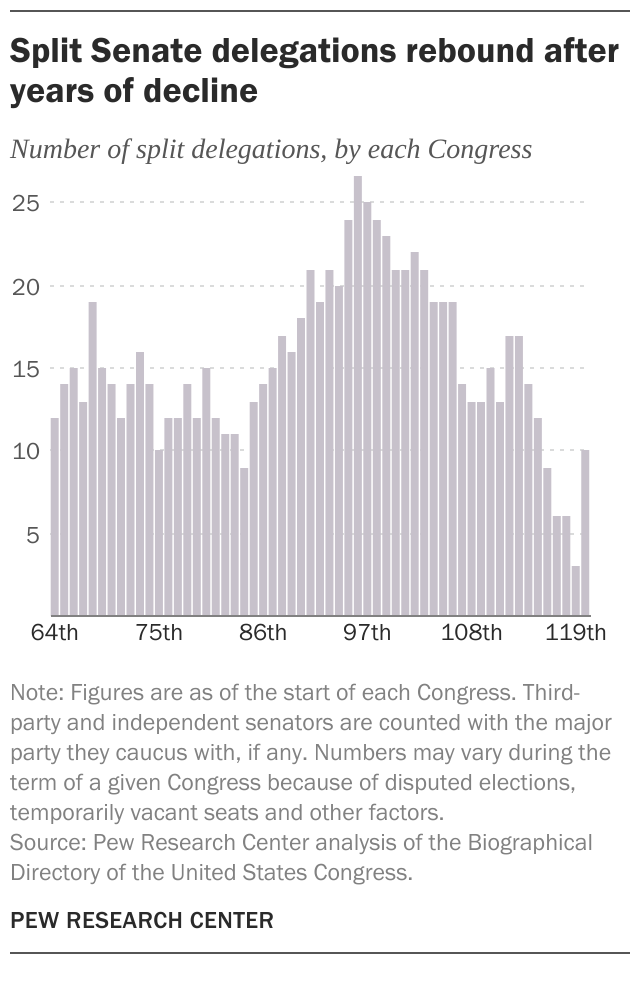
Split Senate delegations rebound after years of decline
Number of split delegations, by each Congress
Note: Figures are as of the start of each Congress. Third-party and independent senators are counted with the major party they caucus with, if any. Numbers may vary during the term of a given Congress because of disputed elections, temporarily vacant seats and other factors.
Source: Pew Research Center analysis of the Biographical Directory of the United States Congress.
PEW RESEARCH CENTER
Split Senate delegations rebound after years of decline
Number of split delegations, by each Congress
| Congress | Number of split Senate delegations |
|---|---|
| 64th | 12 |
| 65th | 14 |
| 66th | 15 |
| 67th | 13 |
| 68th | 19 |
| 69th | 15 |
| 70th | 14 |
| 71st | 12 |
| 72nd | 14 |
| 73rd | 16 |
| 74th | 14 |
| 75th | 10 |
| 76th | 12 |
| 77th | 12 |
| 78th | 14 |
| 79th | 12 |
| 80th | 15 |
| 81st | 12 |
| 82nd | 11 |
| 83rd | 11 |
| 84th | 9 |
| 85th | 13 |
| 86th | 14 |
| 87th | 15 |
| 88th | 17 |
| 89th | 16 |
| 90th | 18 |
| 91st | 21 |
| 92nd | 19 |
| 93rd | 21 |
| 94th | 20 |
| 95th | 24 |
| 96th | 27 |
| 97th | 25 |
| 98th | 24 |
| 99th | 23 |
| 100th | 21 |
| 101st | 21 |
| 102nd | 22 |
| 103rd | 21 |
| 104th | 19 |
| 105th | 19 |
| 106th | 19 |
| 107th | 14 |
| 108th | 13 |
| 109th | 13 |
| 110th | 15 |
| 111th | 13 |
| 112th | 17 |
| 113th | 17 |
| 114th | 14 |
| 115th | 12 |
| 116th | 9 |
| 117th | 6 |
| 118th | 6 |
| 119th | 3 |
| 120th | 10 |
Note: Figures are as of the start of each Congress. Third-party and independent senators are counted with the major party they caucus with, if any. Numbers may vary during the term of a given Congress because of disputed elections, temporarily vacant seats and other factors.
Source: Pew Research Center analysis of the Biographical Directory of the United States Congress.
PEW RESEARCH CENTER
From the 1910s until the late 1960s and early 1970s, there were typically anywhere from 10 to 20 split Senate delegations in any given Congress. There were just nine in the closely divided 84th Congress (1955-57), in which Democrats held a 49-47 majority thanks to independent-turned-Democrat Wayne Morse of Oregon.
Split delegations became more common in the ’60s and ’70s as longstanding political patterns (such as the Democratic “Solid South”) began to break down. By the 96th Congress of 1979-81, more than half the states (27) had split delegations, the highest share in the period we studied. From 1973 through 1994, there were never fewer than 20 split delegations in the Senate.
But since 1980, when the GOP won control of the Senate for the first time in a generation, the trend has been toward more and more single-party delegations. That’s happened as Americans have become more politically polarized and many long-serving senators have died or retired.
The dropoff in split delegations accelerated after the 113th Congress of 2013-15, when there were 17 (and for five months, 18). In the current Congress, which only has a few weeks left, only three states have split delegations.
As split delegations have grown scarcer, political scientists have explored the circumstances under which voters would choose senators of different parties to represent the same state. One suggestion is that some voters deliberately seek to balance their state’s delegation, though other researchers have not found support for that idea.
Other researchers have focused on diverse electorates as predictors of split delegations; argued for candidate-specific factors such as financing, campaigning skill and the presence or absence of scandal; or tied the ebb and flow of split delegations to broader partisan realignments.
Occasionally, states send pairs of senators to Washington who aren’t just from different parties, but so ideologically disparate that their votes all but cancel each other out.
Wisconsin Republican Ron Johnson, for example, is the 13th-most conservative senator in the current Congress, according to the widely cited DW-NOMINATE scoring system from the University of California, Los Angeles. His colleague, Democrat Tammy Baldwin, is the sixth-most liberal. Past examples include Minnesota’s Paul Wellstone and Rod Grams, North Carolina’s John Edwards and Jesse Helms, and California’s Alan Cranston and S.I. Hayakawa (Democrats and Republicans, respectively).
But even when senators from different parties disagree on most things, they sometimes can work together on matters of special interest to their state. In 2020, for example, Montana’s two senators, Republican Steve Daines and Democrat Jon Tester, collaborated on legislation to settle a decades-old water dispute between Montana’s Native tribes and the state and federal governments. And in 2006, Florida’s two senators, Democrat Bill Nelson and Republican Mel Martinez, teamed up on a bill to prohibit offshore oil and gas drilling off their state’s Gulf Coast.