
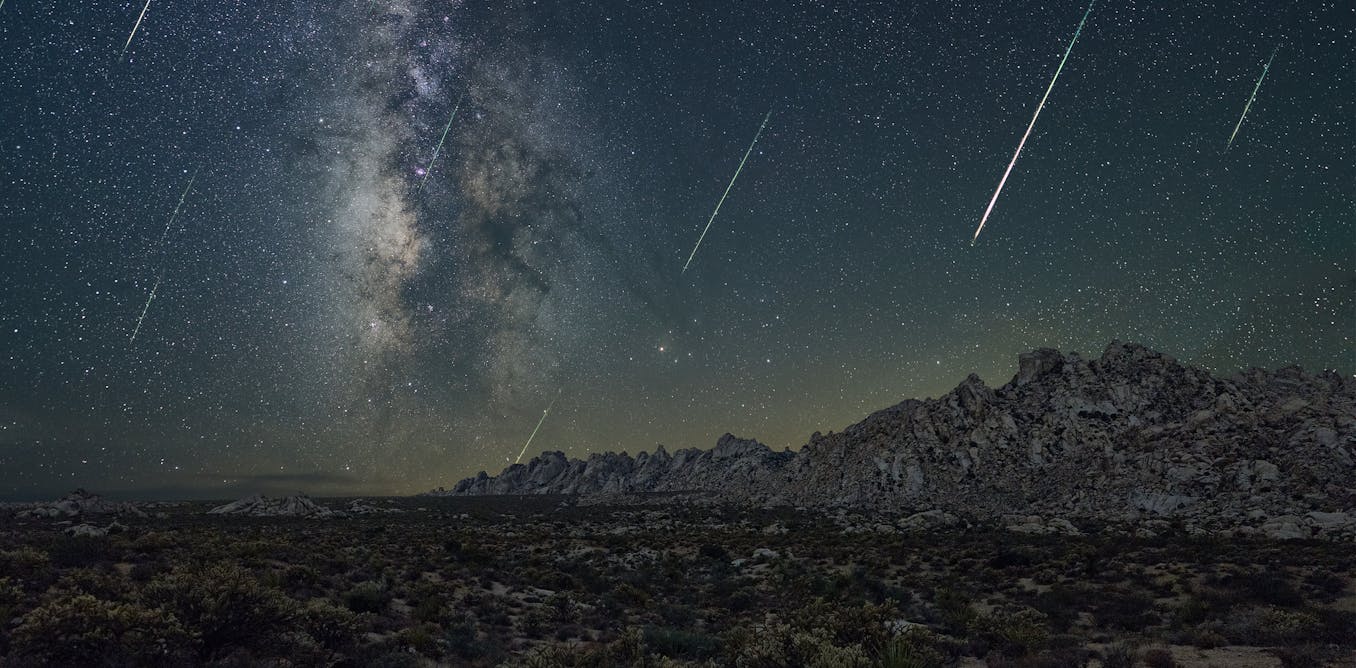
Have you ever been out at night and seen a streak of light blast across the sky and disappear? Ever wonder where that shooting star came from, or how it got to be in your sky?
As the director of the Peters Observatory at Hamilton College, I have seen many similar streaks across the sky, as I spend late nights at the observatory, and I am here to tell you that what you saw isn’t a star at all. You observed the end of a comet or asteroid’s 4.6-billion-year journey right before your eyes.
Remnants from the early solar system
Roughly 4.6 billion years ago, the solar system was in its infancy. A vast ball of gas and dust that would become our solar system was accumulating matter in its center, forming what would eventually become our Sun. It was also condensing dust in smaller patches farther from the center that would merge into the first chunks of materials, called planetesimals.
Asteroids formed from planetesimals in the inner portions of the solar system, near the Sun. This location in the center of the solar system was warm, so the planetesimals were made mostly of the rocks and metals that could withstand the heat. The biggest of these chunks would congeal with others and form the terrestrial planets: Mercury, Venus, Earth and Mars. The remaining planetesimals that did not form into the terrestrial planets are the asteroids of today, left to orbit the inner portion of the solar system.
NASA
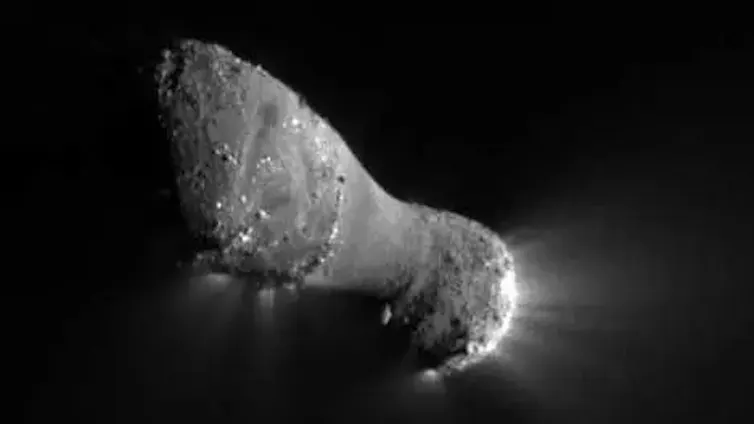
Comets formed in the outer parts of the solar system, where it was cold enough that any water, or similar hydrogen-based compounds, took the form of ice. The planetesimals forming in this region were composed of not just rock and metal but these ices as well.
Some of the planetesimals became big enough, fast enough, that they had enough gravitational pull to hold onto large atmospheres composed of the very abundant early solar system gases, such as hydrogen and helium. These planetesimals became the Jovian planets of today: Jupiter, Saturn, Uranus and Neptune. However, the planetesimals that did not form into the Jovian planets were left to travel through the solar system as comets.
NASA/JPL-Caltech/UMD
Origin of meteors
Asteroids are still abundant in the inner solar system, so inevitably some will collide with Earth. When a chunk of rock enters Earth’s atmosphere, it’s traveling at dozens of miles per second. As it enters, it may create a thunderlike sonic boom in its wake. When it travels through the air faster than the speed of sound, the asteroid produces a shock wave, which can generate that boom.
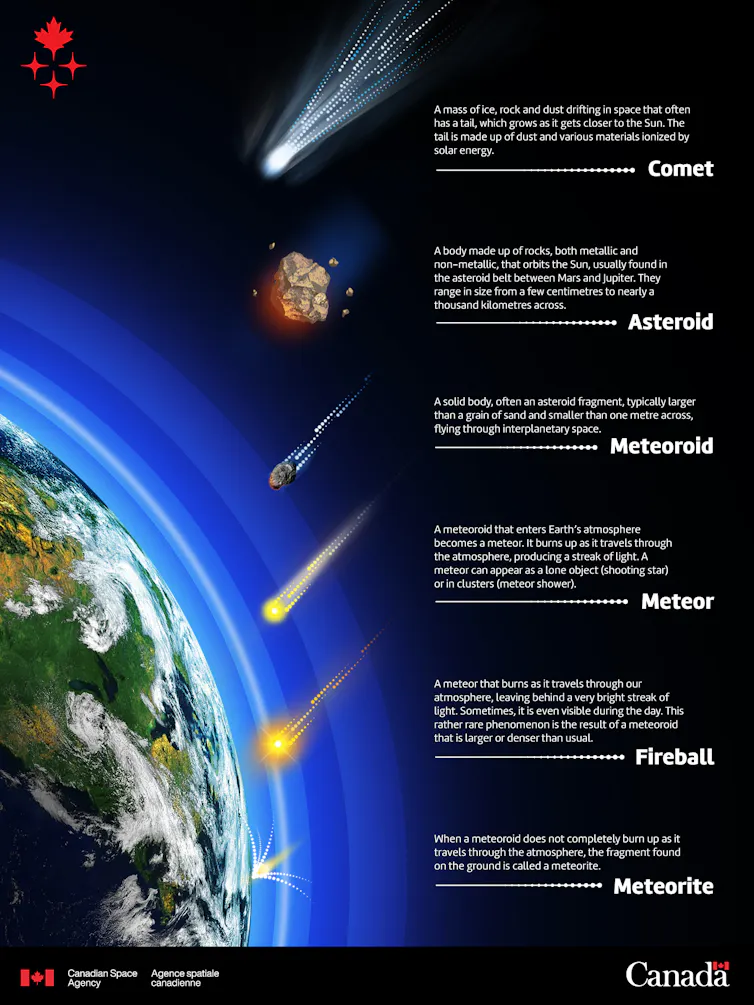
During its journey through the atmosphere over tens of miles, the asteroid collides with air molecules, and the incredible temperatures and pressure usually vaporize it. That trail of vaporizing particles breaking off the asteroid causes a bright streak of light across the sky called a meteor, or colloquially a shooting star.
Comets, though typically found in the outer solar system, can also cause meteors, and even meteor showers. A few comets take long, elliptical paths through the inner solar system every year.
These objects, sometimes called “dirty snowballs” because they are made of dust and ices, tend to slowly melt as they get too close to the Sun, causing the comet to develop a tail of gas and debris left in its wake.
If the path of the comet intersects with Earth’s orbit, the Earth will collide with these debris fields in its yearly orbit around the Sun. As that debris enters the atmosphere, it vaporizes, causing numerous trails of light called meteor showers. Since this happens in the same part of our orbit every year, meteor showers are yearly events. If you find a dark sky, you can see dozens of meteors every hour during these annual meteor showers.
Canadian Space Agency
Finding meteorites
The meteors that are large enough to make it through the Earth’s atmosphere and crash into the surface are called meteorites. Meteorites tend to come from asteroids that were originally larger than a football field.
It can be difficult to identify meteorites, because they look just like Earth rocks. Typically, people recover meteorites in geologically unchanging regions, such as deserts or ice fields, where the meteorites stand out against the landscape.
They are often made of stone, nickel and iron and are likely magnetic. Many have irregular or pock-marked shapes, while others have a smooth crust from their time burning up in our atmosphere.
Meteorites are quite rare and important to the study of the early solar system. If you believe you’ve found one, you should verify your rock’s features fit those of a meteorite and then contact local geologists.
Next time you see a meteor in the night sky, remember that you are witnessing the end of its journey, spanning billions of years, as it burns up in the Earth’s atmosphere.