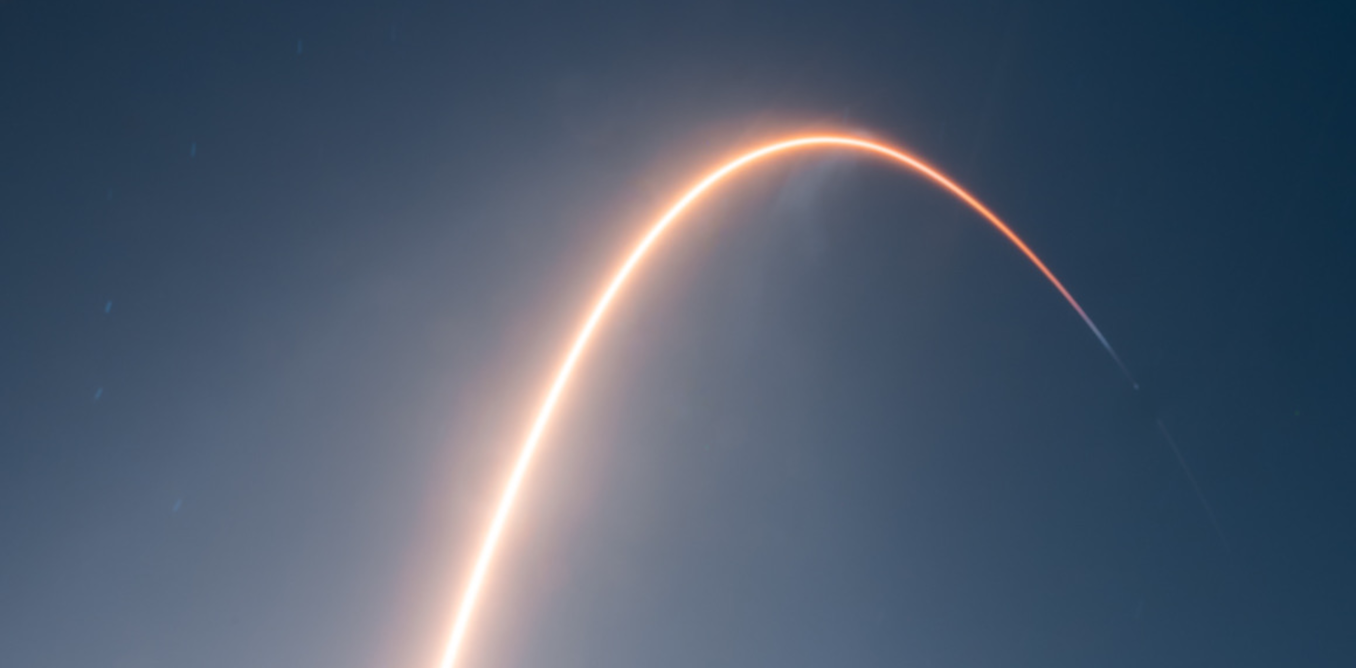
In the early hours of August 5 (UTC), an abandoned SpaceX rocket stage is expected to slam into the Moon at around 8,700 kilometres per hour.
Launched in January 2025, the rocket sent two commercial lunar landers toward Earth’s nearest neighbour.
With its work done, the rocket lacked the fuel to return to Earth or move into deep space. It remained in an unstable orbit until gravity finally set it on a collision course with the lunar surface.
The crash itself poses no danger. However, it signals a looming regulatory problem. As governments and companies race to build a permanent presence on the Moon, there is almost no practical framework for coordinating activities that permanently reshape the lunar environment.
A rare scientific opportunity
For astronomers, the accident is a scientific opportunity. As scientists know the rocket’s size, speed and roughly where it will hit, the impact presents a rare chance to to study exactly what happens when something impacts the Moon.
The crash will provide data to improve computer models of how craters form and how lunar dust behaves.
Researchers expect the collision to excavate a crater roughly 20–30 metres across and eject a cloud of lunar dust, known as regolith, several kilometres above the surface.
What happens on the Moon stays on the Moon
Along with the dust cloud, the impact will also raise a tricky question: who gets to decide when humanity permanently changes the Moon?
Unlike Earth, the Moon has almost no atmosphere and no weather. As a result, any marks we leave behind will remain for a very long time.
More than 50 years after the Apollo Moon landings, footprints remain visible. If left untouched, they may persist for thousands of years.
The results of crashes or accidents will last just as long.
The Moon is a shared neighbourhood
Space agencies, private companies, and researchers are all operating on the Moon at the same time.
Several countries have announced ambitions for long-term lunar scientific stations. Commercial companies hope to deliver cargo, prospect for resources, operate lunar communication satellites, and eventually support a sustained human presence.
As activity increases, so too does the possibility that one mission could unintentionally affect another. A cloud of high-speed lunar dust created by a landing could damage equipment such as nuclear-powered lunar bases or satellites, contaminate experiments, destroy a site of cultural significance, or even risk the lives of people on the lunar surface.
Masao et al / NASA, CC BY
If a poorly planned mission swept away humanity’s first footprints on the Moon or damaged the Apollo lander, it would be a loss of heritage for all humanity.
By good fortune rather than good planning, the rocket’s upcoming collision is expected to occur near the isolated Einstein Crater, away from many significant lunar sites.
Nobody owns the Moon, but some can still change it
SpaceX has unintentionally acquired the power to permanently alter the Moon. There is almost no international process for deciding whether, when or where that should happen.
At the centre of the discussion is the 1967 Outer Space Treaty, the foundation of international space law with 138 state signatories.
Under this treaty, no country can claim sovereignty over the lunar surface. Instead, the Moon is regarded as a place to be explored and used for the benefit of all humankind.
While the treaty prevents ownership, it says remarkably little about practical lunar governance or regulating the lunar environment.
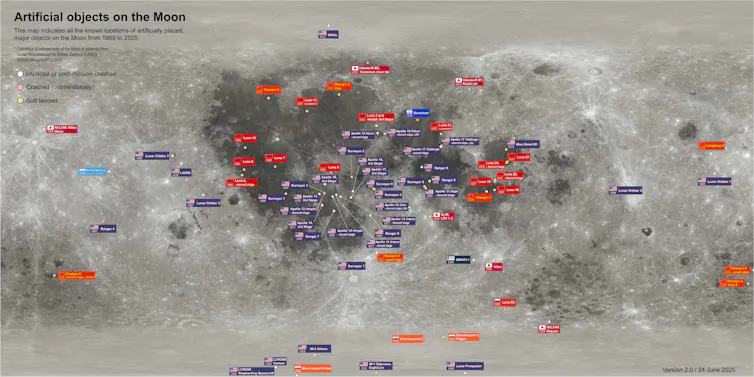
Footy2000 / Wikimedia, CC BY-SA
Unlike Earth, the Moon has no equivalent of UNESCO World Heritage protection, domestic heritage laws, or environmental regulation.
It is each country’s responsibility to supervise their own space companies to ensure they comply with national and international law. That means the American government is, in theory, on the hook for SpaceX’s mistakes.
Lunar accidents could also open up a company to financial liability and associated risks. Damages to equipment or bases could be in the millions of dollars. Accidental deaths could create criminal liability. Damages to a cultural or scientific site could risk international diplomatic incidents.
More transparency and coordination needed
So how can the Moon be a usable space for companies, governments and scientists, while also still being protected for all humanity?
The United Nations Office for Outer Space Affairs (UNOOSA) and the United Nations Committee on the Peaceful Uses of Outer Space are already exploring future solutions. There are working groups examining how countries can regulate space resources and better coordinate activities on and around the Moon.
But these institutions face a difficult reality. UNOOSA has only around 40 staff with a global mandate, and the Committee on the Peaceful Uses of Outer Space meets for only a few weeks each year.
Concurrently, commercial enterprises are throwing vast amounts of money at their race to the Moon meaning the law has not kept pace with the needs of the lunar environment.
From principles to practice
The international community does not need new laws. It needs to put the ones it has to work.
Article XI of the 1967 Outer Space Treaty already calls on states to share information about their space activities. That voluntary measure is fast becoming an operational necessity.
A simple starting point would be a lunar registry where states voluntarily identify planned activities, surface infrastructure, and sites they consider culturally significant. A similar satellite registry is managed by UNOOSA. This complimentary lunar registry would capture the operational details that the satellite registry was never designed to capture.
Aviation has a system of Notices to Airmen to advise pilots and flight operators of flight hazards, and other time-sensitive information. Shipping has Notices to Mariners.
The Moon needs something similar: standardised Notices to Lunar Operators. These would flag landing sites, rover routes and dust-generating activity before missions launch.
Calls are growing for a fourth UN Conference on Outer Space. This would be a forum where governments, industry and scientists could actually build these tools.
While this rocket cannot be stopped, the next accident might be avoided. Whether that happens will depend less on rocket scientists and more on the space lawyers and diplomats.