When asked why Jean-Olivier Irisson, a scientist at Sorbonne Université in Paris, decided to dedicate his life to studying microscopic creatures in the sea, his answer was simple: “They are beautiful.”
Beauty may not be the first thing that comes to mind when we think of plankton – organisms that drift in water and come in an extraordinary variety of shapes and sizes.
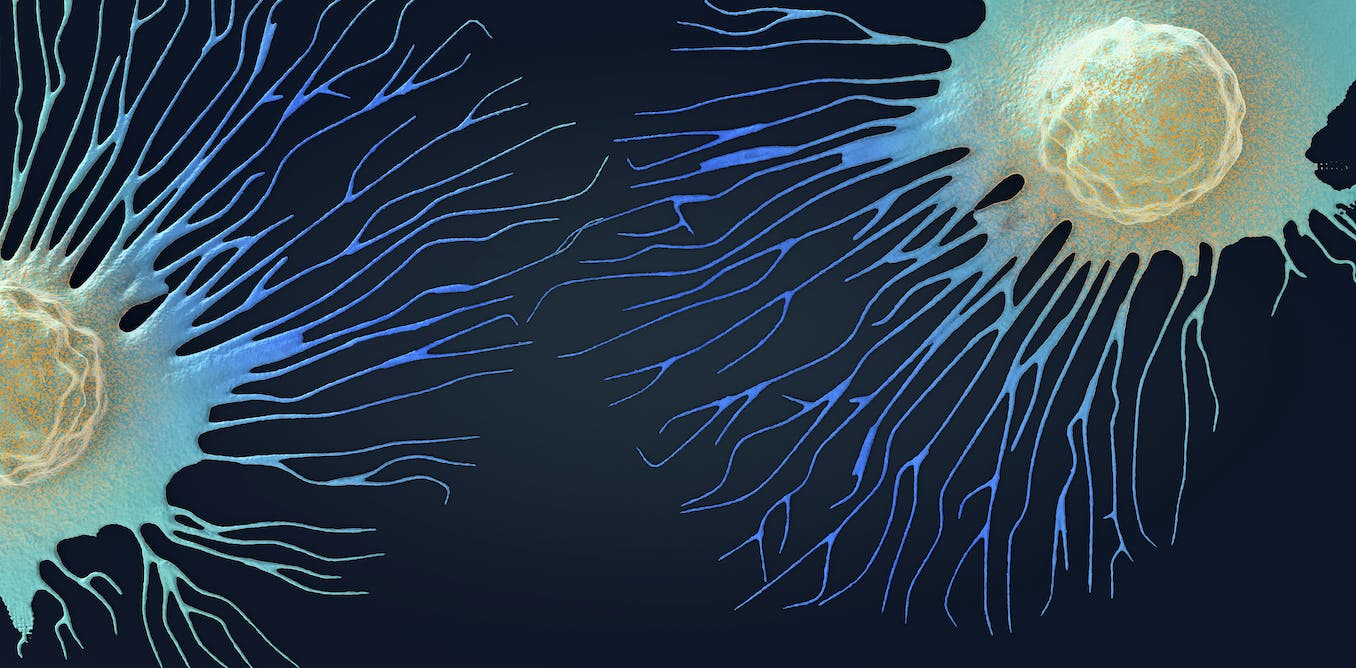
But images by Irisson’s team tell a different story. Shown in striking blues and oranges, as well as black and white, they reveal an unfamiliar and strangely beautiful world.
“This one served as the model for the head of the creature in the Alien movie franchise,” Irisson said, pointing to one particularly unusual specimen.
Plankton are not just fascinating to look at. They are fundamental to marine ecosystems, and play a crucial role in regulating Earth’s climate by helping remove carbon dioxide from the atmosphere.
“Half of the photosynthesis in the world is done by plankton,” said Irisson. “They also form the foundation of the food chain at sea. Without them, there would be no fish.”
Yet studying plankton is painstaking work. Researchers collect water samples and examine them under microscopes. They can contain huge numbers of organisms that all need to be identified and classified – a slow and demanding task when done manually.
AI is now helping to speed things up.
“We already use software to capture and process images, to identify every individual organism,” said Irisson. “For a single dataset we have 2.2 million of these images of individual organisms. That’s impossible to classify manually. With AI, we can, however, do this very fast. That’s opening up new possibilities in our research.”
Drowning in data
Irisson is far from alone in facing this problem. Underwater cameras and environmental sensors mean modern monitoring of oceans, rivers and lakes now generates far more data than researchers can realistically analyse by hand.
“
Faster and cheaper monitoring means problems like plankton decline, litter accumulation, oil spills and coral degradation can be picked up and acted on sooner.
Making sense of that flood of information was the goal of iMagine, an EU-funded research collaboration between aquatic scientists and digital experts from 11 European countries.
Running from 2022 to 2025, the project developed AI tools to help researchers process and analyse large volumes of aquatic data faster and on a much larger scale.
Coordinating the effort was Gergely Sipos, an expert in research computing and digital infrastructure at the EGI Foundation, a not-for-profit organisation that connects researchers across Europe with computing, data and other digital services.
“This is about the health of the ocean, rivers and lakes that people depend on for food, climate, tourism and drinking water,” said Sipos. “Faster and cheaper monitoring means problems like plankton decline, litter accumulation, oil spills and coral degradation can be picked up and acted on sooner.”
AI hype?
But does all this really require AI? With excitement around the technology running high, its capabilities can sometimes be overstated. For Irisson, however, the advantages for his kind of research are clear.
“If we didn’t have AI, we would need someone to sit in front of a sample and count everything,” he said. “What used to take months to even years now takes a few days to weeks.”
AI can also help researchers make use of vast stores of data that were previously too time-consuming to analyse fully.
“Some underwater sensors have been observing what’s happening in our ocean for years, even decades,” said Sipos. “Millions of data points and images accumulate. Without AI, it would be impossible to analyse all that information efficiently. AI is opening up new kinds of research.”
Litter and reefs
Across the 11 countries involved, researchers used the same basic approach to tackle very different aquatic challenges. In Austria, for example, the AI software developed was used to detect floating litter in lakes and rivers.
“That way we can recognise the scale of the pollution, and what kind of litter is in our waterways,” said Sipos. “This will help governments to organise clean-up operations.”
Elsewhere, researchers worked with underwater cameras deployed at various European locations, where AI can sift through years of images, identifying fish and distinguishing between species.
“We can create a statistical analysis that tracks the changes in species,” said Sipos. “That way we can see how ecosystems shift, and what the impact is of things like climate change. It also helps us to look at recovery efforts. We can follow how, for example, the creation of artificial reefs impacts biodiversity.”
A new way of watching our waters
Although iMagine ended in 2025, the tools and data developed by the researchers have been made available for other scientists to use and adapt to their own work.
That includes the datasets used to train AI models to recognise everything from fish species to floating litter. Making them available means other researchers can build on what has already been learned, rather than starting from scratch.
“Anyone can access our work,” said Sipos. “We continue to support scientists. We offer training material, and even jump on video calls if needed.”
“
AI is starting to replace well-established statistical analyses. Science needs to adapt to this new way of working.
This kind of shared access is the idea behind Europe’s research infrastructures: rather than every research team having to develop expensive specialist resources from scratch, scientists can draw on advanced tools, data and expertise developed and shared across Europe.
Monitoring aquatic ecosystems faster and on a much larger scale could also support wider European efforts to restore the health of the ocean and waterways.
One example is the EU Mission: Restore our Ocean and Waters, which aims to protect marine and freshwater ecosystems, reduce pollution and support a sustainable blue economy by 2030. Better monitoring will also feed into Europe’s growing digital picture of the ocean, including the European Digital Twin of the Ocean. This should help researchers and policymakers understand and respond faster to environmental changes.
The new EU OceanEye initiative, launched in June 2026, aims to build a much clearer, real-time picture of Europe’s seas, rivers and lakes by combining data from satellites, underwater sensors and scientific research. AI tools such as those developed through iMagine could help turn that growing stream of images and observations into practical knowledge.
For Irisson, AI is already changing how aquatic scientists do that. As researchers gain access to information that would previously have taken months or years to analyse, new questions can be asked of data already being collected.
“The first papers which use AI to analyse data, in addition to processing it, are recent,” he said. “AI is starting to replace well-established statistical analyses. Science needs to adapt to this new way of working.”
Research in this article was funded by the EU’s Horizon Programme. The views of the interviewees don’t necessarily reflect those of the European Commission. If you liked this article, please consider sharing it on social media.