

Poland recently announced it would transfer two MiG-29 fighter jets to Ukraine in exchange for anti-drone technology. The agreement comes at a time when Russian drones and missiles are wandering into Polish airspace on a regular basis.
The latest incursion occurred on November 20. Poland’s defence minister, Władysław Kosiniak-Kamysz, said Polish airspace was violated three times during Russian attacks on Ukraine that day. The Polish prime minister, Donald Tusk, called the incidents “intentional provocation” by Russia.
Poland has been a staunch ally of Ukraine since Russia’s 2022 full-scale invasion. It has already transferred 14 MiG-29s to Ukraine, as part of a plan to move Kyiv away from older Russian fighters towards western jets. Poland has also provided over €4.4 billion (£3.7 billion) in aid, and has donated over 350 tanks and 250 infantry fighting vehicles to Ukraine.
The other prominent assistance rendered has been in welcoming Ukrainian refugees to Poland. Over 1.5 million Ukrainians fled to Poland in 2022 and official registration rolls suggest around 868,000 remain in the country. This has caused strain on Polish public services, with the population of the south-eastern city of Rzeszów swelling by more than half in the first months of the war.
However, at that time, there was a need to expand Poland’s labour force. Poland’s unemployment rate dropped to 5% on the eve of the war, reflecting a strong demand for labour. The influx of Ukrainians has provided a boon for the Polish labour market, with a UN High Commission on Refugees report suggesting they provided a 2.7% boost to Poland’s GDP in 2024.
DBrownPhotos / Shutterstock
However, the economic relationship between Poland and Ukraine is nuanced. The first major step to increase economic ties between the two countries was the free-trade agreement Ukraine signed with the EU in 2014.
This was agreed after Ukraine’s Maidan revolution that same year, which resulted in the removal of pro-Russian president Viktor Yanukovych.
Since then, the Polish and Ukrainian economies have become more intertwined. The removal or lowering of many western trade barriers with Ukraine through the free-trade agreement has benefited Poland immensely, as it remains a key source of goods for the Ukrainian market.
From 2014 to 2021, Polish exports to Ukraine doubled from €3.1 billion to €6.3 billion. This number has more than doubled again since the war began, to over €14 billion. The trade balance has been in Poland’s favour for several years, hitting a new high of €9.7 billion in the first half of 2026.
Ukraine’s ongoing adoption of the EU’s Acquis communautaire, the body of EU legislation all member states must transpose into national law, is also forcing its businesses to adapt to EU standards.
Its poultry industry has already surmounted the hurdles that come with exporting to the EU, and continuing harmonisation with EU standards may make it easier for Ukrainian firms to export to Poland. With such a large diaspora there, there is a ready-made market.
An uneasy brotherhood
But there are critics within Poland of deeper economic ties with Ukraine, in many cases aided and abetted by provocateurs sponsored by Moscow.
Agriculture is and will remain a problematic point. Farmers are a powerful lobby in Poland and have agitated against Ukrainian imports as being too cheap and produced with less stringent standards.
In fact, it has been agricultural trade above all which has strained the political relationship between the two countries in recent years. Poland has imposed bans on Ukrainian grain imports, and farmers have staged repeated blockades of the border, disrupting grain crossing over from Ukraine.
Far-right Polish politicians have also struck back at the presence of Ukrainian immigrants, portraying them as not pulling their weight and benefiting from the hard work of ordinary Poles. Violence against Ukrainians in Poland – although at a low level overall – increased by 30% in the first months of 2026.
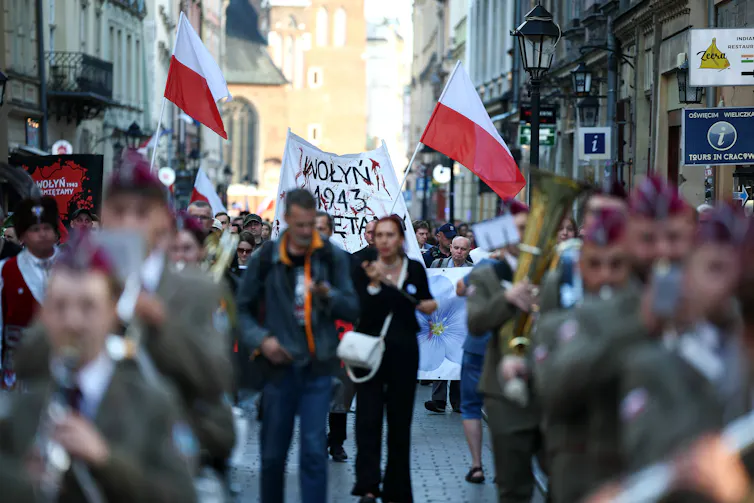
Ukraine’s president, Volodymyr Zelensky, has further exacerbated tensions by resurrecting historical grievances with Poland – including by naming a branch of his country’s special forces after the Ukrainian Insurgent Army (UPA).
The UPA was a partisan force during the second world war that fought against basically everyone, including massacring Poles in eastern Galicia and Volhynia. Zelensky’s move has only provided ammunition for far-right populists in Poland to cast further doubts on the benefits of closer integration with Ukraine.
Lukasz Gagulski / EPA
In reality, Ukraine and Poland’s defence ties are built around the shared goal of defeating Russian military aggression. Unfortunately, the errant views of Polish politicians and powerful lobbying forces in Poland continue to complicate this goal through poor economic policy and trade restrictions.
Sovereign nations will always have disagreements, and the historical relationship between Poland and Ukraine is fraught with difficulties. But the elevation of protectionist sentiment comes at a time when the countries need more solidarity against Russia, not less.
Perhaps the most important effect the protectionist impulse may have is weakening Poland’s governance instead of strengthening its economy. Ironically, Ukraine pursued a similar path for years after its independence, resulting in dependence on Moscow, rampant corruption and subpar economic growth.
Poland should learn from Ukraine’s experience and focus on continued economic liberalisation and military assistance. With a strong Poland backing Ukraine, the Russian invasion will be easier to defeat.