
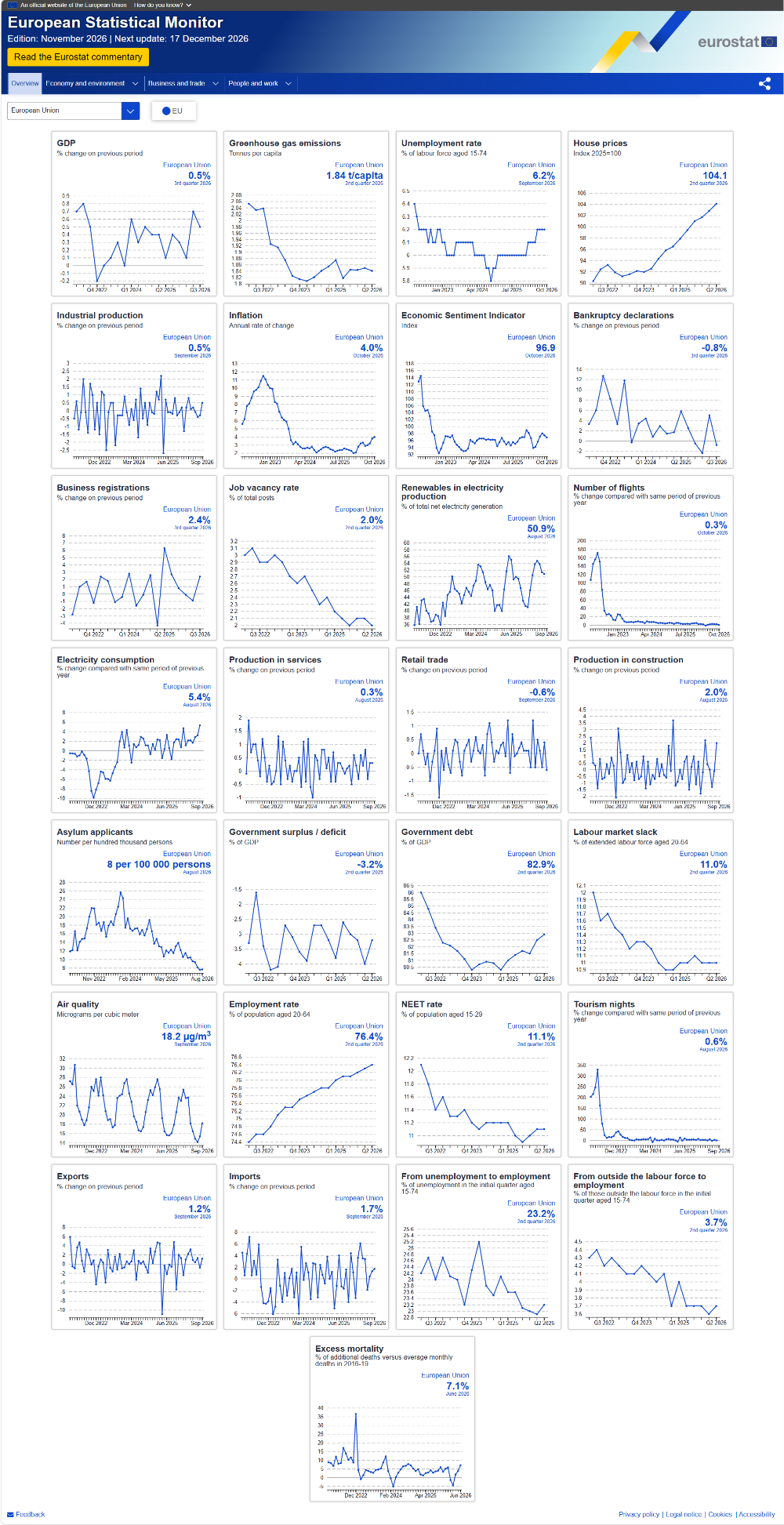
Today, Eurostat released the European Statistical Monitor, a dashboard with monthly and quarterly indicators covering different areas, such as economy, environment, business, health and work.
This monthly updated dashboard is designed to track developments within the EU as a whole and its members, as well as the EFTA countries, providing a holistic overview of key developments. The accompanying Eurostat commentary on the latest developments and the key trends can be accessed by clicking the yellow button located in the top-left corner.
The EU economy continued to grow, with GDP expanding at a moderate but steady pace. Monthly electricity consumption declined as did the share of electricity generated from renewable sources, in line with the usual seasonal pattern. Meanwhile the latest data on greenhouse gas emissions per capita showed a marginal quarter-on-quarter decrease, while the concentration of air pollutants in EU capitals increased.
As inflation kept rising, economic sentiment declined, driven by lower confidence in all sectors except industry. Meanwhile, bankruptcy declarations decreased and new business registrations increased, while monthly business indicators showed mixed signals.
The government debt-to-GDP ratio increased, while the government deficit narrowed at the EU level. The unemployment rate remained stable.
The European Statistical Monitor is updated every month with the latest available data for each indicator.