Pew Knight Initiative
The Pew-Knight Initiative supports new research on how Americans absorb civic information, form beliefs and identities, and engage in their communities.
Pew Research Center is a nonpartisan, nonadvocacy fact tank that informs the public about the issues, attitudes and trends shaping the world. Knight Foundation is a social investor committed to supporting informed and engaged communities. Learn more >
U.S. news sources like CNN, Fox News and The New York Times tend to attract audiences that differ from one another by partisanship and education level. These distinct audiences also engage in public life in varying ways, according to a recent Pew Research Center analysis from the Pew-Knight Initiative.
When we categorize Americans based on patterns in their political activity, civic involvement, religious attendance and attention to news, those who are most engaged across all these areas also tend to be overrepresented in the audiences for certain online and print news sources – particularly outlets that focus on politics. Meanwhile, TV news audiences tend to look more similar to Americans overall in how they engage in public life.
These findings come from Center data on the audiences of 30 prominent news sources, combined with data from our recent study examining how Americans participate in society across a range of behaviors. This type of analysis allows us to see how certain news audiences fit into our four “engagement groups”: Mobilizers, Connectors, Spectators and Outsiders.
Overall, Americans in the most engaged groups tend be overrepresented in the audiences of most news sources. This makes sense since news consumption is among the factors we used to build these categories.
About the engagement groups
A previous Pew Research Center report sorted Americans into four groups based on their answers to 19 questions about how they engage (or don’t engage) in society through political activity, civic involvement, religious service attendance and attention to news. The four groups are:
 Mobilizers: Doing it all. This group is the smallest and the most active across politics, civics, news and religion.
 Connectors: Involved, but less political. This group is larger than the Mobilizers and also highly engaged in many ways – including joining groups and making donations – but much less likely than the Mobilizers to be heavily involved in political activities.
 Spectators: Keeping an eye on things. They follow the news at high rates but are much less likely than the more engaged groups to participate directly in other ways.
 Outsiders: Less involved in most ways. This group is less likely than others to report taking part in most of the activities we asked about – including voting, volunteering and following the news.
Mobilizers are overrepresented in many political news audiences
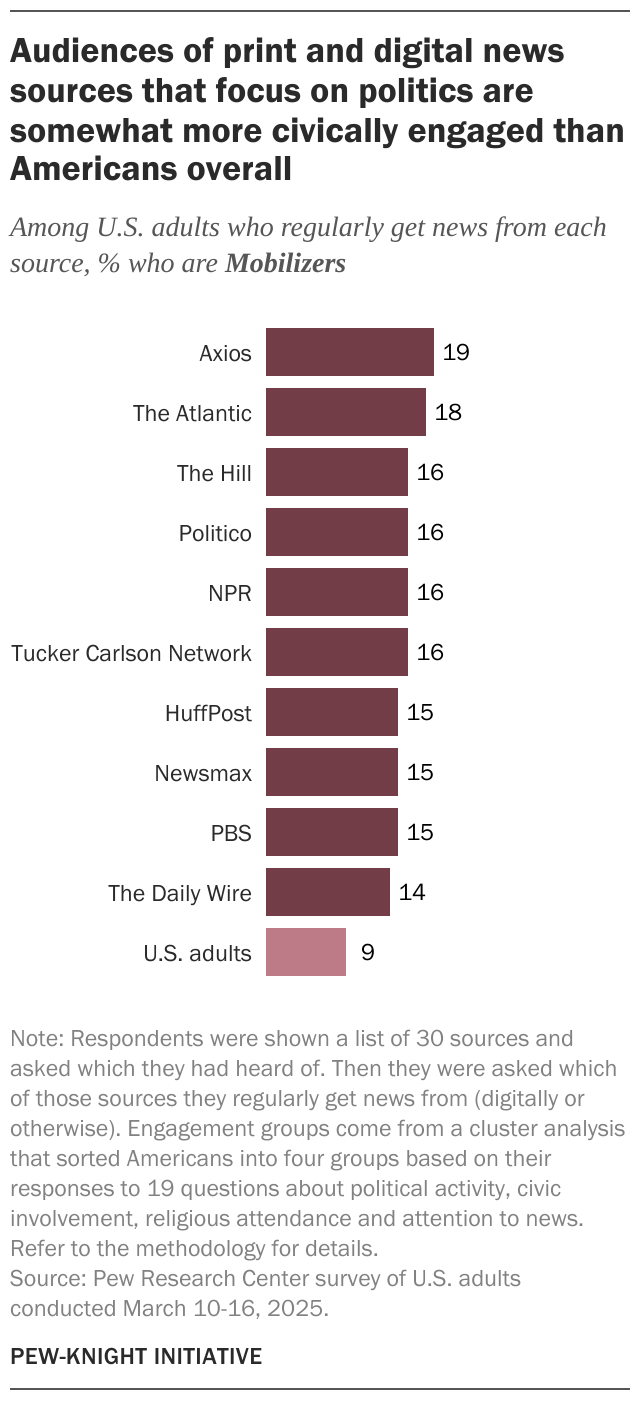
News outlets that heavily cover politics are among the sources whose audiences contain a disproportionately high share of Mobilizers – the most politically active engagement group.
A relatively small share of Americans overall (9%) are Mobilizers. By comparison, 19% of U.S. adults who regularly get news from Axios are classified as Mobilizers. That’s twice the share in the overall population.
Likewise, audiences of The Atlantic (18%), The Hill (16%) and Politico (16%) are classified as Mobilizers at higher rates than Americans overall. The same is true for the audiences of two public media organizations: NPR (16%) and PBS (15%).
Audiences of print and digital news sources that focus on politics are somewhat more civically engaged than Americans overall
Among U.S. adults who regularly get news from each source, % who are Mobilizers
Note: Respondents were shown a list of 30 sources and asked which they had heard of. Then they were asked which of those sources they regularly get news from (digitally or otherwise). Engagement groups come from a cluster analysis that sorted Americans into four groups based on their responses to 19 questions about political activity, civic involvement, religious attendance and attention to news. Refer to the methodology for details.
Source: Pew Research Center survey of U.S. adults conducted March 10-16, 2025.
PEW-KNIGHT INITIATIVE
Audiences of print and digital news sources that focus on politics are somewhat more civically engaged than Americans overall
Among U.S. adults who regularly get news from each source, % who are Mobilizers
| Mobilizers | |
|---|---|
| Axios | 19 |
| The Atlantic | 18 |
| The Hill | 16 |
| Politico | 16 |
| NPR | 16 |
| Tucker Carlson Network | 16 |
| HuffPost | 15 |
| Newsmax | 15 |
| PBS | 15 |
| The Daily Wire | 14 |
| U.S. adults | 9 |
Note: Respondents were shown a list of 30 sources and asked which they had heard of. Then they were asked which of those sources they regularly get news from (digitally or otherwise). Engagement groups come from a cluster analysis that sorted Americans into four groups based on their responses to 19 questions about political activity, civic involvement, religious attendance and attention to news. Refer to the methodology for details.
Source: Pew Research Center survey of U.S. adults conducted March 10-16, 2025.
PEW-KNIGHT INITIATIVE
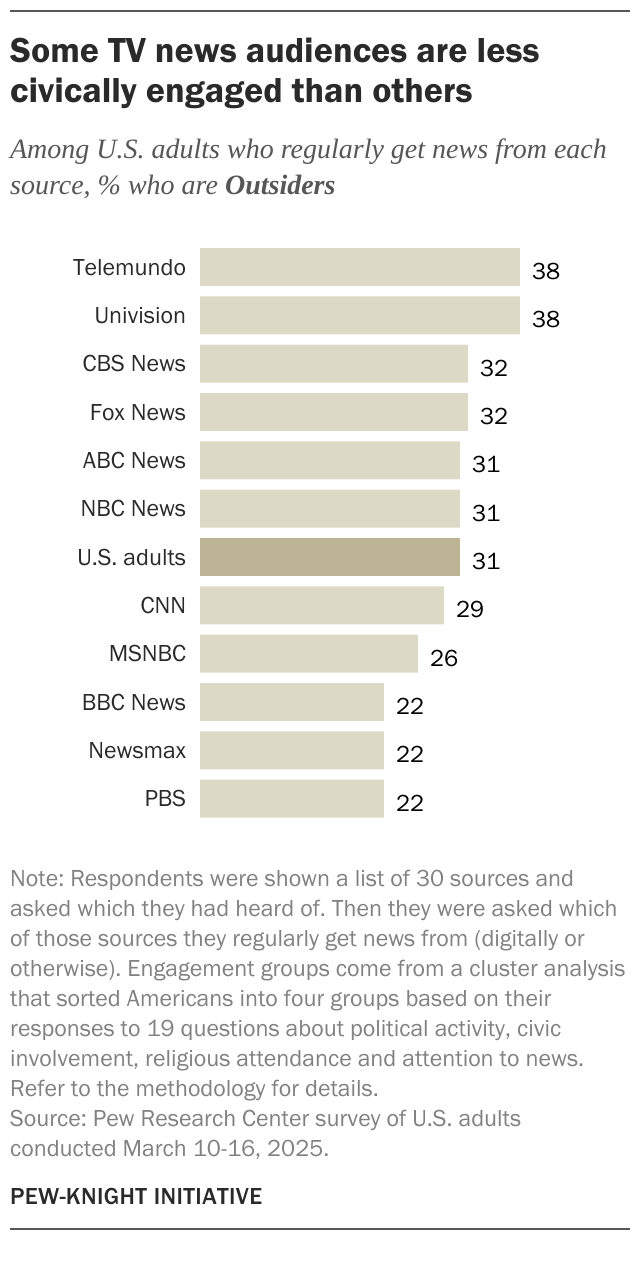
TV news comes closest to attracting a proportionate share of the least engaged Americans
Some TV news audiences are less civically engaged than others
Among U.S. adults who regularly get news from each source, % who are Outsiders
Note: Respondents were shown a list of 30 sources and asked which they had heard of. Then they were asked which of those sources they regularly get news from (digitally or otherwise). Engagement groups come from a cluster analysis that sorted Americans into four groups based on their responses to 19 questions about political activity, civic involvement, religious attendance and attention to news. Refer to the methodology for details.
Source: Pew Research Center survey of U.S. adults conducted March 10-16, 2025.
PEW-KNIGHT INITIATIVE
Some TV news audiences are less civically engaged than others
Among U.S. adults who regularly get news from each source, % who are Outsiders
| Outsiders | |
|---|---|
| Telemundo | 38 |
| Univision | 38 |
| CBS News | 32 |
| Fox News | 32 |
| ABC News | 31 |
| NBC News | 31 |
| U.S. adults | 31 |
| CNN | 29 |
| MSNBC | 26 |
| BBC News | 22 |
| Newsmax | 22 |
| PBS | 22 |
Note: Respondents were shown a list of 30 sources and asked which they had heard of. Then they were asked which of those sources they regularly get news from (digitally or otherwise). Engagement groups come from a cluster analysis that sorted Americans into four groups based on their responses to 19 questions about political activity, civic involvement, religious attendance and attention to news. Refer to the methodology for details.
Source: Pew Research Center survey of U.S. adults conducted March 10-16, 2025.
PEW-KNIGHT INITIATIVE
Outsiders participate in public life in the fewest ways, and they also tend to be underrepresented in many news sources’ audiences. But a number of television outlets are exceptions to that pattern.
About three-in-ten Americans (31%) are classified as Outsiders. The audiences for the country’s three major broadcast news networks (ABC News, CBS News and NBC News) and two most popular cable news channels (Fox News and CNN) comprise roughly the same share of Outsiders.
When it comes to Spanish-language TV stations Telemundo and Univision, 38% of their audiences are Outsiders – slightly higher than the share among U.S. adults overall. On the other hand, 22% of the audiences for BBC News, Newsmax and PBS are Outsiders.
Many news sources attract a high share of Connectors and low share of Spectators
The audiences of most news sources we asked about reflect a higher share of Connectors – a group that is heavily engaged in most areas of public life, except politics – than can be found in the U.S. population overall. Many of the sources that attract a relatively large share of Mobilizers also reach a large number of Connectors.
While 28% of Americans overall are Connectors, just under half of U.S. adults who regularly get news from The Atlantic (47%) and The Hill (45%) are classified this way. Connectors also make up larger shares of the Breitbart, HuffPost and Politico audiences (44% each) than the general public.
Despite following news at similarly high rates as Connectors, Spectators are underrepresented in the audiences of many news sources.
There are some exceptions to this pattern, however. For example, 37% of Americans who regularly get news from The Joe Rogan Experience are categorized as Spectators, compared with 31% of U.S. adults overall.
In addition, Spectators comprise 36% of U.S. adults who regularly get news from Telemundo and 40% of those who regularly get news from Univision. This reflects the fact that Hispanic Americans are significantly more likely than non-Hispanic White or Black Americans to be categorized as Spectators (44% vs. 26% and 35%, respectively).
How the audiences of 30 news sources compare
The most civically engaged Americans tend to be overrepresented in the audiences of most news sources
Among U.S. adults who regularly get news from each source, % who are categorized as …
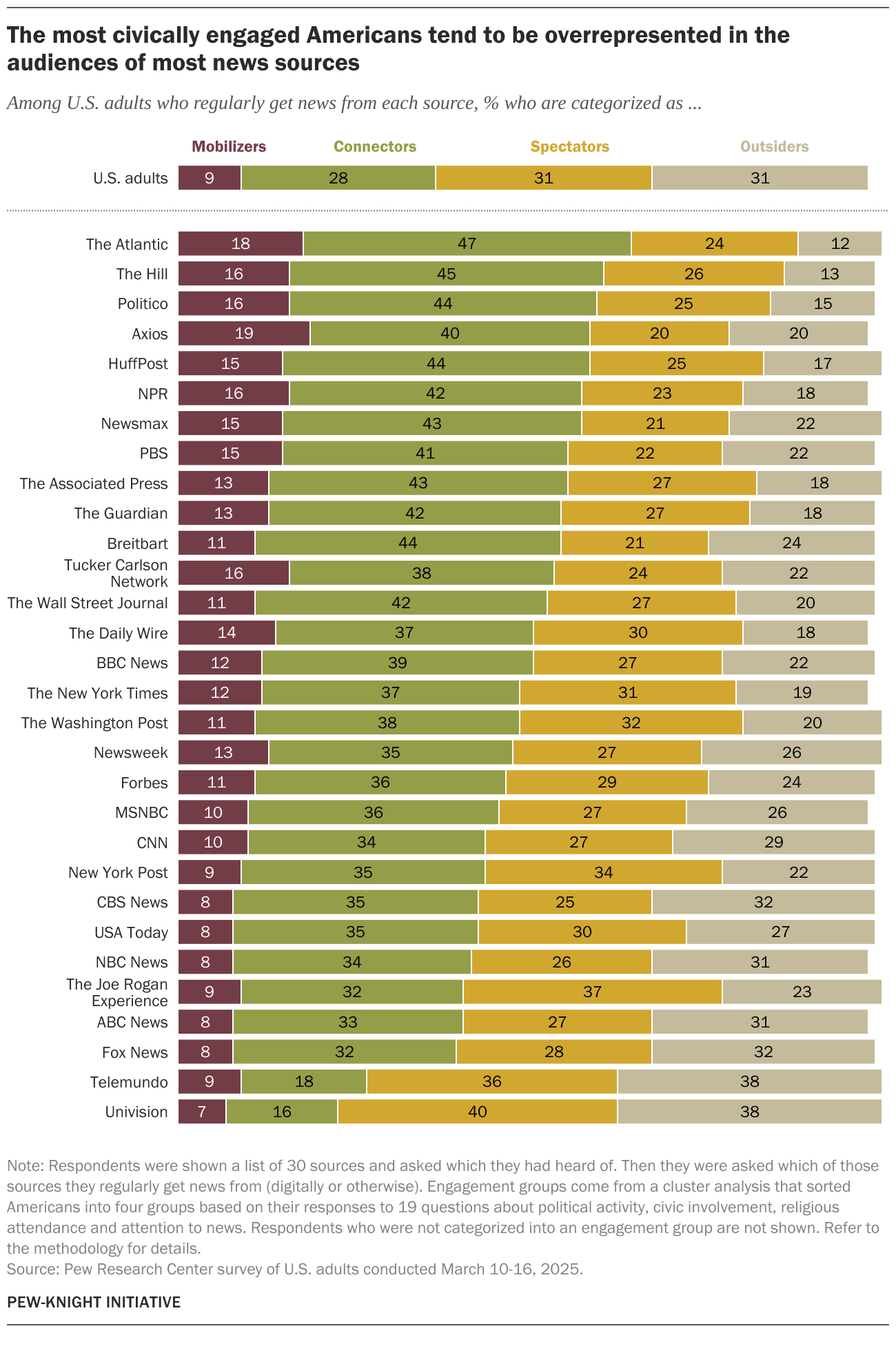
Note: Respondents were shown a list of 30 sources and asked which they had heard of. Then they were asked which of those sources they regularly get news from (digitally or otherwise). Engagement groups come from a cluster analysis that sorted Americans into four groups based on their responses to 19 questions about political activity, civic involvement, religious attendance and attention to news. Respondents who were not categorized into an engagement group are not shown. Refer to the methodology for details.
Source: Pew Research Center survey of U.S. adults conducted March 10-16, 2025.
PEW-KNIGHT INITIATIVE
The most civically engaged Americans tend to be overrepresented in the audiences of most news sources
Among U.S. adults who regularly get news from each source, % who are categorized as …
| group | Mobilizers | Connectors | Spectators | Outsiders | |
|---|---|---|---|---|---|
| U.S. adults | all adults | 9 | 28 | 31 | 31 |
| The Atlantic | media | 18 | 47 | 24 | 12 |
| The Hill | media | 16 | 45 | 26 | 13 |
| Politico | media | 16 | 44 | 25 | 15 |
| Axios | media | 19 | 40 | 20 | 20 |
| HuffPost | media | 15 | 44 | 25 | 17 |
| NPR | media | 16 | 42 | 23 | 18 |
| Newsmax | media | 15 | 43 | 21 | 22 |
| PBS | media | 15 | 41 | 22 | 22 |
| The Associated Press | media | 13 | 43 | 27 | 18 |
| The Guardian | media | 13 | 42 | 27 | 18 |
| Breitbart | media | 11 | 44 | 21 | 24 |
| Tucker Carlson Network | media | 16 | 38 | 24 | 22 |
| The Wall Street Journal | media | 11 | 42 | 27 | 20 |
| The Daily Wire | media | 14 | 37 | 30 | 18 |
| BBC News | media | 12 | 39 | 27 | 22 |
| The New York Times | media | 12 | 37 | 31 | 19 |
| The Washington Post | media | 11 | 38 | 32 | 20 |
| Newsweek | media | 13 | 35 | 27 | 26 |
| Forbes | media | 11 | 36 | 29 | 24 |
| MSNBC | media | 10 | 36 | 27 | 26 |
| CNN | media | 10 | 34 | 27 | 29 |
| New York Post | media | 9 | 35 | 34 | 22 |
| CBS News | media | 8 | 35 | 25 | 32 |
| USA Today | media | 8 | 35 | 30 | 27 |
| NBC News | media | 8 | 34 | 26 | 31 |
| The Joe Rogan Experience | media | 9 | 32 | 37 | 23 |
| ABC News | media | 8 | 33 | 27 | 31 |
| Fox News | media | 8 | 32 | 28 | 32 |
| Telemundo | media | 9 | 18 | 36 | 38 |
| Univision | media | 7 | 16 | 40 | 38 |
Note: Respondents were shown a list of 30 sources and asked which they had heard of. Then they were asked which of those sources they regularly get news from (digitally or otherwise). Engagement groups come from a cluster analysis that sorted Americans into four groups based on their responses to 19 questions about political activity, civic involvement, religious attendance and attention to news. Respondents who were not categorized into an engagement group are not shown. Refer to the methodology for details.
Source: Pew Research Center survey of U.S. adults conducted March 10-16, 2025.
PEW-KNIGHT INITIATIVE