

A vast majority of health and wellness influencers on social media recommended products or services at least once over a three-month period. In fact, 38% of these influencers’ posts promoted some kind of product or service, according to a recent Pew Research Center analysis in spring 2026. But what exactly do these influencers promote? And what do audiences do with these recommendations?
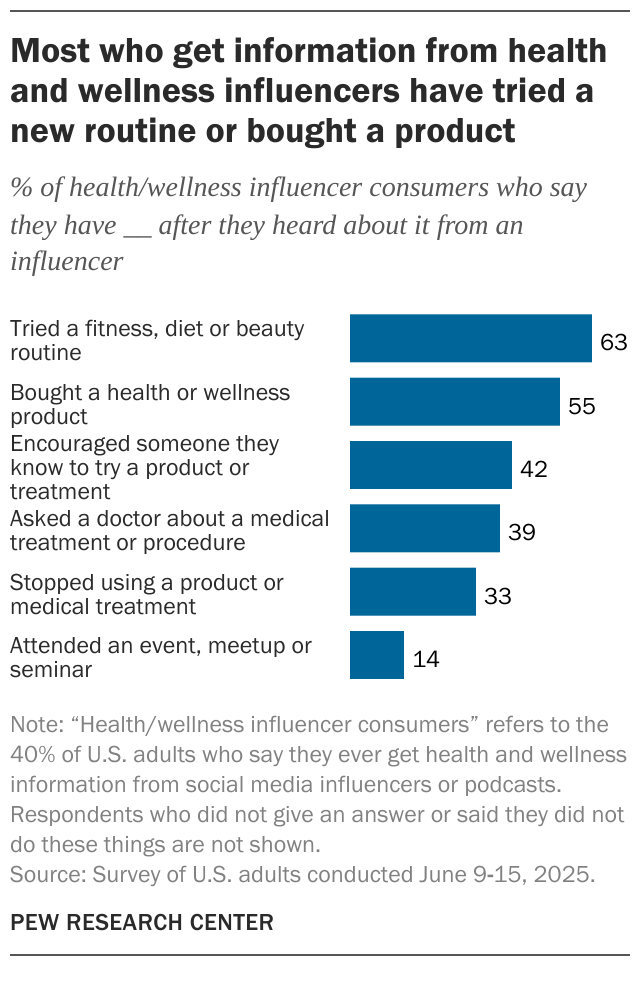
Most who get information from health and wellness influencers have tried a new routine or bought a product
% of health/wellness influencer consumers who say they have __ after they heard about it from an influencer
Note: “Health/wellness influencer consumers” refers to the 40% of U.S. adults who say they ever get health and wellness information from social media influencers or podcasts. Respondents who did not give an answer or said they did not do these things are not shown.
Source: Survey of U.S. adults conducted June 9–15, 2025.
PEW RESEARCH CENTER
Most who get information from health and wellness influencers have tried a new routine or bought a product
% of health/wellness influencer consumers who say they have __ after they heard about it from an influencer
| Response | Share |
|---|---|
| Tried a fitness, diet or beauty routine | 63 |
| Bought a health or wellness product | 55 |
| Encouraged someone they know to try a product or treatment | 42 |
| Asked a doctor about a medical treatment or procedure | 39 |
| Stopped using a product or medical treatment | 33 |
| Attended an event, meetup or seminar | 14 |
Note: “Health/wellness influencer consumers” refers to the 40% of U.S. adults who say they ever get health and wellness information from social media influencers or podcasts. Respondents who did not give an answer or said they did not do these things are not shown.
Source: Survey of U.S. adults conducted June 9–15, 2025.
PEW RESEARCH CENTER
The most common type of product that health and wellness influencers promote is information: Instructional content like workout guides, apps and recipes are recommended in 36% of posts containing promotions. Other content like books, podcasts or YouTube videos are in 11% of these posts.
And overall, these promotions tend to get a response from their audiences. Nearly two-thirds of adults who get information from these influencers (63%) say they’ve tried a fitness, diet or beauty routine because they heard about it this way, while a bit over half (55%) say they’ve bought a product based on these recommendations.
Among those who get information from health and wellness influencers, women are more likely than men to have tried a routine, bought a product or encouraged others to try a product or treatment. And Black consumers are more likely than White consumers to say they have bought a product or encouraged others based on these recommendations.
Changes in consumer choices can go the other direction, too. A third of those who get information from health and wellness influencers say they have stopped using a product or treatment because of an influencer’s discussion of it.
Below, we’ll take a closer look at the following questions:
What do health and wellness influencers promote?
Information
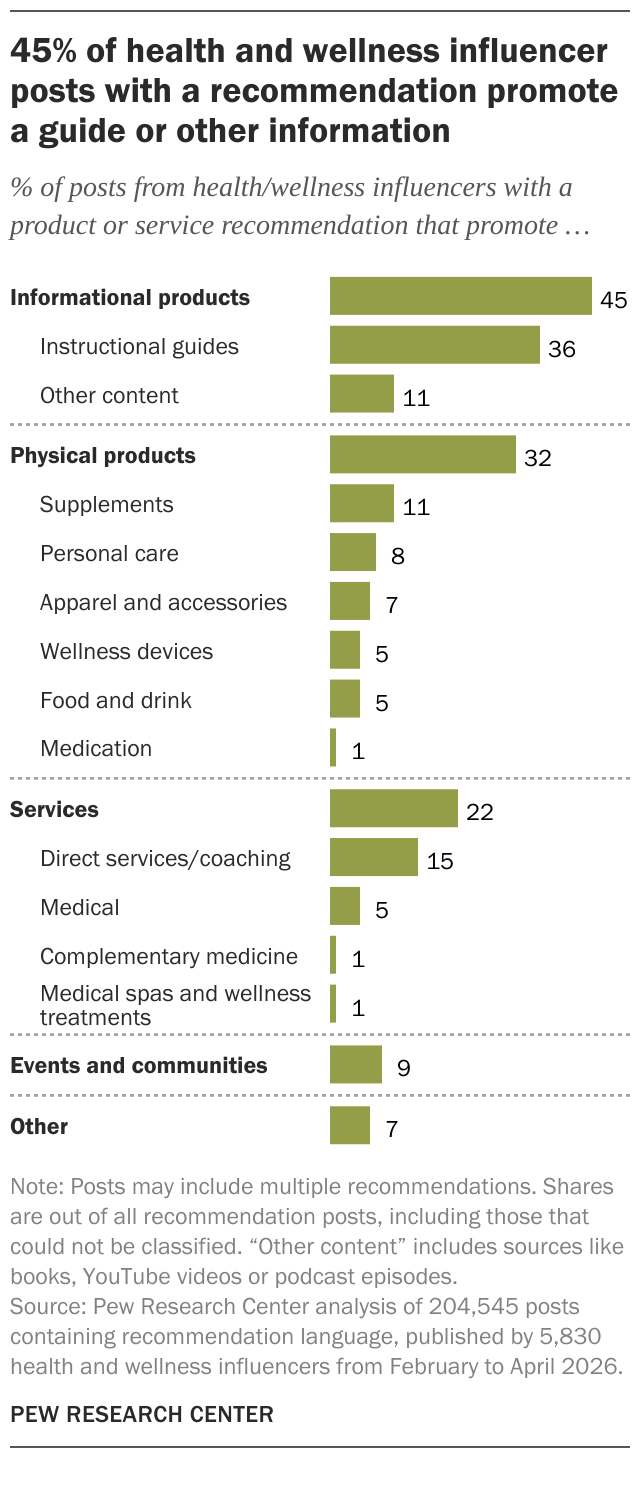
In health and wellness influencer posts that include a promotion, the most common promotion category is informational resources (cited in 45% of these posts).
45% of health and wellness influencer posts with a recommendation promote a guide or other information
% of posts from health/wellness influencers with a product or service recommendation that promote …
Note: Posts may include multiple recommendations. Shares are out of all recommendation posts, including those that could not be classified. “Other content” includes sources like books, YouTube videos or podcast episodes.
Source: Pew Research Center analysis of 204,545 posts containing recommendation language, published by 5,830 health and wellness influencers from February to April 2026.
PEW RESEARCH CENTER
45% of health and wellness influencer posts with a recommendation promote a guide or other information
% of posts from health/wellness influencers with a product or service recommendation that promote …
| Topic | Share | group |
|---|---|---|
| Informational products | 45 | 1 |
| Instructional guides | 36 | 1 |
| Other content | 11 | 1 |
| Physical products | 32 | 2 |
| Supplements | 11 | 2 |
| Personal care | 8 | 2 |
| Apparel and accessories | 7 | 2 |
| Wellness devices | 5 | 2 |
| Food and drink | 5 | 2 |
| Medication | 1 | 2 |
| Services | 22 | 3 |
| Direct services/coaching | 15 | 3 |
| Medical | 5 | 3 |
| Complementary medicine | 1 | 3 |
| Medical spas and wellness treatments | 1 | 3 |
| Events and communities | 9 | 4 |
| Other | 7 | 5 |
Note: Posts may include multiple recommendations. Shares are out of all recommendation posts, including those that could not be classified. “Other content” includes sources like books, YouTube videos or podcast episodes.
Source: Pew Research Center analysis of 204,545 posts containing recommendation language, published by 5,830 health and wellness influencers from February to April 2026.
PEW RESEARCH CENTER
This category breaks down as follows:
- 36% of these posts recommend instructional resources like workout programs, nutrition guides and other how-to materials.
- 11% direct audiences to more general content, like books, YouTube videos or podcast episodes.
About three-quarters of influencers who have shared a post with a promotion recommended an informational resource at least once, making it the most common kind of promotion.
Physical products
About a third of these posts (32%) promote physical products, with some products being more common than others:
- 11% promote supplements.
- 8% recommend personal care and appearance products such as sunscreen or haircare products.
- 7% promote apparel.
- 5% recommend health and wellness devices such as gym equipment.
- 5% recommend food and drinks.
Physical product recommendations are also widespread among these influencers. In fact, around seven-in-ten of them recommended such products at least once.
Related: About 8 in 10 Americans take supplements, and many see them as important to their health
Services
Nearly a quarter of these posts (22%) promote a service:
- 15% point audiences to non-medical services that tend to be directly provided by the influencers themselves, such as coaching, consulting or other sessions.
- 5% promote medical services.
- 1% recommend complementary or alternative treatments.
- 1% promote medical spas and other wellness treatments.
About six-in-ten of influencers with promotions (58%) recommend these kinds of services.
Events and communities
Many health and wellness influencers build communities with their followers through offline and virtual spaces, such as retreats, webinars and online groups.
Promotions for these kinds of communities and events appear in 9% of recommendation posts, and four-in-ten influencers who run promotions include these kinds of recommendations.
Related: Online Community and Connection in America
Which influencers are doing the promoting?
Top promoters
As shown in our previous research on health and wellness influencers, almost all of them (92%) promoted goods or services of some kind at least once in our study period. But some are unusually prolific. Among influencers who promote, 10% produced nearly half (46%) of all posts with a recommendation. These influencers promote something in most of their posts: On average, 66% of their posts are recommendations, compared with an average of 38% for all other influencers who have posted a promotion.
Gender
Influencers who are men and women tend to promote things at similar rates, but there are some differences in what they recommend. Women are more likely than men to promote personal care and appearance products (10% vs. 4% of influencers who promote) and apparel (8% vs. 5%). On the flip side, they are less likely to promote medical services than men (3% vs. 10%).
Influencer background
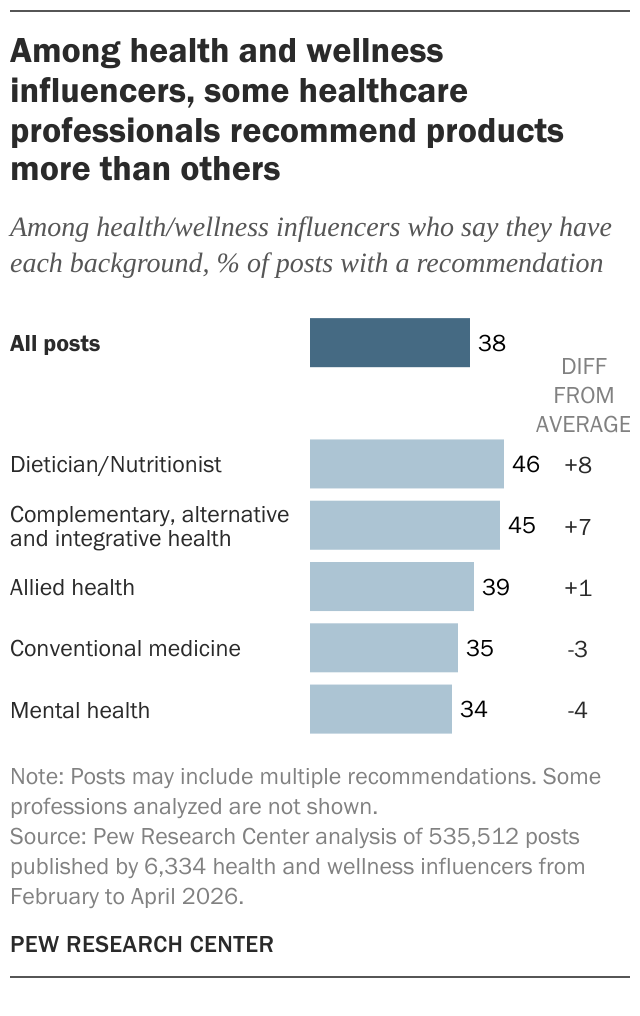
Among health and wellness influencers, some healthcare professionals recommend products more than others
Among health/wellness influencers who say they have each background, % of posts with a recommendation
Note: Posts may include multiple recommendations. Some professions analyzed are not shown.
Source: Pew Research Center analysis of 535,512 posts published by 6,334 health and wellness influencers from February to April 2026.
PEW RESEARCH CENTER
Among health and wellness influencers, some healthcare professionals recommend products more than others
Among health/wellness influencers who say they have each background, % of posts with a recommendation
| Influencer background | Share | group | Diff compared with average |
|---|---|---|---|
| All posts | 38 | 1 | |
| Dietician/Nutritionist | 46 | 2 | 8 |
| Complementary, alternative and integrative health | 45 | 2 | 7 |
| Allied health | 39 | 2 | 1 |
| Conventional medicine | 35 | 2 | -3 |
| Mental health | 34 | 2 | -4 |
Note: Posts may include multiple recommendations. Some professions analyzed are not shown.
Source: Pew Research Center analysis of 535,512 posts published by 6,334 health and wellness influencers from February to April 2026.
PEW RESEARCH CENTER
Influencers with different backgrounds tend to recommend different products and services, and do so at different rates.
This pattern shows up when looking at influencers who are healthcare professionals.
Mental health and conventional medicine professionals, like doctors and nurses, are among the least likely to promote products. In contrast, dieticians and nutritionists and complementary, alternative and integrative health professionals (a category that includes functional medical practitioners, chiropractors and massage therapists) are among the most likely to.
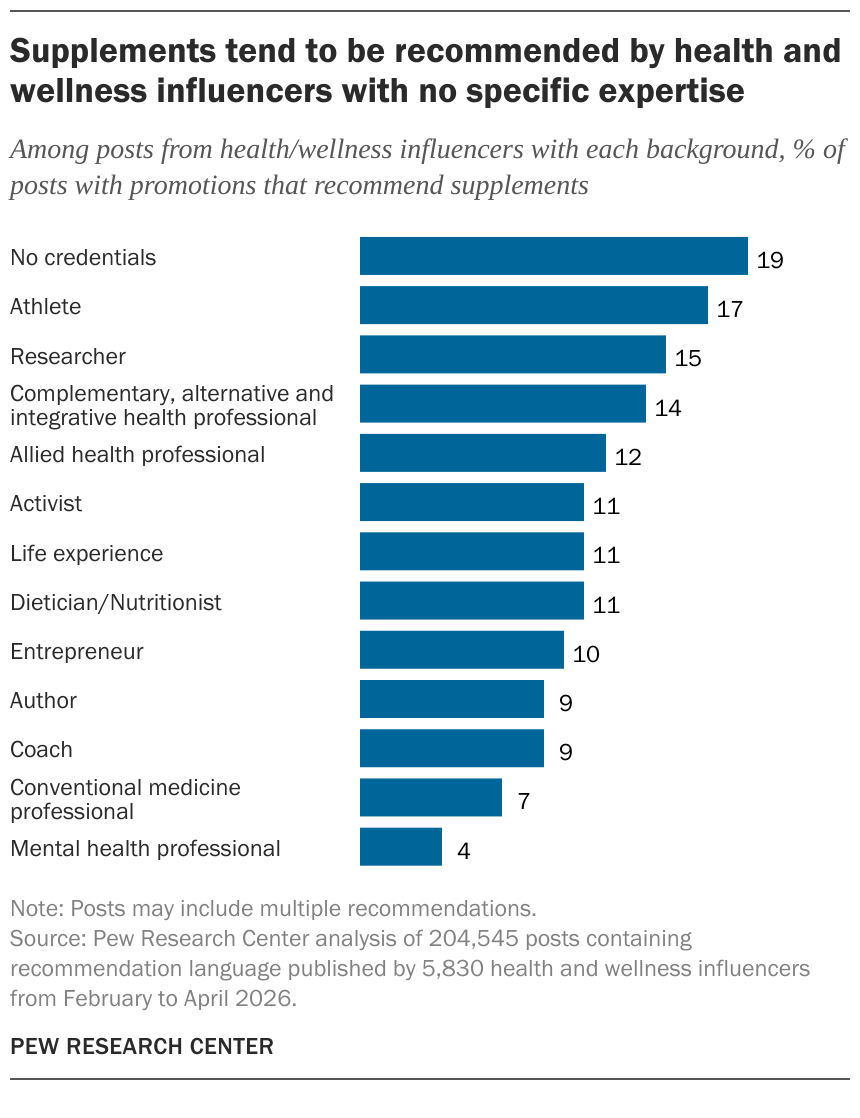
Supplements tend to be recommended by health and wellness influencers with no specific expertise
Among posts from health/wellness influencers with each background, % of posts with promotions that recommend supplements
Note: Posts may include multiple recommendations.
Source: Pew Research Center analysis of 204,545 posts containing recommendation language published by 5,830 health and wellness influencers from February to April 2026.
PEW RESEARCH CENTER
Supplements tend to be recommended by health and wellness influencers with no specific expertise
Among posts from health/wellness influencers with each background, % of posts with promotions that recommend supplements
| Influencer background | Share of posts that promote supplements |
|---|---|
| No credentials | 19 |
| Athlete | 17 |
| Researcher | 15 |
| Complementary, alternative and integrative health professional | 14 |
| Allied health professional | 12 |
| Activist | 11 |
| Life experience | 11 |
| Dietician/Nutritionist | 11 |
| Entrepreneur | 10 |
| Author | 9 |
| Coach | 9 |
| Conventional medicine professional | 7 |
| Mental health professional | 4 |
Note: Posts may include multiple recommendations.
Source: Pew Research Center analysis of 204,545 posts containing recommendation language published by 5,830 health and wellness influencers from February to April 2026.
PEW RESEARCH CENTER
In general, health and wellness influencers tend to recommend products and services that align with their professional backgrounds. For example, athletes are the most likely group to promote apparel. Medical professionals are the most likely to promote medical services, including their own practices. And while influencers of nearly every background recommend instructional guides, this is more common among dieticians and coaches than others.
When it comes to supplements, influencers who don’t list any expertise in their credentials and athletes are among those who tend to recommend them the most. And complementary, alternative and integrative healthcare professionals are about twice as likely to include these recommendations as conventional medicine professionals.
Which posts are most likely to have promotion in them?
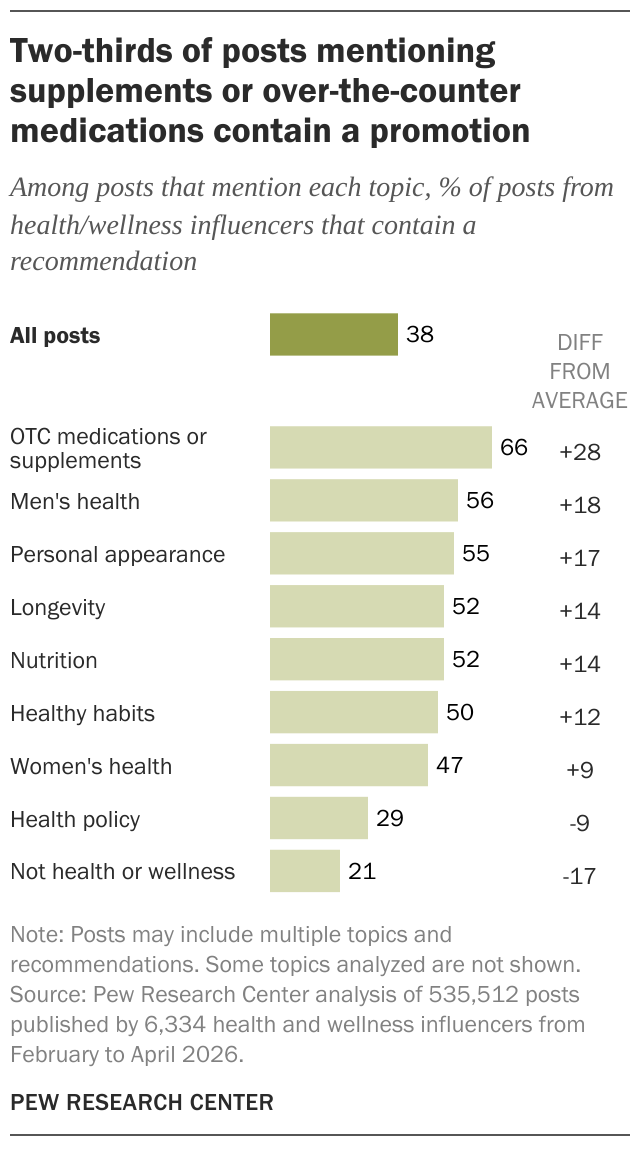
Two-thirds of posts mentioning supplements or over-the-counter medications contain a promotion
Among posts that mention each topic, % of posts from health/wellness influencers that contain a recommendation
Note: Posts may include multiple topics and recommendations. Some topics analyzed are not shown.
Source: Pew Research Center analysis of 535,512 posts published by 6,334 health and wellness influencers from February to April 2026.
PEW RESEARCH CENTER
Two-thirds of posts mentioning supplements or over-the-counter medications contain a promotion
Among posts that mention each topic, % of posts from health/wellness influencers that contain a recommendation
| Topic | Share | Diff | group |
|---|---|---|---|
| All posts | 38 | 1 | |
| OTC medications or supplements | 66 | 28 | 2 |
| Men’s health | 56 | 18 | 2 |
| Personal appearance | 55 | 17 | 2 |
| Longevity | 52 | 14 | 2 |
| Nutrition | 52 | 14 | 2 |
| Healthy habits | 50 | 12 | 2 |
| Women’s health | 47 | 9 | 2 |
| Health policy | 29 | -9 | 2 |
| Not health or wellness | 21 | -17 | 2 |
Note: Posts may include multiple topics and recommendations. Some topics analyzed are not shown.
Source: Pew Research Center analysis of 535,512 posts published by 6,334 health and wellness influencers from February to April 2026.
PEW RESEARCH CENTER
Health and wellness influencers are more likely to include recommendations in posts about healthy living topics or medical topics than in posts about health policy or posts that are not about health or wellness at all.
But there are wider differences by subtopic. For instance, roughly two-thirds of posts mentioning supplements include a recommendation, as do half or more of posts mentioning men’s health, personal appearance, longevity, nutrition and healthy habits.
Which calls to action do health and wellness influencers use?
Influencers employ various calls to action to monetize their content. These range from free resources, such as guides, that may capture future engagement to affiliate links and promo codes that give them a commission on sales.
About one-in-ten posts with a recommendation (12%) promote free products or services. This is most common among posts that recommend informational products.
A smaller share of these posts (6%) include discount codes or affiliate links to stores selling the products they’re promoting. This is most common among posts that promote physical products.
How common is direct collaboration with brands?
About a quarter of health and wellness influencer posts that promote something include a direct sponsorship or collaboration with a brand. But no single brand makes up more than 1% of all posts with a recommendation.
The brands that appear in these posts most often are mostly clothing companies. Seven of the top 10 sell activewear, such as Gymshark, DFYNE, Oner Active and Alo Yoga. Two sell supplements, such as Transparent Labs and Raw Nutrition. The top 10 list also includes the media company Biohack Yourself.
Note: Here are the survey questions used for this analysis, the detailed survey responses and the methodology.