
Overnight on October 13-14, Russia launched 39 ballistic missiles and more than 120 drones at Kyiv and Kharkiv in one of its heaviest bombardments for some time. We already knew that Russia’s new-generation jet-powered drones pose a significant threat to Ukraine’s air defences. They are simply too fast to intercept consistently – so many more can get through than was the case with its less sophisticated drones.
But another factor made it even harder for Ukraine to defend itself. A speed limit had been imposed on the SpaceX Starlink satellite system it has depended on since early in the war. This effectively meant that the interceptors it uses to try to shoot down the jet-powered drones became ineffective.
Elon Musk took to his social media platform X to assert that the US govenrment controls Starlink’s military application, Starshield, so any decision to limit it would be “decided by the US military and ultimately POTUS”.
But it isn’t just Ukraine’s air defences that are hampered by the Starlink slowdown, writes Anthony King. Starshield is the vital backbone of Ukraine’s military operations. So, just as Kyiv is celebrating the success of Operation Vivaldi, a well-planned counteroffensive that has set back Vladimir Putin’s bid to capture the Donetsk region in eastern Ukraine, suddenly its frontline operations have been compromised.
King, the director of the Strategy and Security Institute at the University of Exeter, explains how Ukraine has come to depend on Starshield and what the apparent restriction will mean for its survival as Russia increases the intensity of its bombardment as winter approaches.
Is the US limiting Starlink in Ukraine? The risks could be catastrophic
Vivaldi, meanwhile, represents a coup for Ukraine’s military. The Russian president has repeatedly said he was confident of capturing Donetsk and neighbouring Luhansk by year’s end. This now looks implausible to say the least, writes Chris Tuck, an expert in military strategy at King’s College London.
Months in the planning, the operation showed how Ukraine’s commanders have become adept at combining resources and technology in innovative ways. Most importantly, writes Tuck, it shows how Ukraine has been able to restore manoeuvrability to a battlefield that the sheer number of drones in the air had seemingly made impossible.
Operation Vivaldi: success of Ukraine’s counteroffensive shows it has learned to manoeuvre on a drone-filled battlefield
The sobering news for Volodymyr Zelensky, though, is that the worse things go for Russia on the battlefield, the more it will redouble its attacks on Ukraine’s cities. The Ukrainian president recently reported intelligence intercepts reporting that Putin had told his military commanders to abandon the rules of war that protect civilians. As Zelensky reported: “He said there are no rules now.”
This has been widely reported as a “new Russian doctrine”. But in truth it’s anything but. The principle of “Sodcit” – or “strategic operations to destroy critical infrastructure” – has long been a key element of Russia’s way of waging war, writes Tracey German.
German, an expert on Russian security policy at King’s College London, identifies this as a strategy of exhaustion – by which attacks on an enemy’s economic, material and moral resources over time gradually breaks its people’s morale. She traces it back via Syria and Chechnya to the “Soviet Clausewitz”, Alexandr Svechin, whose 1923 book Strategy has informed Russian (and many other countries’) military planners ever since.
‘Sodcit’ – after battlefield setbacks, Russia returns to destroying Ukraine’s morale
What Russians think of the motherland
On Russia’s home front – and among Russian émigrés meanwhile – the war appears to be prompting something of a rethink as to what many people think of the motherland. Marina Yusupova-Ryder, of Edinburgh Napier University, has provided some fascinating insights as to how this has changed over the course of the war.
Yusupova-Ryder interviewed 40 men in Russia and abroad in 2013-14 and again in 2022-23, asking them about their sense of national identity and what they thought of Russia in general. She says there was a dramatic shift between the two sets of interviews.
The first time she spoke with her interviewees, most saw Russia in a generally positive light and were secure about their own sense of national identity. By 2022-23, only two were positive about their country. One even went as far as to say Russia was like Voldemort, the evil wizard from the Harry Potter books.
How the ‘geopolitical stigma’ associated with Putin’s Russia is affecting ordinary Russians
Is Donald Trump abandoning Ukraine?
The idea – as yet unconfirmed – that the Trump administration may have decided to hamstring Ukraine’s use of Starlink was made all the more believable by events over the past week.
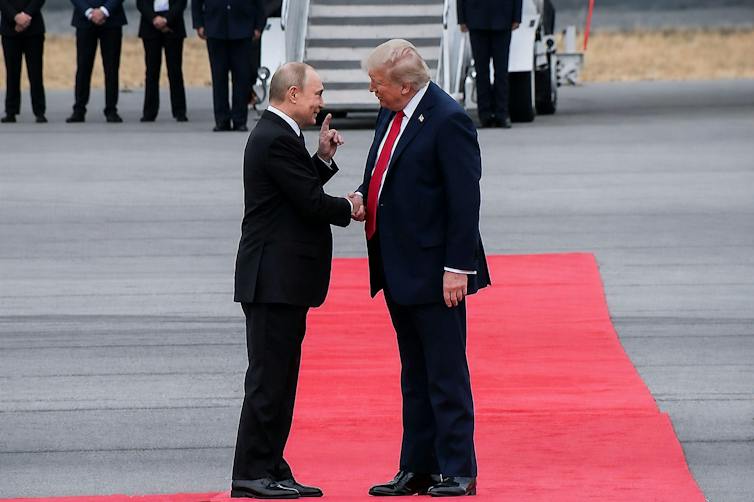
Last Friday, as US negotiators met in Miami with representatives from Ukraine and its European allies, Donald Trump announced he had done a deal with Putin to lift sanctions on the sale of Russian diesel, potentially putting billions into Russia’s war chest.
Ian Shaw/Alamy Live News
The following day he called for Zelensky to be replaced. The day after that, he announced he had arranged an energy ceasefire, which both sides ignored. His administration also threatened to close down the prioritised Ukraine requirements list by which Ukraine’s European allies buy US weapons.
And his negotiators, Steve Witkoff and Jarrod Kushner, reportedly threatened to halt intelligence sharing. So the restrictions to Starlink may be part of that.
Stefan Wolff notes that this bullying is very much of a piece with the Trump administration’s approach to trying to get Ukraine to end the war by offering Russia concessions. It won’t, he writes, make America’s relations with its European allies any smoother.
Donald Trump aligns with Vladimir Putin yet again, leaving Ukraine – and US relations with Europe – under pressure
Debunking lessons from Sweden
Closer to home, UK prime minister Andy Burnham told Alastair Campbell and Rory Stewart on their The Rest is Politics podcast this week that he’d received information clearly demonstrating Russian interference in UK politics. He told the UN recently that Britain would set up a National Centre for Information Defence to guard against mischievous foreign disinformation.
Sweden could provide some useful lessons here. The country has been consciously guarding against propaganda and foreign manipulation since the early years of the cold war.
Drew Caveney-Holler of Durham University takes a close look at Sweden’s Psychological Defence Agency and how it attempts to spot and debunk foreign lies before they can gain traction. The agency is also experimenting in “prebunking” techniques – giving people the tools to spot information manipulation for themselves.
What Andy Burnham can learn from Sweden about defending against Russian disinformation