
Rocky Horror fans everywhere have been celebrating the life and work of actor and cult cinema icon Tim Curry, who passed away at the age of 80 at his home in Los Angeles.
Curry brought distinctive charisma, energy and dramatic flair to countless films, including Annie (1982), Clue (1985), Legend (1985) and Home Alone 2: Lost in New York (1992).
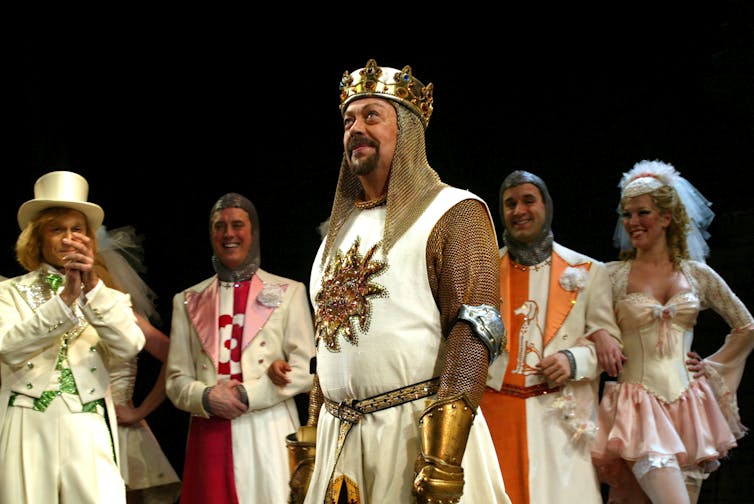
Children of the 1990s may remember him as the murderous, wisecracking clown Pennywise in the TV adaptation of Stephen King’s It (1990). Curry was also a familiar face on Broadway and London’s West End, where he starred in many productions, including Amadeus (1979) and Spamalot (2005).
An illustrious, nearly six-decade career notwithstanding, Curry remained best known for his 1975 screen debut as The Rocky Horror Picture Show’s Dr. Frank-N-Furter, the mischievous, magnetic, stiletto- and corset-clad mad scientist who seduces the straight-laced Brad and Janet (Barry Bostwick and Susan Sarandon) on a fateful, stormy night.
This is the image that Curry’s name has always conjured for me. Like several generations before me, singing along to Dr. Frank-N-Furter’s “Sweet Transvestite” at midnight Rocky Horror screenings has been somewhat of a tradition. Rocky Horror would also come to have a greater impact on my academic and professional life later on.
Yet reflecting on the broader strokes of Curry’s career after news of his passing, I am reminded of the significance that even his lesser-known roles had played in my own life.
(AP Photo/Stuart Ramson)
The many faces of Tim Curry
Kids are often captivated by Dickensian-style orphan tales, an obsession Annie cemented for me early on. Witches and magic were another fixation, and I’d direct anyone looking for a hit of ‘80s nostalgia to Curry’s musical number as The Grand Wizard in The Worst Witch (1986).
These are the performances I connected to most. But reading through Curry’s extensive resumé, it would be difficult to overstate the number of “Oh, that was him too?” exclamations that occurred along the way.
Curry voiced several cartoons I watched regularly, including FernGully: The Last Rainforest (1992) and The Wild Thornberrys (1998–2004). He playfully satirized his Rocky Horror fame in the raunchy horror parody Scary Movie 2 (2001), a clandestine viewing at my seventh-grade sleepover, and helped me pass the time at a babysitting gig or two in Clue and Home Alone 2: Lost in New York.
My inability to recognize Curry in some of these performances initially is not to imply that he was unmemorable. Rather, it speaks to his ability to immerse himself and disappear fully into his roles.
I have little memory of Tim Curry the actor — or the person — growing up. But I do know that It’s Pennywise terrified me, and I remember cheering as orphan Annie outwitted the schemes of Curry’s villainous Rooster Hannigan.
The art of disappearing
Curry himself aspired toward this status of absolute absorption for his characters. In his 2025 memoir Vagabond Curry wrote admiringly of fellow actor Alec Guinness, who prepared for roles by walking down busy streets in character with the goal of not being recognized.
For Curry, acting was a way of disappearing or of hiding in plain sight. It might have been a contradictory state of being, but Curry, fittingly, saw contradiction as one of the most integral and fascinating aspects of human nature.
Acting was a vehicle for exploring such contradictions; a way to understand the most paradoxical aspects of human emotion, as Curry suggested in his memoir:
“Professionally, the lure of pursuing contradictions has drawn me toward complex characters or compelled me to make them more complex and nuanced.”
‘Making the darkness sparkle’
Curry often played villains and antagonists: malicious characters who, on the surface, are difficult to root for, yet remain beguiling and charismatic. He intentionally infused a level of playfulness into even his most nefarious roles, a process he referred to as “mak[ing] the darkness sparkle.”
His empathetic desire to explore even his most unlikable characters can be traced back to the most complex and challenging aspects of his own early life.
Growing up modestly in the “dull, strange time” of post-Second World War England, Curry and his older sister Judy lost their father when he was 11 or 12. Curry described his mother as both emotionally distant and highly mercurial, traits that he, retrospectively, attributed to his mother’s own childhood neglect.
In his memoir, Curry does not shy away from the pain these early experiences caused him, writing with a level of humility and vulnerability that lends an even greater depth to his surviving work.
He also credits some of his key performance techniques to his mother. Her frequent, irate, outbursts became an acting masterclass emotional expression — experiences he would later draw on in his performances.
From church choirs to Rocky Horror
In his memoir, Curry reflects on his youth and early career, describing himself as an imaginative and unusual child who discovered his love for singing and performance through church choirs. While away at boarding school, acting became a satisfying and intellectually stimulating reprieve from what was often a lonely and isolating experience.
Curry also recounts his time studying theatre and literature at the University of Birmingham and his eventual emergence onto the London theatre scene. Success did not always come easily, and he often took a scrappy, hardscrabble approach.
One of his most memorable stories concerns his first major audition for the original London stage production of Hair. Curry recounts that, lacking the required credentials and experience, he lied about both. By the time the truth came out, he had already charmed the casting directors with his musical rendition of “Cool” from West Side Story.
Connections made with Rocky Horror creator Richard O’Brien during the production of Hair would eventually lead to Curry’s casting in the ground-breaking 1973 London stage production.
The creative flair and unmistakably campy, queer-coded sex appeal that Curry brought to the Frank-N-Furter role ensured that director Jim Sharman considered no other actor sufficient for the 1975 film adaptation, even as stars like Mick Jagger vied for the part.
The Rocky Horror Picture Show is still among the most screened titles worldwide, and Curry’s central performance has undoubtedly been integral to its enduring popularity and definitive cult status.
With his powerful voice and electric presence, there is little danger of Curry fading into obscurity. He continues to strut across midnight movie screens everywhere, adding a much-needed “sparkle” to the darkness.