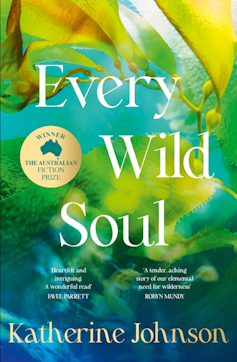
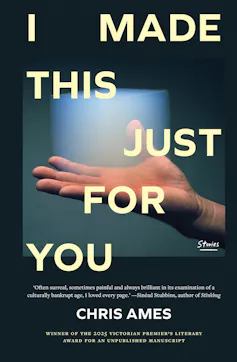
Katherine Johnson’s Every Wild Soul and Chris Ames’ I Made This Just For You do not have much in common. Every Wild Soul traverses the complexities of sheltered upbringings, fragile ecosystems and environmental bureaucracy; I Made This Just For You navigates the absurdity of everyday life in the 21st century with humour, heart and a healthy helping of criticism.
Review: Every Wild Soul – Katherine Johnson (HarperCollins) & I Made This Just for You – Chris Ames (Hardie Grant)
And yet there is something these books share: both were awarded unpublished manuscript prizes. Every Wild Soul won the Australian Fiction Prize (formerly the Vogel Literary Award) and I Made This Just For You won the Victorian Premier’s Literary Award.
So what was it about these two works that made them prize-worthy even before publication?
Every Wild Soul
Every Wild Soul is Katherine Johnson’s fifth novel, and not her first prizewinner. Two of her earlier works, Pescador’s Wake (2009) and The Better Son (2016), won awards for manuscript development. The Better Son also won the University of Tasmania Prize and the People’s Choice Award as part of the Tasmanian Premier’s Literary Awards.
Every Wild Soul follows two women at very different stages of their lives. Eighteen-year-old Min lives a sheltered life on the remote Maria Island, off the east coast of Tasmania. She is struggling against the boundaries imposed by her single father, the head park ranger.
Min has built strong relationships with other people on the island. The most significant is with Werner, a homeless biologist and former national parks worker, who is undertaking his own, sometimes unorthodox, environmental research. Min works alongside Werner and others to facilitate various conservation efforts.
Also navigating the crossover between the natural world and her personal life is Lucie. After years of struggling as a freelance journalist in London, she is trying to revive her career with a series of stories on rewilding efforts around the world. She has returned to her native Tasmania after years abroad, where she covered storks nesting in England and elephant migration patterns in China.
Upon her return to Maria Island, Lucie works hard to better understand the Tasmanian ecosystem – the extinct thylacines, the endangered devils, the waning penguin population – while undergoing a regeneration of her own. Having been through several miscarriages in London, she must now navigate the early stages of pregnancy alone, on the other side of the world from her aloof partner Richard.
As Min and Lucie’s stories entwine, something else is unravelling. A number of competing environmental priorities are up for discussion, and everyone wants to have their voice heard. What is the most important thing for Maria Island? Is it saving the penguins? Building a wind farm to ensure the island has a sustainable renewable energy source? Protecting the endangered population of devils? Or something else entirely?

Amazon
Johnson is a Tasmanian herself, and trained in biology. She writes with ease and authority about Maria Island’s complex biodiversity. It is not surprising to learn she has completed extensive research into rewilding projects around the world – with a special interest in Tasmania’s giant kelp forests.
The passion and precision with which Johnson approaches the topic of rewilding in Every Wild Soul is one of the novel’s great strengths. The descriptions of nature and rewilding efforts, both on Maria Island and worldwide, make the reader care about these things, and caring makes all the difference.
Another strength of the book is its optimism. Every Wild Soul grapples with intense themes, such as coming of age in an era of looming ecological disaster, but it doesn’t lean on cynicism. Underneath everything is a story more hopeful than expected.
I Made This Just For You
I Made This Just For You is Chris Ames’ debut short-story collection. It is a book that highlights the comical, indeed often farcical, aspects of life in the 21st century. One story, Charlie & Charlie & Charlie, suggests the cultural obsession with plastic surgery will eventually result in us all looking exactly the same as our partners. The title story explores the limits and possibilities of online impersonation.
The book also asks questions of its readers. How do we care for each other in a collapsing world? How do we stop ourselves sinking into despair?
Ames’ writing is full of rich, powerful descriptions and reflections on modern-day life. For example, in Everything Solid Is Vibrating In Place, a character with a heart defect gets coffee with his wife. The cashier then asks if they would like to pay for their coffees separately or together, prompting this observation:
No matter how super-concentrated, how binding, that magnetism is still invisible to those outside its field, who, unaware that you’ve held each other in hospital rooms, for the birth of a child, for the death of a parent, for the health scare that lurks beneath everything, might not clock the matching rings on your fingers, and, in an abundance of caution, asks if you’d like to split a $10 total.

Hardie Grant
Every story in I Made This Just For You is teeming with life. It’s satirical, hilarious and absurd in equal measure. It may be uncanny at times, but it is not unrealistic; underpinning each of the 17 stories is a startling sense of the real world.
It’s unlikely the hair in your shower drain will emerge as a doppelganger, as it does in the story Good Light, but, given the current pace of technological advancement, it’s not impossible we might one day upload the likeness of dead parents into an LLM that can reproduce their terrible advice.
One character attempts this in Everything Solid Is Vibrating In Place. Needless to say, it does not go well. Even so, the writing is beautiful. When the protagonist’s house catches fire, she runs back inside to retrieve the technology and, when she fails, releases “a double-howl of grief, for this is the second time she’s watched her mother die”.
Certain stories may be too quirky for some readers’ tastes. One, titled Nine-Letter Word For A Woman I’m In Love With, is told via crossword puzzle clues. But the reason the collection works so well is because it is satire done right. What this means, mostly, is that Ames has not fallen into the trap of attempting satire, failing, and instead replicating the very thing being satirised.
Instead, the book succeeds because it recognises that modern life really is that absurd, that weird, that bizarre. The weirdness is thrilling in its execution, but mostly in its plausibility. The night before a job interview you might well “absent-mindedly tug on your pubic hair and relive every high school humiliation”, as we see a character do in Your Heart Is A Simple Machine.
After the awards
Both of these books had their merit recognised well before they were published. Now that they are both on shelves ready to be enjoyed, it seems important to acknowledge the timeliness of their publication. They have been launched at a time when Australian ecofiction is blossoming and quirky short-story collections are having their moment.
But there’s more to it than that. In Ames’ story You Of All People, a comedic piece about a perpetual press tour, we get this:
“I’m thinking, as a way forward, and hear me out: I kill myself,” Gabbi tells her agent.
This kind of irreverent humour is, of course, a way of dealing with the absurd reality of life. In a world marred by violence, hatred and disaster, it seems natural that books should reflect a growing cultural pessimism. But it isn’t the only possible response. Near the end of Every Wild Soul, Lucie receives an email from a fellow conservationist who has also worked alongside Werner, which reads:
It is not an exaggeration to say that one humble, selfless man on an island at the end of the Earth has started a worldwide movement in rewilding. And, in the process, he has helped heal all those he has met, although he wouldn’t see it that way. I imagine he has no idea what an enormous effect his kindness has had.
These books are excellent independently, but when read together they ask a new question: do we have to choose between having hope for the future and accepting life in all its bizarre banality? Maybe. But reading both of these seemingly unrelated books alongside each other suggests that maybe we can, in fact, do both.