Highways, rail networks, airports, national healthcare systems, defence and information technology… As governments around the world prepare to invest heavily in critical infrastructure, an important question remains: who ensure that the major projects to deliver it are well governed and how?
Global infrastructure investments are expected to exceed $150 trillion through 2050, with annual spending increase from US$4.4 trillion in 2024 to US$6.9 trillion in 2050.
Europe alone is preparing to account for a major share of these investments through increasingly ambitious policy instruments: from Jean-Claude Juncker’s €315 billion Investment Plan for Europe in 2014, to the €806 billion NextGeneration EU package in 2020, to Mario Draghi’s call in September 2024 for an additional €800 billion every year, close to 5% of EU GDP, in decarbonisation, digital and strategic technologies, and defence.
Why is governance the missing piece?
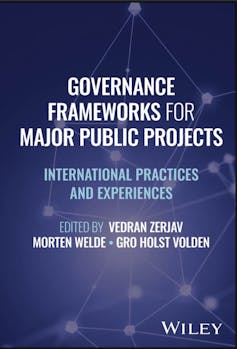
Each initiative has been larger and more ambitious than the last. Yet despite the visibility of these plans, the projects they fund are often poorly governed – running over budget and behind schedule. This issue is at the heart of our recent book on governance frameworks for major public projects which support the delivery of infrastructure, enabling and facilitating social and economic activities.
Wiley
A governance framework refers to the systems, processes, and regulations government implement to improve the likelihood of projects being delivered according to plan and within an allocated timeframe and budget. These frameworks determine who makes decisions, how projects are evaluated, what information is required before funding is approved, and how lessons are retained after completion.
Our comparative study centred on ten national and provincial governments: Norway, the United Kingdom, the Netherlands, Ireland, Denmark, Sweden, the United States, Canada, the province of Quebec, and Australia – as well as supranational entities such as the European Union and the World Bank.
The book focuses on governance arrangements introduced at the topmost level of government for national infrastructure, with Quebec included as a province-level comparator.
For many countries in our sample, governance frameworks were introduced between 2000 and 2010 (with Canada as a notable exception, having introduced its first framework in 1978), providing an opportunity to assess their strengths and weaknesses.
Our analysis identifies the practices that distinguish governments with consistently better outcomes.
Norway stands out as an example of how a project governance framework can operate in a well-functioning institutional setup.
After the Norwegian Ministry of Finance introduced mandatory external quality assurance in 2000 for all public investments above NOK 1 billion (around €85 million), a 2015 study found that the share of large Norwegian road projects experiencing cost overruns fell from 72% before the framework to 27% afterwards.
A 2024 paper looking more broadly at 96 Norwegian government projects found just 25% had cost overruns, with the average project delivered 4.4% below budget. The framework is strictly managed – exemptions are not easily obtained – and independent quality assurance gives ministries a clear incentive to build internal expertise rather than rely on consultants.
Major projects delivered under this regime include the Ferry-free E39 coastal highway programme on Norway’s west coast and a multi-decade series of fjord crossings whose appraisal and quality assurance run through the State Project Model.
The Norwegian case also illustrates a broader pattern: well-governed delivery rests on clear ownership through the project lifecycle, capable public-sector project owners – the agencies that commission, build and operate national infrastructure, such as Norway’s Statens vegvesen – with their own in-house technical capacity, and learning systems that feed evaluations of completed projects back into the next decision.

Xseon/Shutterstock
Whether the frameworks work as intended may depend on transparency and development of skills, and whether the framework is mandatory. In line with that, our comparison points to several current challenges.
Accountability is not always accompanied by full transparency. It remains a central objective across the governments we studied, but is not pursued consistently.
In Canada, for example, “Cabinet Confidence” is frequently invoked to restrict access to information requested by journalists, researchers, and the public. While confidentiality serves a legitimate purpose, it also limits independent scrutiny of major public projects.
Another challenge is that large-scale projects are often announced with fanfare before a robust business case has been completed, as noted in the case of Australia.
Australia’s Snowy Hydro 2.0 – announced in 2017 at A$2 billion – was reset to A$12 billion in 2023 and is now undergoing a further reassessment. In June 2026, the Australian National Audit Office reported that the project’s final cost and completion date remain unknown. At the same time, independent review mechanisms often lack permission to cancel or terminate projects that present significant risks and concerns.
Across the governments we compared, governance frameworks for major public projects have already generated key benefits.
What differences did the frameworks make?
Overall, the experience from the cases suggests that the various frameworks have positively contributed to:
-
An improvement of the quality of decision-making
-
A streamlining of key processes
-
An improvement of cost control in some countries, but challenges remain
-
A disciplined effect on political decisions; however, the tension between politics and rational planning is a perennial issue.
Based on these findings, we recommend the following:
-
Governments should place emphasis on rigorous project appraisal before political commitment is made.
-
Independent quality assurance should play a crucial role: instead of relying solely on internal assessments, external experts should review business cases, cost estimates and rationales before projects can move forward.
-
Accountability should be clearly assigned throughout the project lifecycle. Governments should build in-house technical expertise and prioritise learning capabilities that feed lessons from completed projects into future investment decisions.
-
Governance frameworks should incorporate local stakeholders in management processes, encouraging different actors to collaborate in identifying solutions and addressing issues before conflicts escalate.
Taken together, these findings make the case for a sustained cross-country conversation – one that lets governments share experience and learn from one another.
Sharing experience through networks like the Concept Symposium at NTNU, the UK’s IPA/NESTA, and similar communities – engaging civil servants, practitioners and academics, conducting independent evaluations, and systematically reviewing completed projects – can help ensure that future investments deliver lasting public value rather than costly disappointments.

A weekly e-mail in English featuring expertise from scholars and researchers. It provides an introduction to the diversity of research coming out of the continent and considers some of the key issues facing European countries. Get the newsletter!