
The announcement sent ripples of surprise through Australian performing arts circles: Lucy Guerin will step down as artistic director and CEO of leading Australian contemporary dance company Lucy Guerin Inc at the end of 2026.
Over the past 25 years, Guerin has built one of the most important and best-resourced contemporary dance companies in the country.
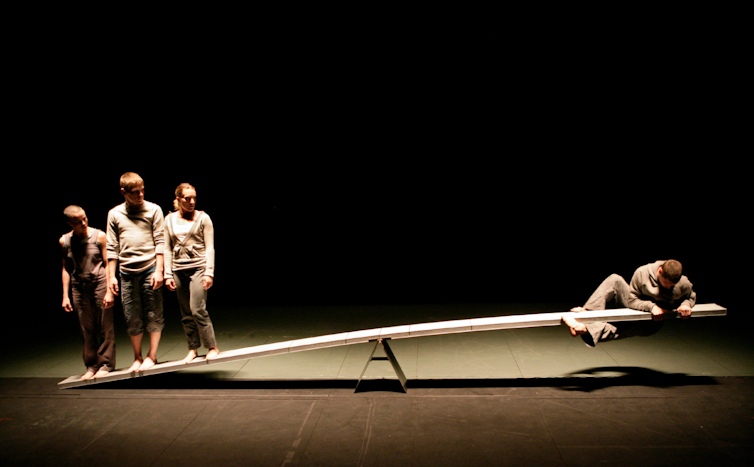
Guerin formed Lucy Guerin Inc (LGI) in 2002, after more than a decade working as an independent choreographer in New York City and Melbourne. The company received multi-year funding from the Australia Council in 2006 and produced in quick succession a series of critically acclaimed evening-length works, including Melt (2002), Aether (2005) and the multi-award-winning Structure and Sadness (2006).
LGI/Jeff Busby
These works were notable for theatricality as much as for pure movement invention. Guerin’s gifts as a director came increasingly to the fore as the scale of her projects grew.
Through LGI, she became one of the key figures in the dramaturgical turn in Australian contemporary dance, culminating in co-presentations with major theatre companies, including Malthouse Theatre on Human Interest Story (2010) and Belvoir on Conversation Piece (2012), bringing dance to an expanded audience.
These works opened fresh conversations around spoken text in dance, portable technology, the choreographic use of iPhones and iPods and the involvement of non-dancers.
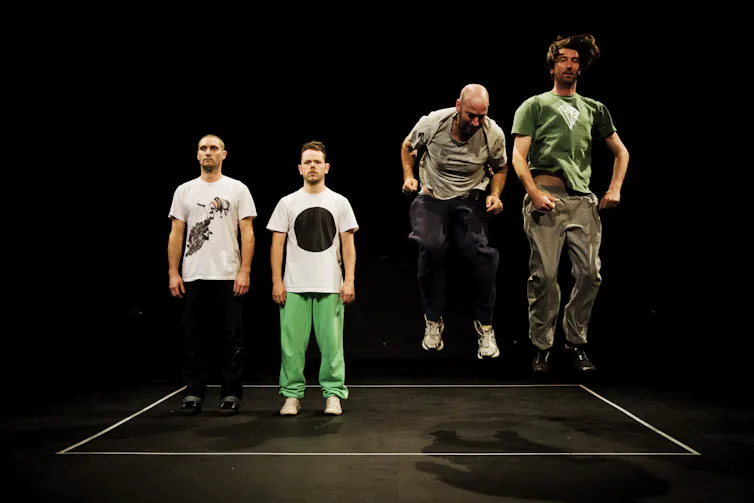
Untrained (2009) paired two trained dancers with two untrained men and became one of the company’s signature works. Few recent Australian dance works have travelled so widely or remained so durable: more than 17 years after its premiere, it returns to Ballarat in December 2026.
LGI
A piece of civic infrastructure
The company has never had a permanent full-time ensemble, but Guerin has developed sustained relationships with dozens of dancers, many now major artists in their own right. Stephanie Lake, Antony Hamilton, Lilian Steiner, Melanie Lane and Alisdair Macindoe are only some of the figures whose careers intersect significantly with LGI.
That’s one reason LGI feels less like a conventional choreographer-led company than a piece of civic infrastructure – and why it is being handed on, rather than wound down.
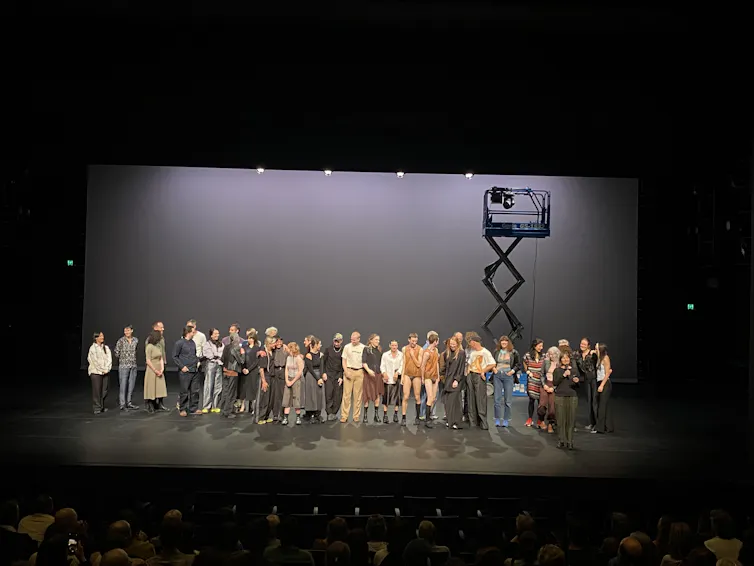
Its studio is as much community centre as an administrative base: a place for classes, workshops, formal and informal conversations, showings, residencies and professional exchange.
LGI
Then there is PIECES, formerly Pieces for Small Spaces, the company’s generator of short works. It began as a rough-and-tumble forum for testing ideas, and is now a crucial generator of high-quality choreography.
Its history doubles as a compressed history of Melbourne contemporary dance. Jo Lloyd, for instance, appeared in the inaugural season, back in 2005, as an emerging choreographer and returned then last year with Post Hoc, a mature, witty and beautifully eccentric work.
Guerin has often spoken about wanting to create the conditions that allow choreographers to develop their practice, drawing on her own experience as an emerging artist in New York.
As PIECES has evolved into a platform for more substantial works by established artists, LGI has also created new initiatives that provide artists with the chance to show work at an early, exploratory stage – and then to talk about it with their peers.
What happens next
There is no indication Guerin is stepping away from dance.
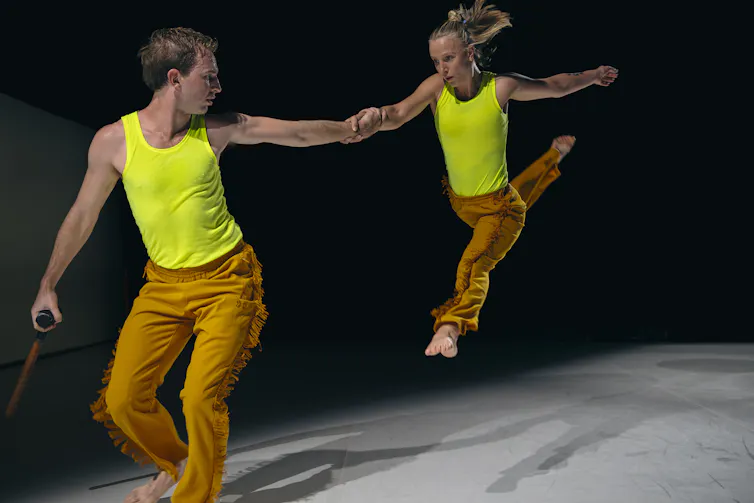
If anything, recent works such as Ground Control (for the Australian Ballet, 2025), One Single Action (2024) and How To Be Us (2022) suggest a renewed enthusiasm for dance. Her final work for LGI will be a new solo. After that, it is easy to imagine her continuing to make work, perhaps on a smaller scale and with less administrative burden.
LGI/Gregory Lorenzutti
The more intriguing question is what happens to the company.
LGI is now advertising for a new artistic director and co-CEO, looking for someone who can lead the company forward with their “own vision, voice and ambition”.
This raises a fundamental question: what, exactly, is being passed on? The programs? The studio culture? The repertoire? The name?
LGI is unusually well placed for this transition. It receives multi-year support from three levels of government, has strong philanthropic relationships, and in 2022 received the A$2 million Chloe Munroe Bequest, one of the largest gifts ever made to Australian contemporary dance.
Whatever the cultural and artistic complexities of the transition, LGI is not in a state of collapse.
It is unusual for a company so closely associated with a single living artist to change hands after more than two decades. More often, such companies are folded up when their founding figure leaves, as was the case with Phillip Adams BalletLab. There are cautionary succession stories too. Leigh Warren handed his company to Daniel Jaber in 2014, but within about a year Jaber had left.
There are more encouraging examples. Meryl Tankard Australian Dance Theatre survived Tankard’s departure in 1999, partly because it was never simply her company, despite the strength of her imprint. It returned to the broader ADT identity and continued under Garry Stewart.
Guerin’s greatest legacy may be that she has already made the company more than herself: a repertoire, a studio, a set of programs, a network of artists and a model of institutional generosity.
The question now is whether that generosity can become a structure strong enough to outlive its inspiration.