
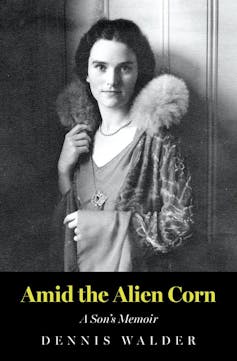
South African-born literary scholar Dennis Walder recently published an evocative life story called Amid the Alien Corn: A Son’s Memoir. In it, he tracks how, even as a child, he became aware that his mother Ruth was withholding something of herself, and her past, from him. This disquiet comes to a head after her death.
The book paints a rich and entertaining description of Walder’s childhood and young adulthood. He grew up near Cape Town in the 1940s and 1950s with his Namibian-born, German-speaking mother and estranged Swiss-born father. But, as you read, this shifts to a single-minded quest to get to the bottom of the contradictory accounts Ruth has given of her past.
Troubador Publishing
After completing a degree at the University of Cape Town in the early 1960s, Walder decided to leave apartheid South Africa, vowing never to return. In 1981, he was nevertheless drawn back to interview renowned playwright Athol Fugard for a book, and to take stock of what was happening in the country.
In fact, Amid the Alien Corn is patterned by departures and returns between South Africa, the UK, Namibia and Germany. It offers fascinating glimpses into the social and political landscapes Walder moved between. In South Africa, there were interactions with members of the almost forgotten African Resistance Movement. There are also vividly described encounters with cultural figures, among them Gibson Kente and Nadine Gordimer.
But it’s his mother that’s at the heart of much of this beautifully written book. As a scholar of South African literature, I was impressed by the complexity it achieves. The reader is drawn into Walder’s search for the truth about Ruth’s life, but he also warns us:
Nostalgia poisons your ability to understand your place in your own narrative, therefore in history too, while drawing you in.
This idea, that emotion-laden memories might hide the truth about one’s life story and its place in history, is what I consider one of the most rewarding aspects of the memoir.
Beyond a memoir
The book’s prologue begins with Walder’s journey to Cape Town in 1992 when he was 50, to bury Ruth. He moves between his own coming-of-age experiences and his attempts to uncover information about Ruth and her parents, who moved to Namibia in the early 1900s from Germany. In the process, Walder makes us aware of how personal histories are connected with wider events.
The cover is dominated by a striking black and white photo of Ruth, who appears to exude self-sufficiency, even determination. She has an enigmatic not-quite smile and holds the viewer’s gaze. This easy first impression is soon unsettled by references to her fragility, her often contradictory accounts of past events. Her “tight smile” indicates a determination to keep words unspoken.
Darker Shade of Pale: why I wrote a book about my grandfather and how it changed my view of him
As Walder later reminds us, the French philosopher and scholar Roland Barthes describes family photographs as offering only “fugitive knowledge”. Our interpretations of what we see depicted are unreliable.
At the same time, the title (from English poet John Keats’ Ode to a Nightingale), invokes the biblical Ruth, a figure of exile, loss, displacement and unbelonging.
This sense of unbelonging is shared by an intellectually precocious and sensitive young Walder. He’s uncomfortable in his own skin while growing up in apartheid South Africa and its oppressive race laws.
Family secrets
Walder’s quest to know more about Ruth’s past leads him and his wife Mary MacLeod to the archives and to genealogy researchers who trace family origins in Windhoek, Cape Town, Bad Liebenstein and Berlin.
Without compromising, he grapples with the possibility that his search might uncover his family’s complicity with colonial history.
His task is made all the more difficult by Ruth’s evasiveness. She recalls the family history selectively. She falsely claims her father Albert Liebenstein was an only child, as was she. Like the Stolperstein monuments (literally stones that you stumble across) in German cities to commemorate the places where holocaust victims and survivors last lived, Walder’s pursuit leads to unexpected discoveries and living relatives he hadn’t been aware of.
He notes his unease at the growing sense that Ruth’s memories, as told to him or imagined, are becoming his own, uninvited. Taking on Ruth’s memories is a way of mourning a mother he felt he did not really know or understand.
Learning from the story of pioneering South African writer Sindiwe Magona
Ruth’s presence after death lingers in places like the grand Villa Lanwers in Windhoek, owned by her father when he was a successful tradesman. Now listed as a heritage house, it becomes a site of memory he feels it is “a duty not to forget” on her behalf.
His grandmother Margarethe’s grave in Windhoek becomes the site of another burial. The couple place a headstone there in memory of Ruth and her mother and father.
Yet there are also bitter realities here, given that the mass graves of the indigenous Herero and Nama inhabitants executed by German colonisers during the century’s first genocide were not dignified with burial rites.
5 great reads by South African writers from 30 years of real-life stories
It would be a spoiler to tell what Walder discovers. But the reason Ruth kept her secret remains unclear by the end. One could speculate that it was to protect her family, or herself, or that she simply tried to erase a personal history that felt too difficult – or even too shameful – to live with.
Whatever the “truth” of her silence may be, the son’s memoir is, if not a record, a memorial to Ruth’s life. But the book’s dedication, “For the Forgotten”, takes in a much wider sweep of humanity, across time and place. It prompts readers to reflect on similar silences within their own and other families.