
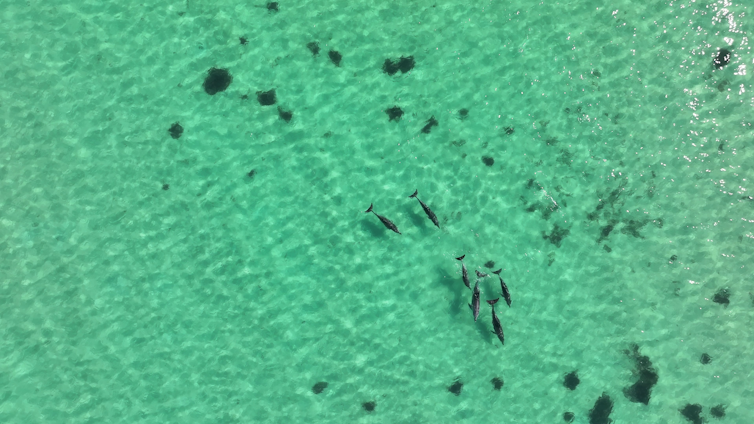
In the turquoise waters of Western Australia’s Shark Bay lives a large resident population of dolphins. Some of these marine mammals are 54 years old, others just infants. But no matter their age, they live highly social lives.
Researchers have studied these dolphins for decades. Forty years on, our extensive dataset reveals crucial insights into how these animals socialise throughout their lives – and how their social choices affect their health and fitness.
In our new study, published in PLOS Biology, we analysed nearly 40 years of data on over 450 wild Indo-Pacific bottlenose dolphins (Tursiops aduncus) from Shark Bay. We found that as dolphins navigate their social world, they develop unique personalities and social preferences, and individuals who are consistent about these preferences may live longer.
Sociality is a spectrum
Dolphins’ social lives mirror our own in remarkable ways.
As they navigate their blue world, dolphins move in and out of social groups, constantly making decisions about who to spend time with and who to avoid, depending on the task at hand.
Much like humans, dolphins vary markedly in how social they are. Research shows some are more cliquish, while others are true social butterflies, embedded in large and complex social networks
These differences matter. Just as in humans and many other species, the way dolphins navigate their social lives can shape their survival, longevity and reproductive success. For example, strong social connections promote resilience, while social isolation can increase mortality risk.
Such patterns are not set in stone either.
In many species, including humans, social behaviour is shaped as we age. In humans, social networks often become smaller, with older adults becoming more selective, investing their time and energy in a smaller number of meaningful relationships.
But what happens as dolphins age?
Previous research on dolphins has shown us that extended maternal care in older dolphin mothers is evidence of reproductive senescence – similar to menopause in humans. This raises an intriguing question: do dolphins also show other patterns of ageing like our own?
Diana Alvarado/Shark Bay Dolphin Research Project, CC BY
Social ageing can be measured in multiple ways
As we age, we develop personalities, build and lose relationships, and create our unique social environment which changes with each passing year. This process of social change as we grow is called social ageing.
Most studies of social ageing have examined how individuals change over time by collecting many measurements, then finding their average. This can be useful for dolphins that have only a few close companions. But for those who frequently join groups large and small, an average tells us very little.
We can instead turn to another measurement: predictability. This describes the spread of an individual’s data. Those dolphins who consistently spend time with the same number of other dolphins are very predictable. Those who flit between groups of many sizes are much less predictable.
Predictability is difficult to measure because it requires a single individual be measured dozens, even hundreds, of times. Luckily, with 40 years of data on over 450 dolphins, research can go beneath the surface to study not only how individuals change in sociability with age on average, but how predictable they are, and if predictability can change, too.
Being consistent is key
For our new study, we examined the effects of sex, age, and individual personality on group size (a measure of sociability) throughout the population of dolphins at Shark Bay. We discovered several key points.
First, dolphins follow a pattern very similar to humans and other long-lived species: they increase their average group size with age, to a point. After that point, which is unique to each individual, those average group sizes begin to decrease.
Second, regardless of what their average group size is, individuals become more predictable with age.
Third, males had a higher average group size and higher predictability than females.
Finally, individuals who continued to increase their group size average and predictability most with age lived longer.
Social stability can being a sustaining force
Our research into dolphins’ social lives suggests that developing a strong and stable social environment can buffer many of the effects of ageing and enhance lifespan.
Studying dolphins’ social traits reveals that it’s not only average behaviour which shapes fitness outcomes, but individual predictability. To truly understand how ageing shapes us, we must look beyond the average to see how the predictability of our social decisions can affect us as we navigate our world.
This study reinforces the importance of maintaining consistent social relationships throughout the ageing process. In the case of the Shark Bay dolphins, it’s not only about how large one’s social circle is; rather, it’s about the social circle staying roughly the same size and type over size.
And this holds an important lesson for us, because the trends we find in dolphins closely parallel the sort of patterns we see in human social behaviour as well.