
Less than a week before Election Day, The New York Times reported that people with links to Alaska Democrat Mary Peltola’s U.S. Senate campaign and the Democratic Senatorial Campaign Committee had recruited a candidate to the race whose name is nearly identical to that of the incumbent Republican senator, Dan Sullivan, whom Peltola was challenging. The plan aimed to siphon votes from the incumbent senator and help Peltola win, according to the reporting.
The story has driven calls for prosecutions, lawsuits and state action. But as a political scientist who studies election law, I can say that the spoiler candidate is one of the oldest tricks in the American campaign toolbox, and the law has rarely touched it.
Early ballots
Smithsonian National Museum of American History
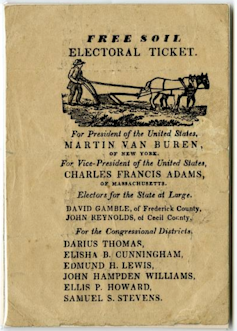
For most of the 1800s, American elections were conducted with ballots designed and printed by the parties. There were no official ballots printed by the state.
In those days, the addition of a rival name to a party ballot by an insidious printer could swing countless votes to the opposing party. The tactic was well known, and voters were often warned to look out for the “Spurious Ticket.”
By the 1890s, the government-printed ballot had gained widespread adoption and ended the practice of counterfeit tickets. But that would not be enough to deter those who wanted to deceive voters.
Power of a name
As observers in Alaska have noted, recruiting candidates with similar or identical names is not a new move.
In John F. Kennedy’s first congressional primary, his opponent was a city councilor named Joseph Russo. An aide to Kennedy reportedly paid a janitor with the same name to enter the race. The real Russo complained, but in the end, Kennedy took more votes in the 1946 race than the Russos combined.
Eight years later, the name Kennedy worked the other way, when a Gillette stockroom supervisor named John Francis Kennedy, no relation, was elected as a Democrat to the position of treasurer and receiver-general of Massachusetts, owing in large part to the familiarity of his name. Names can move votes, so namesakes can be worth recruiting.
Spoilers as surrogates
Some spoiler candidates are not necessarily meant to win votes. Sometimes they are there to amplify a message.
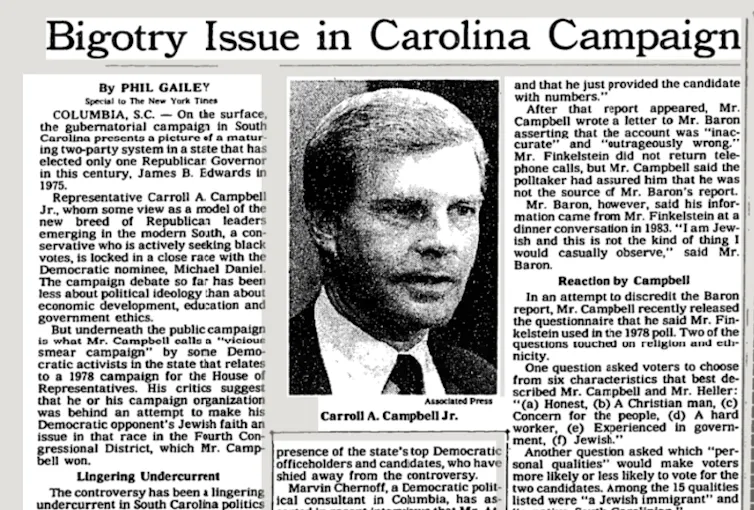
In 1978, Republican Carroll Campbell was running for an open House seat in upstate South Carolina. His opponent was Max Heller, the mayor of Greenville and a Jewish refugee from Nazi-occupied Austria.
Days before the election, Don Sprouse, an independent running for office for the first time, held a press conference and declared that Heller was unfit for office as he had “not made clear to the voters he is not a Christian” and was “not as qualified to represent the Christian people.”
Although Campbell condemned the remarks and Sprouse received only 1,693 votes, Heller lost the race. The allegations, still unproven, of Sprouse being a “stalking-horse” for Campbell only surfaced years later, but they continued to dog Campbell when he ran for governor in 1986.
Sprouse wasn’t going to spoil the election with the votes he could win, but he could be a spoiler with his message, an antisemitic appeal that Campbell would not make directly.
New York Times archive
Candidates who don’t even know they’re running
A different type of ballot shenanigan skips the recruitment and simply puts candidates on the ballot.
This was the case in 2010 when two Oakland County, Michigan, Democratic officials put candidates on the ballot under the Tea Party label in three races. The candidates didn’t even know they were running.
In this case, the law did come back to bite. The county party chair and operations director were charged with perjury and forgery, but the crime was forging signatures, not their strategy.
Some state election codes specifically discuss false declarations or forged election paperwork, but many don’t contemplate this type of scheme. Forgery and perjury, however, are illegal across the country, and it’s almost impossible to put an unwitting person on the ballot without one or the other.
Alaska: No barriers
In Alaska, this tactic can be used cheaply. There is no petition requirement to get on the ballot, just a $100 fee. Moreover, the parties can’t vet candidates in the primary. The state’s unique top-four primary system lets candidates choose their own party label.
The saga of Daniel J. Sullivan, the schoolteacher known as “Petersburg Sullivan” because of where he lives, and Sen. Dan S. Sullivan goes back longer than recent revelations.
Petersburg Sullivan filed to run as a Republican in the Senate race just three days before the deadline; state officials tried to bar him from the ballot. In June a judge said there was nothing in Alaska law to prevent him from appearing on the ballot, and the state Supreme Court subsequently agreed.
Since he couldn’t be removed, the state Division of Elections took unusual steps on their ballot design to help distinguish the two candidates. They listed Sen. Dan S. Sullivan as a Republican, marking him as the incumbent, and left Daniel J. Sullivan without a party designation. This had not been done for previous incumbents in at least a decade.
What the law can do
Assuming there is no forgery of documents with an unwitting and unwilling spoiler candidate, there is little the law can do. History shows us that the real legal exposure in these cases usually lies where it most often does in politics: money.
In a 2020 Miami, Florida, race, a former state senator turned political operative was convicted of three felonies related to efforts to recruit and pay a decoy candidate with the same surname as the Democratic incumbent. In another Florida case, a local Republican Party chair was convicted in connection with a scheme to plant a progressive alternative to siphon votes from the Democratic candidate. In both cases the prosecutions focused on campaign finance crimes, not simply on putting the spoilers on the ballot.
The state of Washington is an outlier, where it is a felony to run under a rival’s surname if the intent is to confuse voters. In 2024, two Bob Fergusons were recruited by conservative activist Glen Morgan to run for governor against state Attorney General Bob Ferguson. Both opted to drop out of their race under threat of prosecution.
There is nothing comparable to these laws in Alaska, however, and whether laws like this could prevent this type of thing in a federal election is still untested. Under the Supreme Court’s decision in U.S. Term Limits v. Thornton in 1995, states cannot add their own qualifications for Congress.
Read your ballots!
The advice from 1860 – “Watch your tickets on election day. There’s a scheme on foot …” – when newspapers urged voters to read their tickets before casting their vote, is still relevant long after the demise of the party ticket. It is unlikely that the law can solve this problem, because to do so would be to wade into the First Amendment waters of why people run for office. Regulating thought and intention is a dangerous proposition under the Constitution.
The old answer is the best one. Self-government depends less on clever rules and more on citizens paying attention. Read your ballots!