
People in the Canadian province of Alberta are voting on whether to stay in Canada or begin a process for a second, binding referendum on independence. By 2030, those in Québec could face a similar choice.
Polls show that some 70 per cent of people in Alberta and Québec favour remaining in Canada, and many oppose the referendums. Looming large in the background is United States President Donald Trump, who has repeatedly called for Canada’s annexation while imposing punishing tariffs on the country.
Canada’s fight with Trump isn’t just economic, it’s existential
Beyond a shared interest in increased autonomy from the federal government, Alberta and Québec have little in common. Alberta’s grievances focus on federal economic, energy and climate policies, immigration and political representation. Québec’s concern is the protection of its distinctive language and culture in an anglo-dominated North America.
Alberta referendum
In May, Alberta Premier Danielle Smith announced a referendum with two options in a clear bid to unite her divided United Conservative Party (UCP). The move followed a court’s dismissal of a citizen petition on independence pushed by separatist elements within the party.
The announcement came after she signed an energy-climate agreement with Prime Minister Mark Carney that eased the way for a new West Coast oil pipeline to ship oil to Asian markets. The deal, she argued, shows Canadian federalism can work.
Smith, who had previously been non-committal, says she’ll vote to remain in Canada, even though a recent poll found that a small majority of UCP members support separation.
THE CANADIAN PRESS/Jeff McIntosh
Québec separatism
There has never been any doubt about where Québec’s Parti Québecois (PQ) stands — sovereignty has been its core value since the party was founded in the late 1960s.
Through three stints governing, the PQ has held two independence referendums. The 1980 vote failed by 40-60 per cent of voter support, and in 1995, those wanting to separate from Canada lost by a narrow 50.6-49.4 margin. PQ Leader Paul St-Pierre Plamondon, whose party won a minority victory in the recent provincial election, has committed to a third referendum.
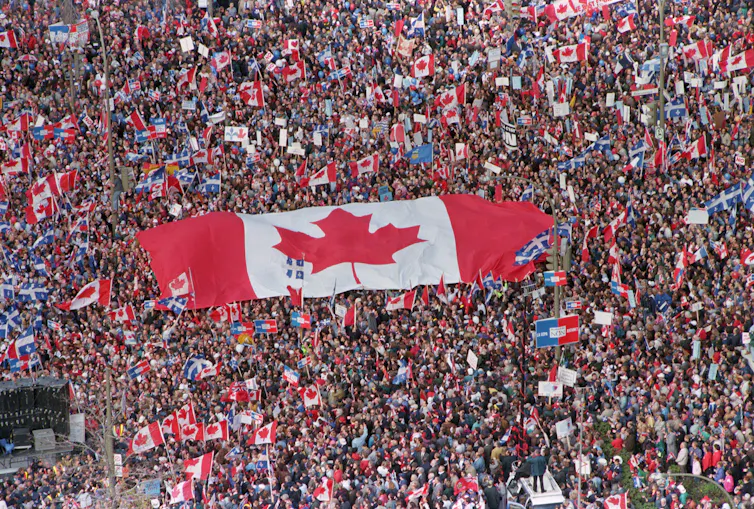
THE CANADIAN PRESS/Ryan Remiorz
Leaders from both provinces have discussed co-operating to further their independent authority and trade. Plamondon, who has met with Alberta separatist leaders, has said a PQ government would recognize an independent Alberta and that Québec should no longer accept equalization payments.
A longtime irritant for many Albertans, equalization is a program funded by federal taxes that assures comparable public services across Canada. Alberta taxpayers are major contributors; Québec is the largest recipient.
But stumbling blocks remain, including Québec’s opposition to a potential pipeline carrying Alberta oil through Québec to Canada’s East Coast.
The impact of Trump’s threats
The Alberta and Québec referendum debates come at a time when Canada-U.S. relations are at a low ebb amid Trump’s talk of making Canada the 51st state and waves of tariffs on billions of dollars of Canadian exports.
Only 23 per cent of Albertans and 10 per cent of Québecers have a positive view of Trump, although some Alberta separatists treat his administration as a crucial ally and held a meeting with U.S. Republican delegates in the province..
Albertans disapprove of Donald Trump — and his brand is weakening separatism, too
Trump’s tariffs have affected the two provinces differently — and they’ve responded accordingly.
Alberta is among the least affected by Trump’s tariffs because its exports of oil, gas and beef are exempted.
Smith has rejected calls to postpone or cancel the referendum because of U.S. actions. In August, she called for “de-escalating and doubling down on diplomacy” after Carney said Canada was “at war” with the Americans following the collapse of trade talks and Trump’s new 50 per cent tariffs on a range of Canadian products.
But it’s far from clear what diplomacy can accomplish with Trump insisting talks take place on his terms.
Québec’s economy, meanwhile, has been hit harder than any province’s by Trump’s tariffs, which have targeted its manufacturing, aluminum, steel and lumber industries.
Concern grew in August when American negotiators reportedly sought changes to the province’s French-language requirements for sales of products and digital services, which they deemed barriers to trade.
Almost half of Québecers believe they’re better off dealing with the Trump administration as part of Canada than as a separate state. Plamondon, who had already cancelled a planned trip to meet with State Department officials in Washington, D.C., has delayed the independence referendum from the original date of 2028 until after Trump leaves office.

THE CANADIAN PRESS/Jacques Boissinot
Possible consequences
The Alberta and Québec referendums create uncertainties for both provinces —and for Canada.
The threat of a revolt by separatists within Smith’s UCP — if, as expected, the independence vote fails — could unseat the premier. That might transform the UCP into a separatist party or lead to the creation of a new one, paving the way for the rival New Democratic Party to win the next provincial election.
The survival of Plamondon’s minority government in Québec will depend on its ability to win opposition party support for its policies. What’s more, minority governments seldom last long and there’s a strong possibility there will be another election before an independence referendum can be held.
Through it all, Carney’s federal government faces the daunting task of maintaining unity at home while confronting the Trump challenge.