Congress has many roles in the U.S. political system, including aiding constituents, approving presidential nominees and overseeing the executive branch. Its main job, however, is passing laws – something congresspeople have done a lot less of in recent years.
The 119th Congress has enacted 121 laws since it convened in January 2025. That’s the second fewest of any Congress in the past four decades, according to a Pew Research Center analysis. Only the 118th Congress had enacted fewer laws (106) by this point in its two-year term.
Congress’ productivity continues to dwindle
Public laws enacted by each Congress, before Election Day
* As of Oct. 14, 2026.
Note: We sorted public laws into substantial and ceremonial categories. Substantive laws spend money, create or change permanent law, order government officials to do something, acquire or dispose of land or otherwise have some real-world impact, no matter how limited. Ceremonial laws have a smaller scope, such as honoring an individual or group.
Source: Pew Research Center analysis of Congress.gov data.
PEW RESEARCH CENTER
Congress’ productivity continues to dwindle
Public laws enacted by each Congress, before Election Day
| Congress | Years | Congress | Substantive laws | Ceremonial laws |
|---|---|---|---|---|
| 100th | 1987-88 | 100th (1987-89) | 388 | 247 |
| 101st | 1989-90 | 101st (1989-91) | 299 | 224 |
| 102nd | 1991-92 | 102nd (1991-93) | 387 | 197 |
| 103rd | 1993-94 | 103rd (1993-95) | 324 | 139 |
| 104th | 1995-96 | 104th (1995-97) | 286 | 46 |
| 105th | 1997-98 | 105th (1997-99) | 306 | 43 |
| 106th | 1999-00 | 106th (1999-01) | 344 | 105 |
| 107th | 2001-02 | 107th (2001-03) | 199 | 77 |
| 108th | 2003-04 | 108th (2003-05) | 304 | 110 |
| 109th | 2005-06 | 109th (2005-07) | 247 | 120 |
| 110th | 2007-08 | 110th (2007-09) | 286 | 162 |
| 111th | 2009-10 | 111th (2009-11) | 194 | 90 |
| 112th | 2011-12 | 112th (2011-13) | 143 | 53 |
| 113th | 2013-14 | 113th (2013-15) | 141 | 44 |
| 114th | 2015-16 | 114th (2015-17) | 172 | 72 |
| 115th | 2017-18 | 115th (2017-19) | 206 | 71 |
| 116th | 2019-20 | 116th (2019-21) | 150 | 43 |
| 117th | 2021-22 | 117th (2021-23) | 160 | 54 |
| 118th | 2023-24 | 118th (2023-25) | 84 | 22 |
| 119th* | 2025-26 | 119th* (2025-27) | 109 | 12 |
* As of Oct. 14, 2026.
Note: We sorted public laws into substantial and ceremonial categories. Substantive laws spend money, create or change permanent law, order government officials to do something, acquire or dispose of land or otherwise have some real-world impact, no matter how limited. Ceremonial laws have a smaller scope, such as honoring an individual or group.
Source: Pew Research Center analysis of Congress.gov data.
PEW RESEARCH CENTER
By our deliberately generous criteria, 109 of the laws passed by the current Congress are “substantive” – meaning they spend money, create or amend permanent law, transfer land or have some sort of other real-world impact, no matter how limited. That, too, is the second-lowest total of the past four decades, behind only the 84 substantive laws enacted by the previous Congress before its election-season break.
In years past, Congress did a lot more legislating. The 100th (1987-89) through the 110th (2007-09) Congresses enacted an average of 440 laws each – including 306 substantive laws – before Election Day. That’s about twice the preelection output of the average Congress since then.
Despite its relatively low productivity, the current Congress has produced some major legislation. Perhaps the most significant is the package of tax and spending changes nicknamed the “One Big Beautiful Bill,” which became law in July 2025.
Other notable laws this term include:
Congress also passed 23 laws to overturn various Biden-era regulations, as well as one to void a Washington, D.C., local law. Together, these reversals comprise 20% of laws passed by the current Congress so far.
The current Congress still has more than two months to run, including a planned post-midterm session that may boost Congress’ productivity numbers considerably. Such sessions are often called “lame-duck” sessions because senators and representatives who’ve lost reelection can still participate and shape policy.
Congressional ‘lame-duck’ sessions are busier than ever
Share of all public laws that became law during the lame-duck period (on or after Election Day)
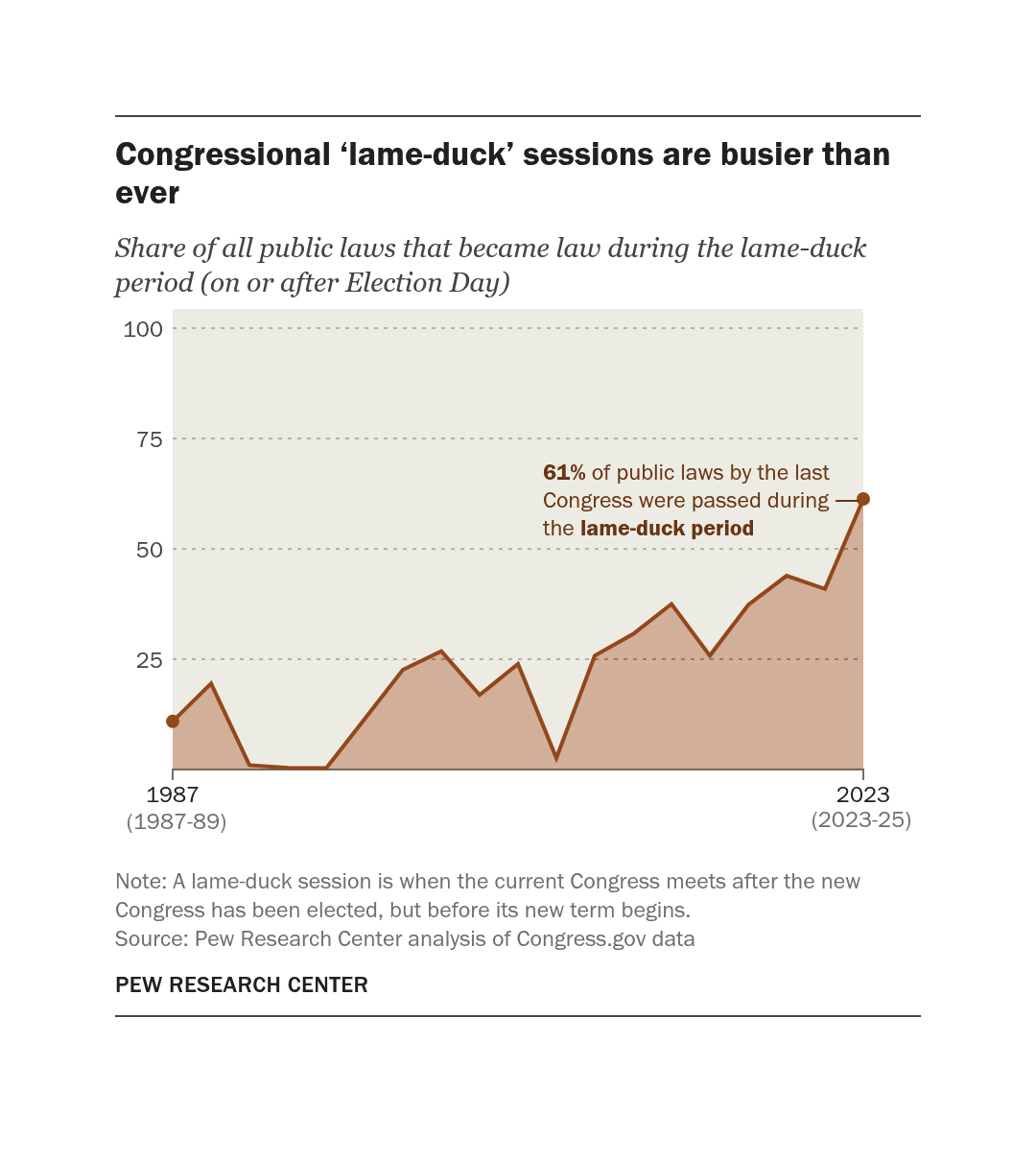
Note: A lame-duck session is when the current Congress meets after the new Congress has been elected, but before its new term begins.
Source: Pew Research Center analysis of Congress.gov data
PEW RESEARCH CENTER
Congressional ‘lame-duck’ sessions are busier than ever
Share of all public laws that became law during the lame-duck period (on or after Election Day)
| Year | Congress | congress | Years | Share of lame-duck laws | remainder |
|---|---|---|---|---|---|
| 1987 | 100th (1987-89) | 100th | 1987-88 | 10.9 | 99.1 |
| 1989 | 101st (1989-91) | 101st | 1989-90 | 19.5 | 90.5 |
| 1991 | 102nd (1991-93) | 102nd | 1991-92 | 1.0 | 109.0 |
| 1993 | 103rd (1993-95) | 103rd | 1993-94 | 0.4 | 109.6 |
| 1995 | 104th (1995-97) | 104th | 1995-96 | 0.3 | 109.7 |
| 1997 | 105th (1997-99) | 105th | 1997-98 | 11.4 | 98.6 |
| 1999 | 106th (1999-01) | 106th | 1999-00 | 22.6 | 87.4 |
| 2001 | 107th (2001-03) | 107th | 2001-02 | 26.8 | 83.2 |
| 2003 | 108th (2003-05) | 108th | 2003-04 | 16.9 | 93.1 |
| 2005 | 109th (2005-07) | 109th | 2005-06 | 23.9 | 86.1 |
| 2007 | 110th (2007-09) | 110th | 2007-08 | 2.6 | 107.4 |
| 2009 | 111th (2009-11) | 111th | 2009-10 | 25.8 | 84.2 |
| 2011 | 112th (2011-13) | 112th | 2011-12 | 30.7 | 79.3 |
| 2013 | 113th (2013-15) | 113th | 2013-14 | 37.5 | 72.5 |
| 2015 | 114th (2015-17) | 114th | 2015-16 | 25.8 | 84.2 |
| 2017 | 115th (2017-19) | 115th | 2017-18 | 37.3 | 72.7 |
| 2019 | 116th (2019-21) | 116th | 2019-20 | 43.9 | 66.1 |
| 2021 | 117th (2021-23) | 117th | 2021-22 | 40.9 | 69.1 |
| 2023 | 118th (2023-25) | 118th | 2023-24 | 61.3 | 48.7 |
Note: A lame-duck session is when the current Congress meets after the new Congress has been elected, but before its new term begins.
Source: Pew Research Center analysis of Congress.gov data
PEW RESEARCH CENTER
For years now, Congress has been pushing more and more of its workload to late in each session – past the point when members have to worry about reelection. Sometimes that means a party that has lost control of one or both chambers can still pass (or block) legislation while the incoming party waits to take power.
In the 100th Congress (1987-89), for example, 78 measures became law on or after Election Day 1988, amounting to 11% of its entire legislative output. For the next two decades, the share of “lame-duck laws” seldom exceeded 25%, and some Congresses held no lame-duck session at all.
That changed starting in the 2010s, when Republican-led Congresses were often at loggerheads with the Democratic Obama administration. More than a third (38%) of the legislative output of the 113th Congress didn’t become law until after Election Day 2014. And by the 118th Congress of 2023-25, 168 out of the 274 measures it ultimately enacted, or 61%, didn’t become law until the lame-duck period.