
Denmark and its Scandinavian neighbours often appear at the top of many of the world’s “best of” lists, from happiest and least corrupt to best place to raise a family.
The Danish way of parenting has inspired a slew of manuals that have become bestsellers. To parents elsewhere, the picture presented is a near utopia of supportive government policies and effortless rearing of happy babies.
But how different is parenting in Denmark really from other countries, like the UK?
I am a professor of psychological science at Aarhus University in Denmark. My research focuses on mental health and parenting in the early years. Here’s what the evidence shows.
Health Gap / Sundhedskløften is a collaborative series from The Conversation UK and Denmark’s Videnskab.dk exploring what the two countries can learn from each other when it comes to health and wellbeing.
From cycling and alcohol to inequality, healthcare and everyday habits, the series looks beyond hospitals and medical treatment to explore how culture, politics and society shape the way people live – and how healthy they are.
More leave for dads
Denmark and the UK differ on leave for new parents in two striking ways: how much compensation is provided and how leave can be shared between parents.
Denmark provides more generous leave compensation than the UK and assigns equal amounts of leave to each parent that cannot be transferred.
In 2022, Denmark implemented a reform offering 11 weeks of leave to fathers, and the equivalent to mothers, that is “use it or lose it”, and fathers are now estimated to take most of their nontransferable leave.
For fathers in the UK, the statutory leave entitlement is much shorter, at just two weeks. It is also less well paid, at around 19% of average earnings, compared with about 50% in Denmark.
Employers in both countries can offer enhanced paternity leave that provides more time off or higher pay than the legal minimum. But nonetheless, UK fathers take much less leave than fathers in Denmark, with a recent survey finding that most took around two weeks.
But mums still do nights
Danish nontransferable paternity leave is intended to make the sharing of infant care more equal between parents and help mothers stay in paid work.
Along with subsidies of at least 75% of early childcare expenses, these policies help explain why Denmark has markedly higher rates of mothers in employment than in the UK.
Childcare does seem to be shared more than is the norm in the UK and financial support helps to smooth mothers’ transition back to work.
pexels/william fortunato
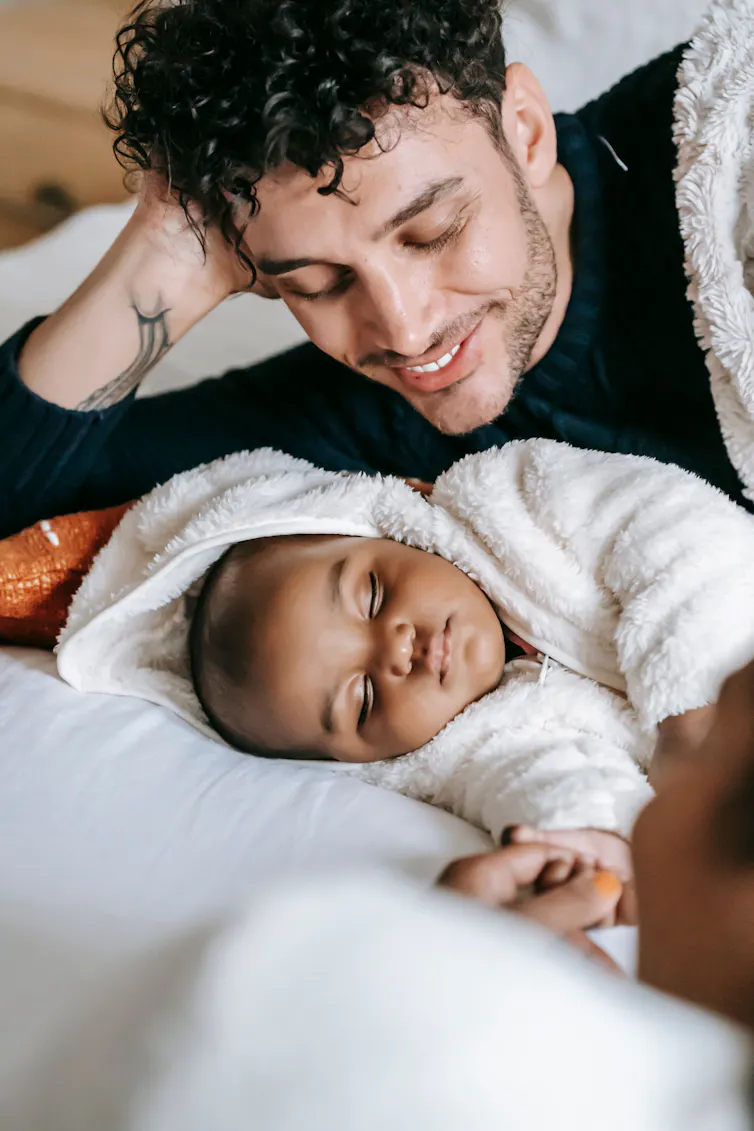
Despite these strong policies to support father’s involvement in early care, in most families in Denmark, as in the UK, it is still mothers who are the primary caregivers. Even during paternity leave, our research shows that mothers are the ones who report getting up more often at night.
This matters for mothers’ health and their postpartum experiences. Disrupted sleep in the months after birth is associated with low mood and, in some cases, symptoms of depression.
Danish fathers and mothers, too, endorse traditional ideas about men’s and women’s parenting ability, with most parents believing that mothers are better than fathers at early childcare.
So while policy clearly helps fathers take an active role, it does not fully equalise the caregiving load of fathers and mothers, or mean that men and women are perceived as equally competent carers.
Naps outside
Beyond policy, there are cultural beliefs about what is good for babies that differ between Denmark and the UK, too.
One highly visible example is the practice of leaving babies to nap outside, despite temperatures that frequently dip below zero.
Uncommon in the UK, babies in Denmark and the Nordic countries often sleep outside during daytime hours, well bundled up in prams. Parents believe that the fresh air is good for a baby’s developing immune system, improves sleep quality and buys mothers some time for themselves.
Though, it is perhaps easier for Danish parents to engage in such a practice against a backdrop of relatively high social trust. In Denmark, 74% of respondents in a nationally representative survey agree that most people can be trusted, whereas only 43% of adults in the UK say the same.
Calmer babies?
Given the generosity of Danish parental policies and the trust in others that allows outdoor napping, it is little wonder that headlines about contented Danish babies appear in the media with some regularity. Indeed, one analysis positioned British babies as crying “the most” and Danish babies “the least”.
Various explanations have been suggested: that Danish parents are less stressed because of generous parental leave; that outdoor napping promotes calmer babies; or simply that Danish parents view crying as a normal way for babies to communicate rather than something to fear.
pexels/josh willink
However, a close look at the evidence suggests reason for caution. The estimates of Danish infants’ crying came from only a handful of studies conducted more than two decades ago, involving relatively small numbers of infants.
What distinguishes parenting in Denmark from the UK is not a single factor, but a combination of family policies, parenting practices and cultural ideas about what is good for children. Policies encourage fathers to be involved early on and make it easier for many mothers to remain in paid work.
They do not, however, mean that care is shared equally between parents. And based on the evidence to date, there is no guarantee that the Danish way results in babies that cry any less!

This series was commissioned as part of a partnership between Videnskab.dk and The Conversation, where articles are published in English and Danish.