
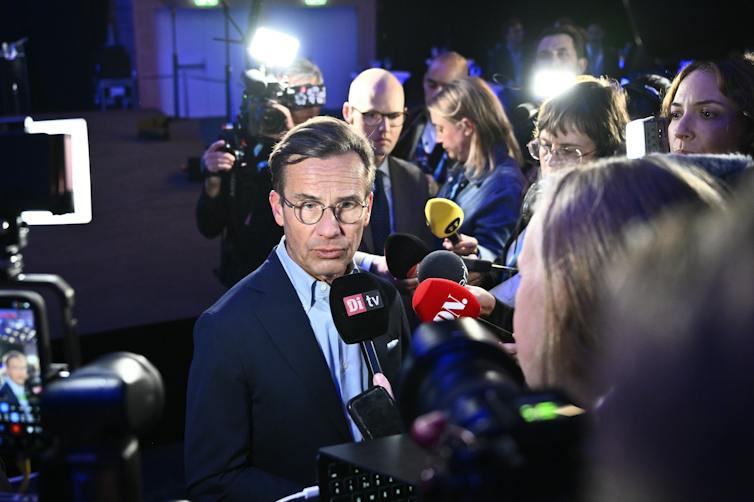
The Swedish election has turned into a nail-biter. With the majority of votes counted in the contest for the national parliament, only a few tenths of a percentage point separate the left-leaning opposition “red-green” bloc and the incumbent centre-right coalition. This group is commonly known as the “Tidö” bloc.
The opposition Social Democrats, led by former Swedish prime minister Magdalena Andersson, has emerged as the largest group in parliament. Preliminary results suggest it has won around 100 seats out of 349. This is its lowest share of the vote in more than a century.
But as smaller left-leaning parties improved their positions compared with elections in 2022, the “red-greens” collectively would have a small majority if the final results confirm the preliminary picture. There are ideological differences between the parties of the left, so it is not a foregone conclusion that Andersson will be able to form a viable government.
The three governing Tidö parties saw their support increase. But a loss of support for the far-right Sweden Democrats, which has supported the Tidö bloc from outside government until now, means they can no longer rely on a majority in the national parliament.
It will be a struggle for the incumbent prime minister, Ulf Kristersson, to remain in power without the Sweden Democrats as “kingmaker”.
Christine Olsson / EPA
Elections simultaneously took place for Sweden’s 21 regional and 290 municipal councils on September 13. Unlike the election for the national parliament, for which it is necessary to be a Swedish citizen to vote or stand as a candidate, anybody over the age of 18 who has been registered as living in Sweden for at least three years has electoral rights in these contests.
Voting rights for non-Swedish citizens have been in place since 1976 and, until recently, have been relatively uncontroversial. But over the past few years, some Swedish politicians have started calling these rights – and the electoral rights of Swedish citizens born abroad – into question.
The current deputy prime minister, Ebba Busch, suggested a couple of years ago that foreigners “can flip a majority in an entire municipality”. The Sweden Democrats, which ran in this election on a slogan of “making Sweden Sweden again”, has also argued that foreign citizens “often do not feel a loyalty to Swedish society” and can “manipulate Swedish elections”.
The party’s leader, Jimmie Åkesson, went as far in a recent election debate as to imply that “Muslim immigrants” would decide the result of the election. His remarks brought the rejoinder from Andersson that the result could just as easily be decided by nurses or sailors; every vote counts equally.
Low non-citizen turnout
Citizenship is the usual qualification for voting in national elections. But there are various arguments for why non-citizens should be able to vote, at least in local elections. The original justification in Sweden was that, through their work efforts and by paying taxes, migrants actively contribute to the country’s development.
Other arguments are that migrants are subject to most of the same obligations in Sweden as national citizens, except military service. And like national citizens, they are affected by a local council’s decisions, are subject to its laws and have a stake in the future of their communities.
Migrant voting rights can also help newcomers integrate into society. Research in Norway has found some evidence that immigrants who are granted voting rights soon after arriving are more likely to vote in subsequent elections, join civic organisations and have higher levels of trust in politicians.
However, even in Sweden and other EU countries where they are enfranchised, non-citizens remain underrepresented. The turnout rate among non-citizens in Sweden’s 2022 regional elections was around 30%, compared to roughly 81% for the electorate as a whole. In some countries, it is lower still among mobile EU citizens.
In part, this is connected to a lack of awareness among non-citizens that they can vote and a lack of information about the political system of their new country. Across Europe, there are also different definitions of local government units and different registration requirements.

Johan Nilsson / EPA
Research I have been carrying out with colleagues at Malmö University on the electoral participation of immigrants in Sweden has found that acquisition of citizenship is the single-biggest predictor of turnout among migrants. In Sweden, electoral turnout rates among foreign-born voters who have become citizens are approximately 30-35% higher than among non-citizens.
However, the acquisition of citizenship itself is becoming more difficult. In recent years, Sweden has moved from having one of the most open migration and citizenship regimes in Europe to one of the most restrictive.
Since June 2026, the miniumum residence period before applying for citizenship has been extended from five to eight years for most people. Strict requirements on income, and knowledge of Swedish language and civic life, have been introduced too.
Immigration in Sweden: how the country went from one of Europe’s most welcoming, to one of its most restrictive
A healthy democracy is based on the broadest participation of those with stakes in its decisions. These changes may further affect the political engagement of migrant voters, making the Swedish political system as a whole less representative of its population.
Having to wait almost a decade before gaining democratic rights at the national level may create a wider representation gap between the composition of Swedish society and of its parliament.
At the same time, the importance of local election voting rights for non-citizens may assume a new importance as the only means by which many Swedish residents will be able to have any political influence at all.
The final result of Sweden’s 2026 elections will become clearer in the days and weeks ahead. But, for now, one thing is clear: the outcome will be decisive for how likely it is that non-citizens will continue to be able to vote in future years.